Showing posts sorted by relevance for query baathists. Sort by date Show all posts

Friday, January 22, 2010

NO to civil war, YES to democracy

I have been reading journalists' fears of renewed civil war in Iraq, but I don't think it will happen, not like it was in 2006 and 2007. The bombings of Iraqi security forces will continue as long as the "resistance" sees ISF and the Iraqi government as illegitimate. We should strive to make the elections as legitimate as possible, not matter what the "resistance" does.

The "resistance" has been bombing ISF and public places since 2003, but I doubt we will see a return to the kind of civil war that engulfed Iraq in 2006 and 2007. Alaa the Mesopotamian reminds us of the horrors at the height of the sectarian violence:

The country was divided into strictly segregated cantons where on both sides all those of the wrong sect were expelled from their homes and some murdered. People were murdered for no other crime than having the wrong name in the wrong place. Baghdad itself was divided into sectarian zones where anybody risked execution and torture if he ventured into the wrong neighbourhood. A childhood friend of my boys who lived few houses away from ours had been just married; he was a Sunni with a kind of neutral name. He was caught by a Sunni militia few hundred meters from my own house. The militia could not ascertain whether he was Shiite or Sunni, so they took his cell phone and phoned his wife asking her about it. The poor girl thought that he was caught by a Shiite Militia, and she told them that he was Shiite; he was promptly executed. To this day she cannot forgive herself and has become a psychiatric case. In January 2007, my own oldest cousin was shot by American soldiers mistaking him for a terrorist. He was buried ceremoniously by an Al-Qaeda crowd as a martyr. His son, a Sunni, however, was a police officer; he made the fatal mistake of showing his identity card in the cemetery. A month later he was pulled from his car in front of his wife and children, taken away and dumped two days later near his house with his body terribly mutilated by torture. He was murdered by the very same people who attended his fathers’ funeral. These were just couple of incidents that I personally witnessed amongst hundreds if not thousands of others. The years 2006, 2007 were the worst. Baghdad was a city of death and many parts of the city were like ghost towns where people feared to venture out of their front doors even for the most basic needs. Scores of corpses were found every morning littering the pavements and side streets and were collected and taken away by pickup trucks. These trucks laden with corpses piled on top of each other were a familiar sight in Baghdad. It was horror beyond imagination. The tragedies that took place are too painful to recall, some of which I witnessed personally. Baghdad had nearly fallen under the very nose of the American forces and the highly inefficient Iraqi security forces that they were trying to form.

Then came the counterattack. The credit must be shared between the troop surge decided by President Bush under the wise leadership of General Petraeus, the establishment of a unified Baghdad command by Al-Maliki’s government and the valiant efforts of the Anbar tribes and the Sahwa movement. The Iraqi security forces began to be developed in good earnest. The Maliki Government deserve to be credited for its determined and largely successful campaigns against Militias in the South primarily and the rather less successful ones in Mosul and Diyala. Towards the end of 2008 and in 2009 the insurgent tide had been more or less reversed. The war is not over and there is still much to be done, to be sure; but at least overt Militia control of entire provinces and neighbourhoods has ended and they were forced underground again. People can go about their business and shops are open; and even some neighbourhoods are becoming mixed again. In the shiaa areas calm has more or less been restored. Sectarian killings have almost stopped. However the scars of battle and the debris of destruction can still be seen all over the place, and underneath the surface animosities and sectarian hatred are still smouldering which is not surprising considering the atrocities inflicted by parties against each other. But the Iraqis are not a stupid people and everybody has realised that the violence did not serve anybody and that all sides stand to lose if it continues.

Iraq Pundit urges readers to not Miss the Real Story:

According to the NYT, the Sunnis are an endangered species. They are surrounded by hostile people coming from all directions. Watch out, Sunni Iraqis, your days are numbered. What utter nuttiness.

The paper says the decision, which is illegal, by the accountability and justice commsion has support among the people of Iraq for the banning of politicians from the ballot. The reporter implies civil war is but moments away:

"Thursday, hundreds of people in the predominantly Shiite cities of Basra and Najaf, in southern Iraq, demonstrated in support of the decision. They held banners denouncing the former Hussein government and burned pictures of some of the barred candidates."

Let's not forget the attitudes, according to the NYT, of the people who equate Sunnis with Baathists and therefore criminals: "The Baathists can't return to Iraq," Jabar Amen, the head of the Basra Provincial Council, said during the protest. "There is no place for them among us. There is no place for criminals."

The foolish reporter gives the impression that Iraq is uniquely horrid. That people here hate each other. It's an insult not only to Iraqis but also to readers who the journalists take for fools. The only way a reader can understand is when the story is simplified dramatically. But who's surprised? The NYT always overlooks the complexity of the Iraqis. Sure there were demonstrations in favour of the illegal decision. But there also were protests against the decision in Basra. Misrepresenting the situation here adds nothing but perhaps kudos from Iraq haters.

I agree with Talabani's move to ask Iraq's Supreme Court to investigate the legality of the bans. They should also investigate whether the candidates were actually involved in terrorist activities. Anybody, including members of Parliament, who can be proven beyond doubt to have been involved in terrorism must be tried in court. Otherwise this the ban is illegal.

Many Iraqi Shia and Kurds equate Baathists with Nazis, maybe worse than Nazis. Baathist leaders committed horrible crimes, no doubt. But the era of Saddam Hussein is over. Iraqi Shia must be reassured that it is impossible for Baathists to return to dominance, given the polls of Iraqi opinion of the neo-Baathists. I have predicted the neo-Baathists (and alliance led by Allawi and Mutlaq) may have up to 15% support in Iraq. With all this attention and the labeling of all Sunni Arabs as Baathists, neo-Baathist support may rise.

A return to civil war is unlikely because Al Qaeda in Iraq has largely been defeated and most Iraqi Sunni Arabs seemed to have joined the political process. The Baathists are embracing democracy like they should have done in 2004, and all Iraqis should support them. Not all Baathists are bad people. The resistance-loving Baathists, however, may continue to terrorize Iraqis, even if neo-Baathists are allowed to participate in the elections. Allowing the non-violent neo-Baathists to participate, however, will make the elections legitimate, and that should be the primary goal of all Iraqis.

Tuesday, April 03, 2007

Sistani Rejects Plan to Permit Former Baathists to Work for Govt

I have agreed with Sistani on just about everything except his fundamentalist religious beliefs. I do not agree with him on this. Former Baathists without blood on their hands should be allowed to work for the Iraqi government.

Shiite Cleric Opposes U.S. Plan to Permit Former Baath Party Members to Join Government

By EDWARD WONG

BAGHDAD, April 2 — The most powerful Shiite cleric in Iraq has rejected an American-backed proposal to allow thousands of former members of Saddam Hussein’s Baath Party to return to government service, an aide to the cleric said Monday.

The rejection by the cleric, Grand Ayatollah Ali al-Sistani, appears certain to fuel hostility between the majority Shiites and the former ruling Sunni Arabs, since many Sunni Arabs say they were unfairly purged from the government in the clampdown on the Baath Party.

The Americans say a partial reversal of the de-Baathification process, which began in 2003, is one of the most crucial steps the Iraqi government can take in wooing back disaffected Sunni Arabs and draining the Sunni-led insurgency of its zealotry. The White House has repeatedly told the Iraqi government that the process must be changed.

The latest proposal was announced by Prime Minister Nuri Kamal al-Maliki and President Jalal Talabani on March 26 at the strong urging of Ambassador Zalmay Khalilzad, the senior American envoy to Iraq, who left his job the same day. American officials oversaw the drafting of the proposal.

Senator John McCain, an Arizona Republican and candidate for president who advocates a troop increase in Iraq, said in an upbeat news conference here on Sunday that the Iraqis had demonstrated political progress by committing to revising the de-Baathification law.

But an aide to Ayatollah Sistani said Monday that there was a “general feeling of rejection” over the proposal.

Ayatollah Sistani, who lives in the holy city of Najaf, generally does not issue proclamations himself, preferring to make his edicts known through his aides or other Iraqi officials. His word is considered sacrosanct not only among the Shiites in Iraq but also among those throughout the world, so his rejection of the draft law means it has virtually no chance of passage.

The comments from the ayatollah’s office came a day after he met with Ahmad Chalabi, the former Pentagon favorite and head of the de-Baathification commission, who has opposed any serious attempt to roll back the purging of former Baathists. After the meeting on Sunday, Mr. Chalabi said at a news conference that Ayatollah Sistani was aware of the law and that he had told Mr. Chalabi that it “would not be the final one and there would be other drafts.”

The Bush administration urged the Iraqi government to follow through with the revision of the law. A senior official said Monday that he hoped that Mr. Maliki would work with Ayatollah Sistani to figure out a way to differentiate between Saddam Hussein loyalists and lower-level Baath Party functionaries. “Among the political benchmarks which the Iraqis themselves have set, this is among the most difficult,” the official said.

News of the rejection drew harsh criticism from Sunni Arab leaders on Monday.

“In my opinion, our country is now one led by the clerics, and the new political process in Iraq is made to allow those clerics and religious parties to govern Iraq,” said Salim Abdullah, a legislator from the main Sunni Arab bloc in Parliament. “The Iraqis will feel the consequences of that.”

Officials from the secular party of Ayad Allawi, the former prime minister, also expressed profound disappointment. Ibrahim al-Janabi, a legislator and senior aide to Mr. Allawi, said Monday that the lobbying of Ayatollah Sistani by Shiites like Mr. Chalabi “is the weapon of losers.”

“When they feel they might lose out, they go to the ayatollahs to get support to push through their goals,” he said.

The upheaval over the draft law transpired on a day of fiery violence in Iraq. At least 59 Iraqis were killed or discovered dead in various attacks, and at least three American soldiers and a British soldier were killed in four separate attacks on Sunday and Monday, military officials said Monday.

The deadliest assault on Monday took place in Kirkuk, where a suicide truck bomb exploded at a police station next to a primary school, killing at least 12 Iraqis and one American soldier, and wounding at least 200 others, police officials and the American military said. Dozens of wounded children could be seen in the front yard of the local hospital, awaiting treatment.

The de-Baathification commission led by Mr. Chalabi was put in place by L. Paul Bremer III, the American proconsul who governed Iraq from May 2003 to June 2004. Mr. Bremer’s very first order was to purge former Baathists from government, a task that Mr. Chalabi’s commission passionately carried out. Mr. Bremer also disbanded the Iraqi Army, which, along with the de-Baathification order, has been widely criticized as fueling the insurgency.

But before handing over power in 2004, Mr. Bremer scaled back some of the de-Baathification policy in an effort to bring back teachers, scientists and others with technical expertise, as well as former army officers who could help rebuild Iraq’s moribund security forces.

Many Sunni Arabs say the reversal has to happen on a much wider scale. In a farewell interview, Mr. Khalilzad said militant Sunnis had pointed to a rollback of de-Baathification as a necessary condition for them to lay down arms.

The proposal announced last week, which was overseen by Mr. Khalilzad, offers relatively generous terms. It decreed that all former Baathists would be able to collect their pensions and that thousands more would be allowed to hold government jobs. The law would also set a three-month time limit for Iraqi citizens to bring lawsuits against former Baathists.

Advisers to Mr. Maliki, a devout Shiite, said the prime minister had been skeptical that conservative Shiite leaders would support the measure. Before he took office, Mr. Maliki was one of the most vocal champions of the purging of former Baathists. Critics suggested that he might have made the announcement last week simply to appear to be offering an olive branch to Sunni Arabs.

Sunday, November 22, 2009

No peace in Iraq since 1970s

I have been thinking about this post for a few days and I thought about titling it “Ugly Peace in Iraq since 1980”. Some Iraqis (especially Kurds) would argue that even in the 1970s Iraq did not have real peace.

Recently I have read a few articles that have tried to summarize the last six years in Iraq and the surge in particular.  Some authors have attributed the reduction in violence in Iraq more to Iraqis than to Americans. Part 1 of Nir Rosen’s “Ugly Peace” focuses on Washash, a Shia-majority district of Baghdad that saw its Sunni Arab residents expelled by Shia militias in 2006. Rosen got the "ugly" part right, but I'm not sure about the peace. He seems to minimize and even disregard the worst violence committed by Sunni extremists, which is ongoing. It seems that not only Rosen but many fine journalists have been ignoring or minimizing the events of 2004 and 2005, when Sunni extremists attacked Shia all over Iraq in the most brutal ways.

Rosen exposes the injustices committed by Shia militias, as every journalist should, and I'm glad he makes a distinction between criminal elements of Jaish al Mahdi and those who only wanted to protect Shia from Sunni extremists, but he writes as if Shia militias started the sectarian violence after the bombing of the Askari shrine in Samarra in 2006. He explains that after the Samarra bombing, JAM began killing innocent Sunni Arabs, without really explaining what happened to the Shia in 2003, 2004, and 2005.
 
Rosen summarizes the explanation for the fall in violence: “the increasing calm stemmed from the ‘exhaustion of sectarian violence’ and a ‘Sunni return to politics,’ among other factors.”
 
Sounds like good news, but I do not know what Rosen means by “exhaustion of sectarian violence”. Maybe he means Shia militias stopped attacking Sunni Arabs. Sunni extremists continue to attack Shia. Maybe he did not read about the dozens of suicide bombings that have been carried out this year by AQI, which has always been the worst of the sectarian militias.

Nir Rosen:
“One explanation that few are prepared to discuss openly is that Iraq’s civil war ended because Shias won: violence against Sunnis ceased after Sunnis were brutally cleansed from Basra and large swaths of Baghdad, and Shias gained firm control of government ministries and local police. Sunnis knew they were defeated and Shias no longer worried that Ba’athist oppression would resume. With no external enemy, Shia militias began to fight each other and turned into criminal gangs terrorizing their own communities. The defeat of the Sunnis and divisions among Shias created space for new possibilities, and the government and American forces occupied that space.”


The Sunnis were “brutally cleansed” from Baghdad, as if Shia were not treated brutally before Shia militias began their murderous rampages. It is as if all of Iraq’s Sunni Arabs have been kicked out of Iraq, as if they have no representation in the Iraqi government. The violence stopped because there are no Sunnis left to kill, and hence the "ugly peace".

Here is a map of Baghdad in mid 2008, showing many districts dominated by Sunnis:


In his article Rosen summarized some of the violence of 2003 and 2004, but he did not elaborate on the incredible violence aimed at Iraq’s Shia, except to call it simply a civil war and to write “by the middle of 2005 sectarian violence was endemic”, hinting that Shia too were innocent victims. But he does not go into detail about the ugly crimes of Sunni extremists. Instead he emphasizes the brutality of the Mahdi Army and gives examples of evidence of their crimes in Washash and other areas.

Here he details the violence aimed at Sunnis in 2003 and 2004, as if to rationalize subsequent Sunni attacks on Shia:

“In October 2003 a Sunni Sheikh, his brother, and a teenage assistant were riddled with bullets as they walked home from mosque. In August 2004 a police chief and a patrolman were killed in an explosion. In December 2004 several members of a Sunni Salafist group were killed. Sunni and Shia clerics issued a futile joint edict banning sectarian fighting, and by the middle of 2005 sectarian violence was endemic.

American soldiers raiding a house in 2006 found evidence that Shia militias were cleansing Sunnis from Washash. There was a list of nearly 70 homes where Sunni families were expelled and a list of “good” families who were not be disturbed. There were letters threatening Sunnis, as well as copies of a DVD with a message from the Mahdi Army: images of exploding houses.”

 
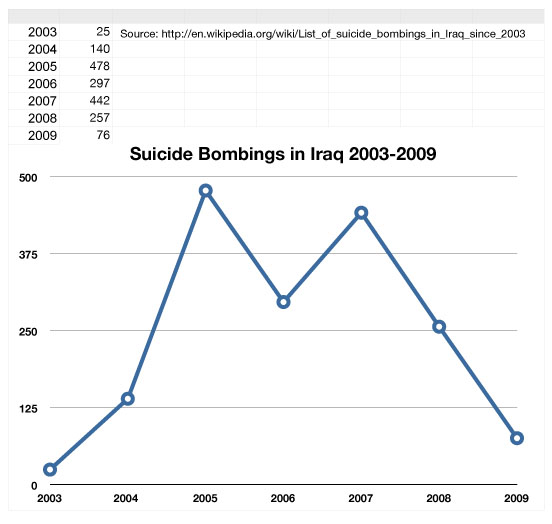
Not a single mention of the Sunni violence that was intended to destroy the new Iraq from the very beginning. No mention of the hundreds of Sunni suicide bombers who targeted Iraq’s security forces and ordinary Shia between 2003 and the 2006 bombing of the Askari shrine.  Suicide bombings are a good indication of violence perpetuated by Sunni extremists; Shia do not participate in suicide bombings that target Iraqi civilians or security forces. The largest number of suicide bombings in the war occurred in 2005:


There have been more than 1700 suicide bombings in Iraq, many involving more than one bomber. This extraordinary statistic, which is symbolic of the violence perpetuated by Sunni extremists and is unprecedented in the history of the world, does not receive mention in Nir Rosen’s “ugly peace” analysis. Instead Mr. Rosen highlighted the crimes of the Shia militias and ignored the mostly one-sided sectarian violence aimed at Iraq’s Shia before 2006.
 
My uncles who lived most of their lives in Amriya, a neighborhood of western Baghdad, were expelled from their homes in the summer of 2005.  From my perspective, it was Sunni extremists who began expelling Shias from their homes in Sunni-dominated neighborhoods and even turned Amriya, which according to Columbia University had a Shia majority in 2003 (I will call it “mixed” in 2003), into a Sunni majority district by 2006.

Maybe I should not be so critical of Nir Rosen, who is an excellent journalist and with “Ugly Peace” he has shed some light on the sectarianism that is the root of Iraq’s political problems. It’s just sad for me, as a liberal Iraqi American, to see liberal journalists seemingly taking sides and ignoring history.

Nir Rosen is not the only one who seems to be biased. Even in the documentary “Understanding the Surge”, which I posted last week, it is suggested that Iraq’s Sunni Arabs turned to Al Qaeda because Shia militias were expelling Sunnis from their homes, implying that Sunni Arabs allied themselves with AQI in 2006, after the Samarra bombing.  Sunni militia actually began joining forces with AQI in 2004, after Saddam was captured, when it became clear that the US was determined to prevent hardcore Baathists from regaining power and to ensure a democratic government was established in Baghdad.

People who insist that Baathists, being secular, could not possibly ally themselves with Salafi (fundamentalist) groups should remember Saddam’s alliance with Saudi Arabia in the 80s and they should understand that hardcore Baathists would do anything to gain and retain power. Saddam and his cronies were experts at manipulating Islam for political gain. They called their attempt to exterminate Iraq’s Kurds the “Anfal”, a Qur’anic term that refers to the spoils of war belonging to Allah and his messengers. Saddam and his henchmen played God and the Wahhabi Arabs supported them in the 80s, so why would one be surprised by an alliance between Baathists and Salafi groups today? In the 1980s Saddam's regime also expelled tens of thousands of Iraqi Shia - today this is known as "ethnic cleansing", so they already had experience in that area too. Some might even dare to call it "sectarian violence". But in the eyes of many journalists, it seems that "sectarian violence" happens only when Shia militias attack innocent Sunnis.
 
Rosen did offer this bit of truth about the pre-2006 violence aimed at Shia, quoting an Iraqi Army Captain who commented on the security situation in 2004: 

“At the time,” he told me, “there was only al Qaeda, not the Mahdi Army. We confiscated a lot of weapons and car bombs. This was before the sectarianism started.”

 
I should thank Rosen for quoting the Iraqi Army Captain who said there was only Al Qaeda in 2004 and no JAM. He also mentioned Baathist oppression, but he does not mention the expulsion of Shias from Sunni neighborhoods before the spike in sectarian violence of 2006.  Perhaps he did not know about the expulsion of Shias from Sunni neighborhoods before 2006, or maybe I'm taking this too personally, or maybe with “Ugly Peace” he wanted to focus only on the sectarianism in Washash. Maybe Part 2 of "Ugly Peace" will be different from Part 1.
 
Rosen also quoted another Iraqi who said this: “most Sunnis supported al Qaeda and turned on them because of pressure from the government.”
 
So Rosen did offer bits of truth about the violence aimed at Shia before the Samarra bombing, but in the entire article he did not elaborate on the violence directed at Shia except to quote an Iraqi who said that there was only AQI in 2004. What did AQI do in 2004? What did Saddam's ousted leaders do? I suppose it is not worth mentioning or researching, or it would have made the article too long to read.

Many journalists’ accounts of recent history in Iraq read as if Iraqi Baathists were fighting a legitimate war against occupation, as if Baathists did not engage in sectarian violence against Iraqis. It is as if Rosen is afraid or unwilling to put Iraq’s Sunni Arabs in a bad light.  The people who expelled my Shia relatives from Amriya in 2005 may not have been Iraqi, but the people who committed those crimes could not have known where the Shia lived in Amriya if they had not received help from locals, from Iraqis.

It seems that this Wikepedia entry, also the source for the numbers of suicide bombings since 2003, has it right:
 
‘A 2005 Human Rights Watch report analysed the insurgency in Iraq and highlighted, "The groups that are most responsible for the abuse, namely al-Qaeda in Iraq and its allies, Ansar al-Sunna and the Islamic State of Iraq, have all targeted civilians for abductions and executions. The first two groups have repeatedly boasted about massive car bombs and suicide bombs in mosques, markets, bus stations and other civilian areas. Such acts are war crimes and in some cases may constitute crimes against humanity, which are defined as serious crimes committed as part of a widespread or systematic attack against a civilian population."[2]
 
A 2008 RAND Research Brief Counterinsurgency in Iraq: 2003 - 2006 depicts a chart that shows in June and July 2004, Iraqi insurgents began to shift their focus away from attacking U.S. and coalition forces with roadside bombs and instead began targeting the Iraqi population with suicide bombers and vehicle-borne IEDs. By increasing the number of suicide bombings against civilians and accepting their targeting in retribution, the insurgents sought to expose the weakness of the coalition-Iraqi security and reconstruction apparatus, threaten those who collaborated with the government, generate funds and propaganda, and increasingly enact sectarian revenge. The U.S. failure to adapt to this shift had dramatic consequences. By June 2004, U.S. deaths represented less than 10% of overall deaths on the battlefield and Iraqi deaths represented more than 90% - a figure that remained constant for the next 18 months of the War.’


From my perspective based on my experiences and what I have heard and read, the truth about Iraq that most people seem to avoid is the fact that Iraq has been in a state of ethnic and sectarian conflict since 1980. There was a relative peace after the end of the war with Iran 1988, but it lasted only two years. The Arabs don’t like talking about it, but in general the Arabs have seen Iran as an enemy for decades, and Saddam used Iraq to fight that war that Sunni Arab states supported financially. That war with Iran, which Saddam always saw as an extension of the ancient war between Mesopotamia and Persia, continues today.

The war of 1991 and the following Shia rebellion against the dictator resulted in the deaths of hundreds of thousands of Iraqis. Approximately half of my relatives fled Iraq in the 80s and 90s. Journalists did not seem as concerned about those Iraqi refugees. In 2003, after the Liberation, two more of my relatives left Iraq because they finally could without risk of harm to their families. Many Iraqi Shia fled Iraq after 2003, even after they “won”.

There have been 76 suicide bombings in Iraq this year. I consider that to be sectarian violence. Sunni extremists continue to attack the Iraqi government and its security forces, even attacking police in Sunni towns, but primarily targeting the Shia-led government.

Discussing last month's bombings of three Shia-dominated Ministries,
'The top U.S. commander in Iraq, Gen. Ray Odierno, told a news conference last week that he believed a number of insurgent groups, including Baathists and al-Qaida in Iraq, were behind the bombings.

"This is a very complex issue. It's not black and white," he said.'

I would not call the situation in Iraq an “ugly peace”. It is no peace at all. Iraq has been in sectarian conflict since 1980, and the sectarian conflict continues, even as democracy sprouts in Iraq.

The criminal actions of AQI and the Baathists who supported them have shown that democracy and security in Iraq are very difficult to achieve. The hardcore Baathists will always attack the Iraqi government until they become the government. Baathists used violence to gain power in the first place, and they used violence to retain power for three decades.

Even as some of Iraq’s Sunni Arabs continue to support violent attacks against the Iraqi government and security forces, many Iraqi Sunni Arabs are participating in government, showing off their political strength. Tareq al Hashemi, one of Iraq’s Vice Presidents, has vetoed the recently passed election law, which the Iraqi parliament had been arguing about for weeks, because he said it does not include enough parliamentary seats for Sunni Arab refugees. This would be like a Shia VP of Saudi Arabia vetoing an election law because he believes it does not provide enough seats in the Saudi parliament for Saudi Shia (there are no elections and no Shia ‘VP’ in KSA). Like in war, in politics Iraq’s Sunni Arabs are playing hardball.

Even in a state of war, Iraq seems to be more democratic than most Arab countries. And Iraqis want better. Most Iraqis I know are tired of Maliki’s government, and they want to see big changes. I hope Iraqis will vote secular this time, and I hope the outcome of the election will result in true peace in Iraq, not just an “ugly peace”.

Iraqis must resolve their differences, and when they do so, hopefully they will also bring peace, justice, and prosperity to all of Iraq’s districts. Iraqis are making progress towards reconciliation without government efforts. One of my uncles who was expelled from his home in Amriya in 2005 was able to visit that house a few weeks ago and he found living in it a Sunni family, who graciously agreed to pay rent to my uncle. I have also read about Shia families being invited back to Adhamiya. I think that getting the history right, as difficult as it may be, may also contribute to the healing.

The Shia did not “win” in Iraq by expelling Sunni Arabs from Basra and Baghdad. The Shia sorta won by establishing a democracy, or at least a semblance of one, with the help of Americans. Clearly there are hurdles to overcome, and Baghdad is more segregated along sectarian lines than ever before. But there are still large numbers of Sunni Arabs in Baghdad, and it seems the Shia militias' "cleansing" and killing of innocent Sunni Arabs ended many months ago. Iraq’s Shia, after all their struggles, have not won a huge victory, and they will not be victorious until all of Iraq is truly peaceful, like it was before 1980. Real democracy in Iraq, and therefore victory, will be realized when power is passed peacefully from Nouri al Maliki to an Iraqi who will end the era of corruption and sectarianism and lead Iraq to a real peace.

Friday, February 05, 2010

When should the US get out of Iraq?

Two years ago I asked "when should the US get out of Iraq?" Those were opinions from a few pundits. When I started this blog I added two polls (not scientific) to my sidebar, one asking "when should the US withdraw from Iraq?" With 1,481 votes, almost half believe the U.S. should stay in Iraq for "as long as it takes." One commenter asked "For as long as it takes to do what?" Good question.

On one hand, many people feel that the US should stay in Iraq to ensure that Iran does not take over Baghdad completely. On the other hand, many Iraqis believe that the US should stay in Iraq to ensure that Saddamists do not return to dominate. In an email exchange with my friend Alaa the Mesopotamian, he wrote:

I have lived with Baathists in Iraq and worked with them. I must admit that like most people in Iraq today we would be prepared to forgive many of them if they really felt that there was something wrong of the Baathist era. Some are quite normal people and had to join the party as we all know, for purely opportunist reasons. Some could not avoid it, for sure because of Baathist policy of demanding membership for army people, for University teachers, for a teaching job etc. etc. So like they say, if these were not involved in any crimes, I suppose they have to be reintegrated and given their civil rights. The problem is that the Baathists as a whole cannot be trusted. Their pretense of wanting to join the political process is not just innocent desire to join the new democratic process. Mostly it is an attempt at infiltration with a coup in the back of their minds. Believe me no one knows them better than me. I managed to avoid joining for years despite the fact that I used to be employed in the most sensitive kind of jobs.

I dont really believe, that anyone who does not really want to join couldnt avoid it. However, it will be most gratifying and a dream if these people can really change. The most terrifying thing from my perspective is the question of what will happen once the Americans do withdraw as is expected. I have talked about that and I am very apprehensive about the future. You left Iraq early in your life and you dont really know these people. In the words of someone I knew who was himself a high ranking member and left them, words that I cannot forget: "The Baath party is an organisation for criminals". Who do you think is doing all these acts of terrorism in Iraq? Al-Qaeda? AQ was always a tool in their hands, admittedly once out of control, but nowadays almost insignificant and what remains of them are entirely in the service of the Baathists and their allies. The Iraqi AQ members themselves were mostly ex-regime members. This is a fact that everybody knows and amply proved from the many arrests that have been made.

Well, with the Americans around, they will not dare stage any coup; but with the Americans out - Allah Yustur. [God have mercy]'

I believe we should be careful when labeling people "Baathist" and we should remember that the majority of Baathists did not participate in violent crimes. However, I can understand Alaa's perspective and I share his fears. I believe the Iraqi government should allow the neo-Baathists to run and participate in government, but the US should stay in Iraq until Iraqi security forces can stand on their own and can defend against any threat.

Even in the case of a complete withdrawal from Iraq, the US military will not be far away in Kuwait and Qatar.

Wednesday, April 01, 2009

Any moderate Taliban out there?

Check out this good article that explains the differences between Iraq and Afghanistan. Just keep in mind that although Baathists are moderate compared to the Taliban, the hardcore Baathists have murdered many innocent Iraqis. And the Saudi radicals may have been interested in striking primarily at coalition forces, but most of their victims have been Iraqis.

From the article:

* The Iraqi malcontents comprised an assortment of the disaffected--secular Baathists, Sunnis suddenly deprived of long-held privilege and power, simple religious bigots (rather than committed doctrinal fanatics, and there is a difference), and, to be honest, Iraqis who merely resented the 2003 intervention. Notwithstanding Beltway blather denying its existence--some emitted by now vice-president Biden--an Iraqi national identity, however limited, exists.

* The Sunni Awakening was encouraged when the Iraqis found their alleged "resistance" increasingly dominated by Saudi Wahhabis who had come over the long Saudi-Iraqi border in the "second Iraq intervention," as detailed here, here, and here. When "Al Qaeda in Iraq" manifested its Taliban characteristics--executing women caught without covered faces, possessors of music CDs, Sufis, and others they deemed apostates--the anti-coalition combatants perceived that the United States and Baghdad authorities were a preferable alternative to governance by lynching.

Wide as the horizons of their global ambition doubtless were, and dedicated as they were to using Iraq as a platform for reinforcement of Wahhabism in their own country, the Saudi radicals who streamed north were primarily interested in striking at the coalition, to stimulate new support for their perverse cause, and did not aim at immediate expansion into Jordan or Kuwait.

By contrast, the Taliban is not a mélange. They include no secular types comparable to the Baathists and few "Afghan patriots." Afghan national identity is much weaker than that found even in Iraq. The Pashtun base of the Taliban is tribal, but they have a lesser presence in local history than the Iraqi Sunnis that usurped power in Mesopotamia. The Taliban embody monolithic radicalism in the Wahhabi style, rooted in the Deobandi school of fundamentalism, and consider all Muslims who fail to share their ideology to be unbelievers deserving liquidation. The Iraqi Arab Sunnis, even at the height of their influence under Saddam, could not wipe out the Iraqi Shias or the Kurds, but the Taliban massacred the indigenous Hazara Shias in Afghanistan, effecting a nearly-successful genocide.

Further, the Taliban have demonstrated that their current goal, rather than mere power in Afghanistan, is the "Talibanization" of Pakistan, a nuclear-armed failing state. This would provide the running dogs of al Qaeda with unconcealed weapons of mass destruction as well as millions of fresh foot-soldiers in an environment that, along with its large and problematical diaspora in Britain, has become the main breeding ground of Islamist extremism worldwide. '

Saturday, February 06, 2010

The "ideology is whatever Saddam says it is"

Sharp: By the early 1950s a teenaged Saddam was demonstrating against the government. Like countless other Iraqis, he was expressing a general sense of resentment against British colonial rule and Iraq's domination by rich landowners. Pan-Arabism was also on the rise---the movement to bring Arab states together into one big nation. In 1958 a revolution overthrew Iraq's British-backed monarchy. The change ushered in a chaotic and violent decade. By this time Saddam Hussein had joined the pan-Arabist Baath Party. In 1959 he and fellow Baathists tried to assassinate Iraq's new military leader General Abdel Karim Kassem. The attempt failed and Saddam Hussein was forced to flee the country. Four years later he came back, just after the Baathists did manage to kill Kassem.

They showed their ruthless side, parading the general's bullet-riddled body on television. But the Baathists were thrown out of power nine months later. The years after this, the mid-60's, were critical ones for Saddam Hussein. He linked up with his one of his uncle's cousins, now high up in the Baath Party. Historian Charles Tripp says Ahmad Hasan al-Bakr and his young sidekick made quite a team.

Tripp: "Ahmad Hasan al-Bakr was very much an old style regimental officer. And Saddam Hussein was not an officer, was not in the army, but was an excellent "street organizer" I think is the phrase often used euphemistically which meant someone who could organize the beating up of opponents, demonstrations, street violence, who had his ear to the ground in ways that Ahmad Hasan al Bakr couldn't."

Sharp: The Baath Party returned to power for good in 1968. Ahmad Hassan al-Bakr became president. Saddam Hussein quickly emerged as his right hand man. And he turned out to be more than just a party thug. He was also methodical, and politically astute. He took over the state security apparatus. Then he and Bakr began to eliminate their rivals. Some were executed, some were shipped off to diplomatic posts, some were simply outmanoeuvered. Even as they consolidated their power, the Baathist leaders were intent on modernizing their country. And shaking off foreign influence.

Excerpt from President Bakr's Oil Speech 1972: "...Patriots and progressives, in the Arab homeland and in the entire world, in waging decisive battle against the oil monopolies our revolution is taking forward positions in face-to-face clashes with imperialism and its monopolies, to carry out an honorable patriotic and national duty..."

Sharp: President Bakr announced the nationalization of the Iraqi oil industry in 1972. His message was "Arab Oil for the Arabs." A year later fuel prices shot up. Iraq's oil revenues quadrupled. The Baathist regime poured its new money into the military, but also into education and infrastructure. Roads were built, villages electrified, literacy campaigns launched. Iraq became a modern, urban state with a substantial middle class. But if Iraq was modernizing on the surface, behind the scenes something far more primitive was unfolding. Saddam Hussein turned out to be merciless in his quest for power. In 1979 he made his move on his old patron, Ahmad Hasan al-Bakr. Hussein forced his relative to resign and took over the presidency himself. No sooner had he done so than he purged the party's Revolutionary Command Council. Hussein announced the discovery of a plot against himself and the Baathist regime. Then he held a kind of show trial, which he videotaped. The footage shows party members gathered in a large auditorium. Saddam Hussein is on stage, smoking a cigar. The alleged plot leader confesses his crime. Then he reads out the names of his supposed co-conspirators. As their names are called out they are led from the hall to be arrested and shot. Members of the audience shout out their allegiance to Saddam Hussein...

Archival Audio of 1979 Meeting

Tripp: "You notice the mounting hysteria as nobody knows quite who's name is going to be called out next. And so of course this means that the survivors cheer even more frenziedly for Saddam Hussein. It's a very chilling documentary. But Saddam Hussein wanted that to be seen. This was an exercise of power which he would use to impress upon the surviving Baathists in Iraq that he had absolute control over their lives and deaths."

Kanan Makiya: " The whole thing is like theatre except it happens to be real."

Sharp: Kanan Makiya is a prominent Iraqi writer and dissident. He's also seen the footage---and researched what happened next.

Makiya: "And when the firing squad is assembled to execute these so-called traitors who does he use but the remaining members of the Revolutionary Command Council and his own ministers and so on to implicate them in a sense in his own rise to power. Because that is the event upon which he cements his own presidency."

Sharp: By this point any political ideology Saddam Hussein once adhered to seemed to have vanished. Fear became the key to his rule. Historian Phebe Marr says Pan-Arabism had given way to Saddamism.

Marr: "This is a one-man regime, it's more of a personal dictatorship in which we find the cult of Saddam. And yes it's in the name of the Baath Party and yes there's some kind of ideology but the ideology is whatever Saddam says it is."

Tuesday, January 29, 2008

Konfused

Konfused Kid has recently published a post in which he basically says that much of my blog is filled with half truths.

Kid writes Iraqi Mojo says he has no homicidal hatred of Sunnis, as he says when he met Sunni Arabs, the way you would speak when you explore a new species in the Amazons: "I have met Sunni Arabs and they are really nice." That's quite lovely of him, but even though Mojo occasionally talks about Muqtada al-Sadr's antics or his lack of love for Shia theocracy, they don't seem to be much of his concern, he rarely posts about them, if at all. For the curious American bystander who is curious to learn about how to get the hell out of Iraq, Iraq's problem, viewed through his blog is one long wail against the solitary horrors and evils of al-Qaeda, Wahhabiya, Saudi Arabia, the Arab Jarab (a term he often uses) and just about everything else you would expect a self-respecting Shia to hate, either intentionally or not, and all of which are, incidentally, the evil creations of the same very nice Sunni Arabs brothers.

I thought I defended myself pretty well in his comments section, and in one comment I wrote "I disagree that the horrors and evils of Al Qaeda are the evil creations of the same Sunni Arab brothers that I've met and befriended. No, actually, my Sunni Arab friends hate what Al Qaeda has done. I think that a majority of Sunni Arabs hate Al Qaeda. I remember an incident I read about in Ramadi, in which Al Qaeda wanted to expel and/or murder Shia residents of the town. The Sunni Arab tribal leaders of Ramadi organized a posse to defend their Shia neighbors against the impending evils of the Wahhabi scum."

In the comments of IBC's latest post, Kid addressed my responses: but please read your blog and see how many posts have you made about the "filthy Wahhabi scum", "the Baathists", and the "Arab Jarab" So would you feel comfortable with a blog that is bascially one long rant against the "Saffavid Scum", "The Fire-Worshipping Iranians" and the "Sons of Mut3a" with an occasional one or two posts praising Shiite seculars like Iyad Jamal al-Din? The truth is terrible.

I guess it depends in what context one would use "Saffavid Scum". Can Saffavids even be compared to Wahhabis? Do Iranians actually worship fire? Do any Iraqi Shia worship fire?? Are all Shia males sons of Mut3a (temporary marriage)? Are ANY Shia males sons of temporary marriage, and if so, is this a bad thing? I responded with the following comment:

'OK, I searched for "Wahhabi scum" and this is what I found:

Wahhabi scum: Two posts that I will never apologize for. In the first post I said "Iraq is being terrorized by the people who LOVED Saddam and the Al Qaeda scum buckets who seek to destroy any hope for democracy in Iraq. Saddam was a piece of shit, and so are the people who love(d) him. So are the Wahhabi scum of earth who believe that Shi'a are infidels and deserve to be murdered." Do I blame all Sunni Arabs? No. Do all Sunni ARabs love(d) Saddam? I don't think so. Please correct me if you believe I'm wrong.

In the second post I wrote "The people who murder Shi'a just for being Shi'a must be the Wahhabi scum from outside Iraq - I cannot imagine that even Ba'thists would commit these kinds of crimes." Hmmm, seems that once again I'm not blaming all Sunni Arabs, and in fact I stated that I cannot imagine that even Ba3thists would commit these kinds of crimes.

I also searched for jarab - it gives just one post in which I wrote "Today my uncle referred to the 'Arab Jarab' (jarab means 'scab'), which reminded me of a recent post by Baghdad Treasure, in which he laments the treatment of Iraqis by Arab countries like Jordan and Syria. Konfused Kid has also reported that undercover Jordanian security forces have been questioning Iraqis to find out if they are staying in Jordan longer than their visas allow."

I admit that I've used (maybe abused) the term "jarab" in my comments section and the comments section of Angry Arab, usually in heated debate, but I have also distinguished between good Arabs and jarab. There IS a difference. I wish I saved a comment I left on Angry Arab a couple weeks ago in which I gave a bunch of examples of jarab, including Zarqawi, Usama bin Ladin, Yusuf al Qaradawi, and even Muqtada al Sadr. Again, most Arabs are not jarab.

I also searched for "Baathists" and nearly crashed my computer, but I don't understand why the use of this term would be offensive. My father is a former Baathist - he had to be in order to work in the Oil Ministry. The hardcore Baathists who still express their love for Saddam can stay in Amman and Damascus forever. That would be nice:)'

It seems that Konfused Kid really is confused! Do I blame all Sunni Arabs? I don't think so. Do you think so? Are all Sunni Arabs Wahhabi scum? Are all Sunni Arabs Baathists? Are all Arabs jarab? My family and I are Arab, after all.

PS: if there is such a thing as "Safavid scum", have they ever blown up a market place?

Saturday, October 04, 2008

Russian alliance with Baathists in the making?

It has happened before.

"So far, the United States is trying to cajole Maliki into supporting the Awakening, offering $300 to $500 per month for each member of the Sunni militia. At the same time, US military officers in Iraq have promised to guarantee the payments to the Sunni forces and to shield the Awakening from attacks or reprisals by the regime. But among Sunnis, including those interviewed for this story, there is widespread concern that they are on their own and that the United States will not abandon the government in Baghdad despite its sectarian, pro-Iran leanings.

In that case, said a former top Iraqi official, many Sunnis may turn to an unlikely source for support: Russia. "The Russians are very active," he said. "They are talking with many Iraqis, including resistance leaders and Awakening members, in Damascus, Syria. They are in discussions with big Baathists." According to this official, former Baathists, army officers and Awakening members in Damascus, Amman and inside Iraq are looking to Russia for support, especially since Russia seems intent on reasserting itself in the Middle East. "The Russians intend to come out strongly to play with the Sunnis," he said. "I heard this from sahwa members in Damascus and Amman. 'If the Americans abandon us, we will go to the Russians.'"

Wednesday, November 18, 2009

Al Qaeda in Iraq becoming less foreign

'Al Qaeda in Iraq is becoming more Iraqi and less dominated by foreigners as the insurgent group increasingly joins forces with Saddam Hussein's outlawed Baath party, the commander of U.S. forces said on Wednesday.

Investigations into massive suicide bombings in Baghdad on Oct. 25, in which more than 150 people died, indicated that explosives or fighters were coming across from Syria, U.S. General Ray Odierno also said.

The U.S. commander's comments reinforced accusations by the government of Shi'ite Prime Minister Nuri al-Maliki that al Qaeda and former Baathists were working together to undermine improved security and elections expected to be held in January.

Maliki's government has also accused neighbouring Syria of giving a safe haven to Baathists plotting attacks in Iraq.

"Al Qaeda in Iraq has transformed significantly in the last two years. What once was dominated by foreign individuals has now become more and more dominated by Iraqi citizens," Odierno told reporters at the U.S. military's main base in Baghdad.

"There's still a small foreign element to al Qaeda, there are some who used to be Sunni rejectionists or ex-Baathists who are involved in this because of course they don't want the government to succeed."

Overall violence in Iraq has fallen sharply in the past 18 months and November so far has experienced one of the lowest civilian casualty levels since the 2003 U.S. invasion.

But attacks by suspected Sunni Islamist insurgents like al Qaeda remain common.

The twin suicide bombings in Baghdad on Oct. 25 devastated the Justice Ministry and the Baghdad governorate headquarters, while two similar suicide bombings on Aug. 19 killed almost 100 people at the foreign and finance ministries.'

Tuesday, November 10, 2009

Ex Baathists may participate in elections

"Iraqi Prime Minister Nuri al-Maliki said Tuesday that former Baathists could participate in the upcoming elections provided they cut ties with the former ruling party of the country.

However, he said he would not negotiate with Baathists who remained loyal to the party and its former leader Saddam Hussein, accusing them and al-Qaeda of creating instability and insecurity in the country ahead of the vote.

They would also be barred from the political process, Maliki told reporters in Baghdad."

Friday, September 07, 2007

US Officials meet with Izzat al Duri??

It seems very odd to me that US officials would meet Izzat al Duri, with a $10 million bounty on his head!  What is going on?? (Thanks Fayrouz)

Allawi says US officials met with ex-Baathists
By Agence France Presse (AFP)

Saturday, September 08, 2007

DUBAI: Former Iraqi Prime Minister Ayad Allawi said in comments aired Thursday that he had organized meetings between senior US officials and representatives of the banned Baath Party of executed dictator Saddam Hussein. Allawi said he himself had taken part in some of the meetings, which involved representatives of Saddam's fugitive number two Izzat Ibrahim al-Duri, who has a $10 million US bounty on his head. "The dialogue took place at the request of the United States," the former premier said in the comments broadcast by Al-Arabiya television. "It took place in an Arab country and partly in Iraq in my presence," Allawi said. "The meetings were aimed at reaching a mutual understanding between the Baathists and the US government which was represented at a senior level." Allawi gave no date for the talks. Allawi said that at the center of the talks had been moves to relax the ban on former senior or middle-ranking Baathists taking up government or military jobs that has been in force since 2003. - AFP


Thursday, November 16, 2006

The Great Hypocrisy of the Arab ‘Resistance’ and the Civil War in Iraq


Before the invasion of Iraq in March 2003, one of my cousins told me that he was afraid that the Baathi regime of Saddam Hussein would burn the country and poison the rivers if they were overthrown. It seems that he was right, although they have yet to poison the rivers, maybe because the rivers run through many Sunni Arab towns. Hopefully they don’t read this and come up with crazy ideas. After the invasion, non-Iraqi Arab and Muslim insurgents poured into Iraq to become part of the ‘resistance’ that has ostensibly fought US troops there. Unfortunately, insurgents have also attacked Iraqi civilians. Despite the fact that ‘about 80% of insurgent attacks are targeted against coalition forces, the Iraqi population suffers about 80% of all casualties, according to US officials in late 2005.’

Insurgent attacks against the Iraqi government and the civilian Shia majority of Iraq, no doubt carried out by the surviving hardcore Baathists who ruled Iraq for 35 years, have not been entirely surprising to me. Iraqis have always feared that the regime of Saddam Hussein would destroy Iraq before giving up power. What has surprised me most has been the non-Iraqi Arab fighters who have flocked to Iraq, many of them willing to die while killing Iraqi security forces, members of the Iraqi government, and ordinary civilian Iraqi Shia, who are considered by many Wahabis to be infidels. These backward aberrations of the Islamic faith, these fools who travel hundreds of miles to murder Iraqis who work for and with Americans, come from countries like Saudi Arabia, a US ally where thousands of Arabs work for American companies like ARAMCO*. They come from Jordan and Egypt, whose governments have collaborated with the Israeli and American governments for decades. Yet the ‘resistance’ fighters in those countries have not fought their respective governments like the ‘resistance’ has fought the new Iraqi government. The ‘resistance’ in Iraq has been praised by the Arab street and most of the Arab media for fighting the American occupiers for the last three and a half years, yet the illegal occupation of the West Bank, Gaza, and East Jerusalem, coupled with continued Israeli annexation of Palestinian land and killing of Palestinian civilians, will enter its 40th year in 2007 without much resistance from these ‘brave’ Arab fighters.

Until 2005, the Iraqi Shia for the most part did not retaliate against Sunni civilians, partly due to Sistani’s efforts to call for calm despite the mass murder of Shia and the numerous attacks on Shia mosques. In 2005 the Shia militias, evidently supported by the Interior Ministry, started rounding up ordinary Sunni men in Baghdad and jailing them without trial and often torturing them to death. Earlier this year, after the attack on the Askariya mosque in Samarra, Shia militias sharply escalated their attacks on Sunni civilians, and the sectarian violence has turned into a full blown civil war. Even Sistani is apparently no longer able to influence the Shia militias and politicians. The escalation of random sectarian violence by Shia militias has obviously aggravated the already tense situation in Iraq and has tainted the image of the Iraqi government. I hope to see Prime Minister Maliki fire Minister of the Interior Bayan Jabr**, who spent many years in Iran and has undoubtedly been influenced by the Iranian regime, like so many prominent members of the Iraqi government have. Maliki must crack down on all militias that target innocent Sunni civilians for the sake of Iraq, for the sake of justice. Maliki and his government should not be influenced by the Iranian regime, who may only want revenge against Sunni Arabs who worked for and supported Saddam’s regime. Most Sunni Arabs in Iraq are good people after all, and they do not deserve to be jailed or killed just because they are Sunni. Even among the Baathists there were many decent people who did not necessarily support the unjust policies of Saddam, and those decent ex-Baathists who spent many years working diligently for Saddam while silently denouncing his mayhem are still capable of participating in governing Iraq. The Prime Minister must pull those good Iraqis into the current government, and he must rid the government of people whose only interest is revenge.


Corrections and Revisions


*(11/21/06): My father has informed me that ARAMCO is now fully Saudi owned and has been for years - thanks dad. Americans and other westerners still work in Saudi Arabia, and many other American companies do business with the Saudis. If you haven't already, watch "Fahrenheit 9/11" to learn more about Saudi-US relations.


**PM Maliki appointed Jawad al Boloni as the new Interior Minister in June 2006. To his credit, Bolani has charged 57 employees of the Interior Ministry with human rights crimes against Sunni Arabs.

Revised 1/4/10: Replaced "led by" with "carried out".

Monday, March 26, 2007

Iraq may allow Baathists to return

Hopefully this will lead to peace.

Iraqis may allow Baathists to return

By STEVEN R. HURST and QASSIM ABDUL-ZAHRA, Associated Press Writers

BAGHDAD -
Iraq's prime minister and president will introduce a bill in parliament as early as Tuesday that allows former members of Saddam Hussein's Baath party to return to government jobs and join the military, two Iraqi officials said.

The measure — long demanded by the U.S. to appease Sunnis — provides for a three-month challenge period after which Saddam's ex-followers — including those who worked in the feared security apparatus and paramilitary forces — would be immune.

The measure goes to parliament under the names of Prime Minister Nouri al-Maliki, a Shiite, and President Jalal Talabani, a Kurd. Shiites and Kurds make up nearly 80 percent of Iraq's population and both were severely repressed by Saddam's largely Sunni regime.

"We present the draft law of Accountability and Justice to parliament to build an Iraq that is accessible to all Iraqis determined to build a new, democratic Iraq that is far from sectarianism, racism, tyranny, discrimination, exclusion and disenfranchisement," al-Maliki and Talabani said in a joint statement released late Monday.

Monday, April 05, 2010

Hardcore Baathists think killers are Iranian

"The talk about the suicide bombers was lively today at work. Not one person said they supported the killers because nobody could justify the killing of civilians. The intersting thing was those who are pro-Baath said the killers were Iranian." --Iraq Pundit

I've heard this brand of conspiracy theory before. The hardcore Baathists, like so many Arabs, apear to be clueless. My comment on IP's post was that the Baathist idiots seem to ignore logic completely. One of the targets was the Iranian embassy!

Saturday, February 06, 2010

History of Middle East Oil

I have found "Hidden Wars of Desert Storm" on YouTube. Watch it to understand the history of the relationship between the West and oil-producing Middle Eastern countries. Watch Part 2 to see American Ambassador April Glaspie (at 2:25) say at a press conference in 1990 that the US has no "defense or security commitments to Kuwait" - that was just six days before Saddam invaded Kuwait. Watch closely the expression on her face as she says this.


I wrote about "Hidden Wars of Desert Storm" in my post "The First American War Against Iraq".

Points of clarification about the documentary:

1) The Soviet Union was still in the process of collapsing when Saddam invaded Kuwait in August 1990.

2) Abdul Karim Qasim had already nationalized most of Iraq's oil fields by the time he was assassinated in 1963.

3) Abdul Karim Qasim was assassinated by Baathists in 1963, but the Baathists held power for only nine months. Ahmed Hassan al Bakr took over in the 1968 coup. Bakr appointed Saddam as VP and nationalized the remainder of Iraq's oil by 1972.

In 1963, the Baath Party successfully overthrew the government and took power which allowed Saddam to return to Iraq from exile. While home, he married his cousin, Sajida Tulfah. However, the Baath Party was overthrown after only nine months in power and Saddam was arrested in 1964 after another coup attempt. He spent 18 months in prison, where he was tortured, before he escaped in July 1966.

During the next two years Saddam became an important leader within the Baath Party. In July 1968, when the Baath Party again gained power, Saddam was made vice-president.

Tuesday, January 15, 2008

Kudos to the Iraqi Parliament

"On Saturday afternoon in central Baghdad, Iraq's often raucous Parliament did something out of character. It voted to pass an actual piece of legislation. Just over half of the 275 members of Iraq's parliament voted in favor of a new de-Ba'athification law after months of obstruction by hard-line Shi'ites, effectively rolling back the previous order set by the American administration in 2003."

A few Baathists and Americans are not completely happy with the revision of the de-Baathification law, apparently because not all Baathists are allowed to work for the government - the murderers are excluded from this offer. Also, Baathist leaders still claim that they are the legitimate and sole representatives of the Iraqi people and will not stop fighting until they return to power. Yeah, good luck with that.

Sunday, December 20, 2009

Iraqi Refugees Before 2003

Iraq Pundit wrote another great post:

'The Atlantic magazine has a moving pictorial about Iraqi refugees. The slide show is accompanied by this commentary: "It has been almost seven years since the U.S. invaded Iraq. While the war is officially over, another crisis continues to unfold, attracting far fewer headlines and less public debate. All across Iraq, civilians are fleeing their homes. There are nearly three million of these refugees, according to various NGO and relief-group estimates."

No Iraqi would begudge the attention these people are getting. But some of us can't help but ask where this thoughtful commentary was when we were forced to leave Baathist Iraq? Thank God for the agencies that help the great number of refugees who fled since 2003. But trust me, the story is incomplete.

Iraqis do not have a tradition of emigration the way the peoples of the Levant do. Most Iraqis left in the 1980s and 1990s. Certainly the last several years resulted in the deaths of countless Iraqis leading to refugees next door. But so did the Iran-Iraq war. Also, Saddam kicked out, chased out, and murdered millions. Otherwise, travel was not possible. Saddam had all sorts of rules about how and when anyone could travel -- if allowed to leave Iraq at all. I don't remember anyone losing sleep over the artists, the musicians, the scientists, and scholars who had to start life over again far away from home. I know first hand what it's like to leave the life you know and start all over again. My heart goes out to those mentioned in magazine.

Many people left in recent years for serious reasons. But those of us who left earlier also had serious reasons to leave. I do recall countless articles about the well-connected political people, but there was nothing about ordinary people. One reason is probably that the fear of the Baathists was so strong that Iraqis lived quietly. That same fear remains so strong that many continue to do so. It sounds to me as though if one opposes Saddam and the Baathists, his plight is not as interesting as one who opposes the United States. My question to The Atlantic is simply why?'

Friday, March 19, 2010

Some Iraqi Shia Love Ahmed Chalabi

'Mr. Chalabi has been accused of opportunism in forging his alliance with Shiite extremists, but he said that was not his intent. “Sectarian politics gets votes in Iraq,” he said. “But sectarian government fails in Iraq.”

THE de-Baathification controversy, which caused an uproar both in the West and among Sunnis, was actually, say some Western diplomats now, a masterstroke by Mr. Chalabi. It cemented his alliance with Shiites, tapping into their still bubbling reservoir of resentment here toward the indignities of living under Mr. Hussein.

“He’s a hero, Chalabi, because he uprooted the Baathists,” said Ahmed Khalaf, 33, who works in a grocery store in Sadr City, a predominantly Shiite neighborhood of Baghdad. “Any Baathists he found, he tore them out of the government.”

Another Sadr City resident, Abu Ahmed Hassan, 50, called Mr. Chalabi “beloved.” He said, “The Americans hate him, the Jordanians arrested him. So he must be good.”

Saturday, February 06, 2010

Former Fedayeen Saddam should not be allowed in govt

I don't know about banning Baathists, as Baathism is merely an ideology. But Fedayeen Saddam were criminals. Read this to understand how.

The blacklist was compiled last month by an integrity and accountability committee, sparking tensions between the country's Shiite majority and its Sunni Arab former elite.

It includes -- both Sunnis and Shiites -- suspected Baathists and alleged members of Saddam's once deadly Fedayeen (Men of Sacrifice) militia and Mukhabarat intelligence division.

I learned from Nir Rosen's article 4 years ago that many members of the Mahdi Army were former members of the Fedayeen Saddam. Until then I thought Fedayeen Saddam could only be Sunni Arab. I did not think that a Shiite could murder a fellow Shiite for the sake of Saddam, for money. Sadly I was wrong.

Friday, January 07, 2011

Baathists introduced new torture techniques

One of the things I do like about As'ad Abu Khalil is his writing about Saddam and the Baathists. He has often correctly portrayed Saddam as a murderous dictator who led Iraq to war and ruin. That's unusual for a non-Iraqi Arab.

I like this one: "Saddam's former ambassador (the Lebanese Ba`thist, Jihad Karam) insults all Latina women in his lousy book about his experiences in the Ba`th Party. I need to write something on the Ba`th Party: its own contribution has been new torture techniques used on Arab prisoners in both Syria and Iraq. Oh, and they also excelled in the art of car bombings which they had copied from Zionist terrorist methods."

I agree that one should not insult Latina women and I agree that the Ba3thi thugs introduced new torture techniques to Iraq. But they copied car bombings from Zionists? Really?