"According to a report published in the Australian Saturday via the Times of London, several Bahraini soccer players including stars of the country's national team, were tortured while held in detainment after their arrest by security forces for participating in a protest against Bahrain's ruling Al-Khalifa family in March."
Remember how the Arabs & Muslims reacted to torture and abuse committed by Americans at Abu Ghraib? Apparently the Arabs are against torture only when Americans do it.
Thanks Homam for posting on fb.
PS: Iraq appeals to Bahrain for footballer's release
Showing posts with label Football. Show all posts
Showing posts with label Football. Show all posts
Sunday, July 10, 2011


Wednesday, June 08, 2011
As F1 returns to Bahrain, footballers languish in jail
CNN: 'The 28-year-old striker had been instrumental in Bahrain's greatest footballing achievement, reaching the semi-finals of the 2004 Asian Cup, where he finished joint top scorer.
His goals also helped Bahrain reach two World Cup qualifying play-offs, failing to reach Germany 2006 and South Africa 2010 by just a single goal on both occasions. Remarkable achievements for a country with fewer than a million citizens.
But heroes are made or broken on slim margins.
In February Hubail ceased to be a national hero to some in Bahrain after he, his brother Mohamed and fellow national team regular Sayed Mohamed Adnan -- who was nominated for the 2009 Asian Player of The Year award -- were arrested following violent February protests that nearly brought down Bahrain's Al Khalifa royal family.
All three were sacked from their club sides and effectively banned form playing on the national team.
The authorities say they were part of illegal, violent protests; international and local human rights groups say that the players, along with more than 150 sportsmen, women and administrators, were being punished for protesting peacefully against the government.
"The violence and abuse is so huge. We have too much work. We can't cope here. A lot of doctors, a lot of people have been targeted, soccer players, basketball players, handball players, teachers, unionists," said Nabeel Rajab, president of the Bahraini Center for Human Rights.'
His goals also helped Bahrain reach two World Cup qualifying play-offs, failing to reach Germany 2006 and South Africa 2010 by just a single goal on both occasions. Remarkable achievements for a country with fewer than a million citizens.
But heroes are made or broken on slim margins.
In February Hubail ceased to be a national hero to some in Bahrain after he, his brother Mohamed and fellow national team regular Sayed Mohamed Adnan -- who was nominated for the 2009 Asian Player of The Year award -- were arrested following violent February protests that nearly brought down Bahrain's Al Khalifa royal family.
All three were sacked from their club sides and effectively banned form playing on the national team.
The authorities say they were part of illegal, violent protests; international and local human rights groups say that the players, along with more than 150 sportsmen, women and administrators, were being punished for protesting peacefully against the government.
"The violence and abuse is so huge. We have too much work. We can't cope here. A lot of doctors, a lot of people have been targeted, soccer players, basketball players, handball players, teachers, unionists," said Nabeel Rajab, president of the Bahraini Center for Human Rights.'
Wednesday, March 09, 2011
Wednesday, January 06, 2010
Uday's Penalty Kick
I just watched this clip of a documentary about how Uday treated the Iraqi soccer team during the 1990s. The documentary must have been filmed shortly after the 2003 invasion. I can't believe I just saw it for the first time.
One player said "Thank God, today I feel we have the freedom to express ourselves with soccer."
I hope all the people filmed in the documentary are still alive and well.
"While Uday Hussein and his brother Qusay are now dead, they will never be forgotten by the people of Iraq - certainly not by the Iraqi soccer team. Uday was their chief patron - a key position in this soccer-mad country - and, as Olivia Rousset reports, no soccer fan was madder than Uday Hussein."
One player said "Thank God, today I feel we have the freedom to express ourselves with soccer."
I hope all the people filmed in the documentary are still alive and well.
"While Uday Hussein and his brother Qusay are now dead, they will never be forgotten by the people of Iraq - certainly not by the Iraqi soccer team. Uday was their chief patron - a key position in this soccer-mad country - and, as Olivia Rousset reports, no soccer fan was madder than Uday Hussein."
Wednesday, November 25, 2009
Maliki should lead reconciliation effort
It's a tad embarrassing (but not all that surprising) to see top Shia politicians in Iraq unwilling to reconcile with Sunni Arabs in government. The Shia in government may not fully trust Sunni Arab politicians, who were for decades dominant in Iraqi politics and have since the fall of the dictator tried in many ways to get back on top, but Maliki and his Da3wa should at least offer an olive branch to Iraq's Sunni Arabs, even if it has to be in the form of Parliamentary seats. Even if ousted Baathists gain power they do not deserve, the Iraqi Shia and Kurds together will have a clear majority in Parliament. So why all the squabbling? I wish the Shia in power would just reconcile with Hashemi and get this over with, and I think Maliki would do himself a favor by encouraging the Shia in Parliament to make some concessions and get the election law passed. Even vote during Arba3een - why is that such a problem?
While hashing out the details of an engagement to an Iraqi girl a couple of years ago, she told me the engagement cannot take place during Arba3een. She is secular, but her family is not. I was surprised and asked my parents what the fuss was about. They informed me that religious Shia do not get engaged or wed during Arba3een, the 40 days of pilgrimage and other observations that religious Shia do after Ashura, the tenth day of Muharram. It's supposed to be a time of mourning, not happiness. I find these rules to be annoying and rather silly, but I try to respect Shia who observe them, and I can understand why they insist on having the freedom to observe Arba3een in Iraq after it was outlawed by Saddam for so many years. But how far should we allow religion to interfere with government?
The Iraqi Shia must solve their political problems so that Iraqi Sunni Arabs will be fully united with them. Only then they can effectively defeat the extremists who continue to attack Iraqis in the most violent ways. Sunni extremists, the truly irreconcilable, continue to attack fellow Sunnis for cooperating with government. We must support the Sunnis who support Iraqi democracy.
Hashemi has shown leadership by encouraging marriages between Shia and Sunna in Iraq. What has Maliki done? Be a leader, Mr. Maliki. Act like every month is Muharram (no fighting), and don't allow religious holidays to interfere with Iraq's constitution. Stop crying and stop embarrassing your fellow Shia. Parliament should work, even on their religious holidays, to get the election law passed. Iraqis have bigger things to worry about, like soccer.
While hashing out the details of an engagement to an Iraqi girl a couple of years ago, she told me the engagement cannot take place during Arba3een. She is secular, but her family is not. I was surprised and asked my parents what the fuss was about. They informed me that religious Shia do not get engaged or wed during Arba3een, the 40 days of pilgrimage and other observations that religious Shia do after Ashura, the tenth day of Muharram. It's supposed to be a time of mourning, not happiness. I find these rules to be annoying and rather silly, but I try to respect Shia who observe them, and I can understand why they insist on having the freedom to observe Arba3een in Iraq after it was outlawed by Saddam for so many years. But how far should we allow religion to interfere with government?
The Iraqi Shia must solve their political problems so that Iraqi Sunni Arabs will be fully united with them. Only then they can effectively defeat the extremists who continue to attack Iraqis in the most violent ways. Sunni extremists, the truly irreconcilable, continue to attack fellow Sunnis for cooperating with government. We must support the Sunnis who support Iraqi democracy.
Hashemi has shown leadership by encouraging marriages between Shia and Sunna in Iraq. What has Maliki done? Be a leader, Mr. Maliki. Act like every month is Muharram (no fighting), and don't allow religious holidays to interfere with Iraq's constitution. Stop crying and stop embarrassing your fellow Shia. Parliament should work, even on their religious holidays, to get the election law passed. Iraqis have bigger things to worry about, like soccer.
Monday, July 13, 2009
Iraq beats Palestine 4-0 in Baghdad
Soccer will help Iraq heal itself.
 'In the capital, Shaab stadium was filled to capacity with 45,000 fans who were allowed free entry. Some supporters sat on the edge of the field, and police were barely able to contain the crowds that poured into the stadium.
Fans waved Iraqi and Palestinian flags and chanted "Glory to Baghdad", "The Shiites and the Sunnis are brothers" and "Our hearts are with Gaza."
Balloons and white doves were released before the start of the match.
Hawar Mulah Mohammed scored the first goal in the 27th minute, while Karar Jassim and Alaa Abdul-Zahraa consolidated the lead. Emad Mohammed scored the fourth goal with a penalty kick.
"I insisted on coming here despite my disability and the heat," said Karim Ahmed, who came to the stadium from Baghdad's Sadr City district in a wheelchair four hours before the start of the match. "All the fans are eager to see the national team in Baghdad. It is a clear sign that Iraqis are not deterred by terrorist attacks."
Najih Hamoud, a senior Iraqi soccer federation official, said the match showed that Baghdad is safe.
"We hope that this match will make the FIFA officials think of lifting the ban on holding matches in Baghdad," he said.
Although violence is sharply down, insurgents still carry out attacks regularly. Four people died in bombings of churches in the capital on Sunday.'
 'In the capital, Shaab stadium was filled to capacity with 45,000 fans who were allowed free entry. Some supporters sat on the edge of the field, and police were barely able to contain the crowds that poured into the stadium.
Fans waved Iraqi and Palestinian flags and chanted "Glory to Baghdad", "The Shiites and the Sunnis are brothers" and "Our hearts are with Gaza."
Balloons and white doves were released before the start of the match.
Hawar Mulah Mohammed scored the first goal in the 27th minute, while Karar Jassim and Alaa Abdul-Zahraa consolidated the lead. Emad Mohammed scored the fourth goal with a penalty kick.
"I insisted on coming here despite my disability and the heat," said Karim Ahmed, who came to the stadium from Baghdad's Sadr City district in a wheelchair four hours before the start of the match. "All the fans are eager to see the national team in Baghdad. It is a clear sign that Iraqis are not deterred by terrorist attacks."
Najih Hamoud, a senior Iraqi soccer federation official, said the match showed that Baghdad is safe.
"We hope that this match will make the FIFA officials think of lifting the ban on holding matches in Baghdad," he said.
Although violence is sharply down, insurgents still carry out attacks regularly. Four people died in bombings of churches in the capital on Sunday.'
Friday, July 10, 2009
Iraq beats Palestine 3-0
Iraqi soccer team wins 1st home game in 7 years
By YAHYA BARZANJI
IRBIL, Iraq (AP) — Iraq played its first home soccer game since 2002, defeating Palestine 3-0 in a match that was as much about the nation's struggle for stability as it was about sports.
A sellout crowd of about 25,000 attended the exhibition game at Fransou Hariri Stadium, many waving Iraq and Palestine flags and chanting "Iraq, Iraq."
Some fans sat on the roofs of nearby buildings to catch a glimpse of the game in the capital of a Kurd-ruled region that was safer than many other parts of the country.
Palestine planned to fly to Baghdad for a second game Monday despite a deadly wave of bombings in the capital Thursday.
continued
By YAHYA BARZANJI
IRBIL, Iraq (AP) — Iraq played its first home soccer game since 2002, defeating Palestine 3-0 in a match that was as much about the nation's struggle for stability as it was about sports.
A sellout crowd of about 25,000 attended the exhibition game at Fransou Hariri Stadium, many waving Iraq and Palestine flags and chanting "Iraq, Iraq."
Some fans sat on the roofs of nearby buildings to catch a glimpse of the game in the capital of a Kurd-ruled region that was safer than many other parts of the country.
Palestine planned to fly to Baghdad for a second game Monday despite a deadly wave of bombings in the capital Thursday.
continued
Thursday, December 20, 2007
"I WAS UDAY HUSSEIN"
Uday Hussein, who was the heir apparent to Saddam Hussein until he became deranged, was one sick piece of khera. Thanks Datta for sending me these articles.
The hand that rocks the oil pumps controls the world. Between 1979 and 2003, that hand was Saddam Hussein's. He would also use it to sign death warrants on dissenters, to murder his own countrymen, to plot disastrous wars with neighboring countries, and to be the puppet master of his entire population. In September 1987, Saddam—or more accurately, his son, Uday—picked up my strings. Uday wanted a double, and I was unlucky enough to resemble him.
 his was not my first encounter with Uday. Because of my father's wealth I was sent to the best school in Iraq, and a young, spoiled, arrogant Uday became my classmate. We all hated him even then. He would cruise the streets in his cars and, with the assistance of his bodyguards, would pick up girls whether they wanted to go with him or not—and most did not. At least one girl who refused to be taken by him was kidnapped and thrown to his starving dogs. In class he would act like his father, showing no enthusiasm for lessons and acting threateningly toward anyone who crossed him. A teacher who reprimanded him for bringing his girlfriend into class disappeared and was never seen again. My classmates used to tease me and call me Uday because even at that age I resembled him. I used to imitate him for laughs.
When my second encounter with Uday came about, I was a captain on the front in Iraq's pointless war with Iran. My unit's command received a dispatch saying that I should be sent to the presidential palace. I was taken there and informed that I was to become Uday Hussein's fiday, or body double. This would involve attending functions, making appearances, and assuming his persona when rumors of assassination were circulating. Saddam had several fidays already, and Uday obviously longed for one just like his daddy. I was to be his first. My initial refusal was met with a long spell of solitary confinement and mental torture in a cramped cell without so much as a toilet to maintain my dignity. Eventually, this treatment, and vile threats against my family, forced me to agree to Uday's demands.
 Throughout a lengthy period I was trained to act like him and to speak like him. I was also, through cosmetic surgery, made to look even more like him. Indeed, having my front teeth filed down and being given a set of caps that mimicked Uday's gave me a lisp just like his. I was, during my "training," desensitized to the ugly barbarity of the regime by being forced to watch endless, excruciating videos of real torture, mutilation, and murder perpetrated by them on dozens of men, women, and children of Iraq, usually prisoners or prisoners' family members. These films also served as a warning as to what I could expect were I to decide to challenge the regime at any time in the future.
My first public appearance as Uday was at a football match in Baghdad's People's Stadium. My job was to wave at the crowd from a dignitaries box and present medals to the players at the end. When Uday saw the appearance on television he was impressed. He congratulated my trainers and accepted me as a member of his circle, albeit on the outer reaches. He could not allow anyone to become too close to him, particularly anyone from outside the Tikriti clan from which the majority of the regime was drawn. Indeed, I had been the first fiday to be plucked from the outside world.
From then on my days were spent living in his palaces, effectively a prisoner, as I was not allowed to do anything without permission. But it was a prison of opulence and luxury, with access to the finest food and drink the world had to offer. Swimming pools and other such charmed diversions made the time a little more bearable.
his was not my first encounter with Uday. Because of my father's wealth I was sent to the best school in Iraq, and a young, spoiled, arrogant Uday became my classmate. We all hated him even then. He would cruise the streets in his cars and, with the assistance of his bodyguards, would pick up girls whether they wanted to go with him or not—and most did not. At least one girl who refused to be taken by him was kidnapped and thrown to his starving dogs. In class he would act like his father, showing no enthusiasm for lessons and acting threateningly toward anyone who crossed him. A teacher who reprimanded him for bringing his girlfriend into class disappeared and was never seen again. My classmates used to tease me and call me Uday because even at that age I resembled him. I used to imitate him for laughs. When my second encounter with Uday came about, I was a captain on the front in Iraq's pointless war with Iran. My unit's command received a dispatch saying that I should be sent to the presidential palace. I was taken there and informed that I was to become Uday Hussein's fiday, or body double. This would involve attending functions, making appearances, and assuming his persona when rumors of assassination were circulating. Saddam had several fidays already, and Uday obviously longed for one just like his daddy. I was to be his first. My initial refusal was met with a long spell of solitary confinement and mental torture in a cramped cell without so much as a toilet to maintain my dignity. Eventually, this treatment, and vile threats against my family, forced me to agree to Uday's demands.
Throughout a lengthy period I was trained to act like him and to speak like him. I was also, through cosmetic surgery, made to look even more like him. Indeed, having my front teeth filed down and being given a set of caps that mimicked Uday's gave me a lisp just like his. I was, during my "training," desensitized to the ugly barbarity of the regime by being forced to watch endless, excruciating videos of real torture, mutilation, and murder perpetrated by them on dozens of men, women, and children of Iraq, usually prisoners or prisoners' family members. These films also served as a warning as to what I could expect were I to decide to challenge the regime at any time in the future. My first public appearance as Uday was at a football match in Baghdad's People's Stadium. My job was to wave at the crowd from a dignitaries box and present medals to the players at the end. When Uday saw the appearance on television he was impressed. He congratulated my trainers and accepted me as a member of his circle, albeit on the outer reaches. He could not allow anyone to become too close to him, particularly anyone from outside the Tikriti clan from which the majority of the regime was drawn. Indeed, I had been the first fiday to be plucked from the outside world.
From then on my days were spent living in his palaces, effectively a prisoner, as I was not allowed to do anything without permission. But it was a prison of opulence and luxury, with access to the finest food and drink the world had to offer. Swimming pools and other such charmed diversions made the time a little more bearable.
 ut the captivity grew stultifying. Most of the time I would not be making appearances; I would be bored out of my mind, intellectually and socially unchallenged. I had graduated with a degree in law and had dreamed of following in my father's footsteps and becoming a businessman. This had never been part of my master plan. I was living a brainless, useless existence with no independence or exercise of free will. But worse was to come. I got sucked closer to Uday and he started to treat me as one of his bodyguards, taking me out with him as protection against assassination at the hands of any of his multitude of enemies. This is when I witnessed the depravity of Uday firsthand. I saw him rape, murder, bully, and destroy anyone who dared to question his will. This could be anyone from friends of his father to innocent passersby. On one occasion a honeymooning couple, the wife of which Uday took a liking to, was split apart forever when she threw herself to her death from a balcony after being raped by Uday.
 I was saved by the beginning of the invasion of the US-led forces, which seemed to give the regime other things to think about. Uday came to visit me one day. He had me shaved from head to toe and dumped on the doorstep of my parents' home. My mother discovered me but did not recognize the bald, skeletal figure at her feet until I spoke to tell her who I was.
I eventually managed to flee to Austria, but Uday was not finished with me. Two of Uday's men arrived at my family's home and told my father that Uday wanted to see him in his office. They said the meeting would not take too long and that they would pick him up and bring him back. The meeting took place in the headquarters of the Iraqi Olympic Committee, the organization led by Uday more as something for him to do than through any interest he might have had in sports. At 4 AM my father was dropped off at home. The family was still awake, terrified that he had been kidnapped, tortured, or murdered. He said he did not feel well, and just sat there in the lounge, obviously in some distress. In time he started to feel dizzy. Everyone assumed he was tired, as the past few hours would have been a serious drain on his physical resources. But his skin was changing color, at first unnoticeably but eventually unmistakably, to a sickly shade of yellow. He eventually keeled over and took his last breath.
A few hours after my father was dropped off, Uday's bodyguards arrived at the house and imposed a no-funeral rule. They told my family simply to put his body in a grave and unceremoniously bury him. They must have known he would be dead by then, which confirmed to anyone in any doubt that he had been deliberately poisoned. Their rationale was that he was killed because he was the father of Latif Yahia, in their view one of the country's greatest criminals, one of its traitors, who was working alongside the CIA to overthrow Saddam.
I continue to blame myself for the death of my father. And I cannot see the day when I will forgive myself. I could have stayed in Iraq and faced the music. Perhaps I would have been the one to accept the orange juice, to have my bones broken, my soul forced through the mangle. Perhaps then my father would have been the one blaming himself—for sending me to the same school as Uday, for being wealthy. Who knows? It is pointless thinking about it. All I knew was that he was the biggest thing in my life—my father, my friend, my teacher, my confidante, a line of continuity in a place where arbitrary acts of violence and mayhem kept its inhabitants in fear and obedience. And now he is gone.
--LATIF YAHIA
Also read: Goal! Soccer the Iraqi Way
Sunday, July 29, 2007

The Iraq captain Younis Mohmoud holding up the winning trophy as he and his teammates celebrated victory in the Asia Cup final in Jakarta. (Saeed Khan/Agence France-Presse)
Soccer: From shattered Iraq, a united team triumphs, 1-0
"The solitary goal, 71 minutes into the game, was sparked by a corner kick by Hawar Mulla Mohammed, and headed into the net at the far post by Younis Mahmoud Khalaf.
The majority of those who poured into the streets of Baghdad, Basra, and many other Iraqi towns and cities will not have cared in their euphoria that the maker and the scorer of that goal both happen to be from the minority Kurdish community in the north.
Hawar Mohammed, 25, was born in Mosul and plays his professional soccer for Apollon Limassol in Cyprus. He has been an Iraqi international player since his teens, and was chastised by Kurdish nationalists a few days ago for wrapping himself in the green, red, white flag of Iraq.
Younis Mahmoud, 24, is from Kirkuk. Gunmen opened fire on shoppers in a Shiite Turkomen village southwest of his home city earlier Sunday, killing seven and wounding six according to the police.
Yet this son of Kurdish stock, already the captain of Iraq's national squad, is - if anyone of Iraqi origin is - on his way to stardom."
Iraq beats KSA!
Iraq beats Saudi Arabia 1-0 for first Asia Cup title
JAKARTA, Indonesia: Iraq won the 2007 Asian Cup on Sunday in a victory that represented one of the most inspiring moments in sport, but one that was also weighted by the tragedy from which the team has only temporarily emerged.
A 1-0 victory over Saudi Arabia clinched Iraq's first ever Asian Cup, with a squad drawn together in ad-hoc circumstances from all parts of the Gulf, and with its players straddling the bitter and violent ethnic divides.
And it was no lucky win. Iraq dominated the final against a heavily favored Saudi Arabia, a three-time Asian Cup champion.
At the final whistle, captain and goal scorer Younis Mahmoud sprinted across the pitch with his elated teammates in pursuit before they collapsed into a pile, overwhelmed with their achievement.

"It's very clear, from our arms, our respect to the people who died when we put Korea out of the competition," Vieira said. "This victory we offer to the families of those people."
Vieira also remembered the team physio Anwar, who was killed in a bombing as he was collecting tickets to attend the pre-tournament training camp in Jordan.
"He died and left behind a wife and four kids. He was our physio, everybody liked him. This cup we offer to Anwar, our physio."
The experienced Vieira will leave his post immediately after this match, exhausted by the difficulty of preparing an Iraqi team in such circumstances, but left with strong impressions of his briefly adopted nation.
"I have worked my best to bring a warm smile to their lips and my mission is accomplished," Vieira said. "The satisfaction is doubled when you can get this cup and you bring happiness for a country, not just a team. It's more important than anything.
"Iraqi people, Iraqi players are fantastic people. They are the type of people who have fantastic power within themselves. I learnt a lot with these boys... and I will keep it forever in my life."
Iraq — Olympic semifinalists in 2004 and Asian Games finalists last December — dominated the match from the beginning, and Vieira was not exaggerating when he said the side could easily have won by two or three goals.
The goal to live on in Iraqi folklore came in the 71st minute. A corner by Hawar Mulla Mohammed was floated high to the far post. Saudi goalkeeper Yasser Al Mosailem came for the ball and flapped at it without making any contact, presenting a simple chance for an unmarked Mahmoud to nod in the winner.
Rather than sit on its lead, an inspired Iraq continued to push forward, and only in the last five minutes did they put men behind the ball, clinging on desperately as Saudi Arabia probed for the equalizer to no avail.
Mahmoud won the player of the tournament award — ending as joint top scorer — and midfielder Nashat Akram player of the match.
Amid the Iraq victory, Saudi Arabia was almost overlooked, but left the tournament as worthy finalists.
Coach Helio Cesar dos Anjos said he warned his players pre-match of a the powerful motivation of Iraq, and paid credit to an opponent that never allowed his team to get its fluent passing game going.
"We know the political situation in Iraq, and we are sad for that," he said. "I hope the best for the people of Iraq, they deserve to be happy, but I am also sorry for the people of Saudi Arabia who were dreaming of winning this cup."
Iraq Prime Minister Nouri al-Maliki's office announced that each player on the Iraqi team would receive US$10,000 for their achievements.
The jubilation over the ascension of the team known as the "Lions of the Two Rivers" to the final gave Iraqis a rare respite from the daily violence.
Defying authorities, celebratory gunfire resounded across Baghdad after Iraq's final win, when Iraqis welcomed a rare moment of joy that sent revelers pouring into the streets, but the shooting killed at least four.
Mosques broadcast calls for the shooting to stop, while security forces enforced a vehicle ban in the capital in an effort to prevent a repeat of car bombings that killed dozens celebrating Iraq's progress to the finals.
"Those heroes have shown the real Iraq. They have done something useful for the people as opposed to the politicians and lawmakers," said Sabah Shaiyal, a 43-year-old policeman in Baghdad's main Shiite district of Sadr City. "The players have made us proud. Once again our national team has shown that there is only one, united Iraq."
JAKARTA, Indonesia: Iraq won the 2007 Asian Cup on Sunday in a victory that represented one of the most inspiring moments in sport, but one that was also weighted by the tragedy from which the team has only temporarily emerged.
A 1-0 victory over Saudi Arabia clinched Iraq's first ever Asian Cup, with a squad drawn together in ad-hoc circumstances from all parts of the Gulf, and with its players straddling the bitter and violent ethnic divides.
And it was no lucky win. Iraq dominated the final against a heavily favored Saudi Arabia, a three-time Asian Cup champion.
At the final whistle, captain and goal scorer Younis Mahmoud sprinted across the pitch with his elated teammates in pursuit before they collapsed into a pile, overwhelmed with their achievement.

Mahdi Karim, No. 18 and Younis Mahmoud, 10 celebrating with their team after beating Saudi Arabia in the Asian Cup soccer final in Jakarta on Sunday. (Jerry Lampen/Reuters )But that elation was juxtaposed against the tragedy in their homeland, and as coach Jorvan Vieira and Mahmoud sat wearing black armbands in the post-match news conference to commemorate the dozens of fans killed during post semifinal celebration, they represented the victory's bittersweet nature.
"It's very clear, from our arms, our respect to the people who died when we put Korea out of the competition," Vieira said. "This victory we offer to the families of those people."
Vieira also remembered the team physio Anwar, who was killed in a bombing as he was collecting tickets to attend the pre-tournament training camp in Jordan.
"He died and left behind a wife and four kids. He was our physio, everybody liked him. This cup we offer to Anwar, our physio."
The experienced Vieira will leave his post immediately after this match, exhausted by the difficulty of preparing an Iraqi team in such circumstances, but left with strong impressions of his briefly adopted nation.
"I have worked my best to bring a warm smile to their lips and my mission is accomplished," Vieira said. "The satisfaction is doubled when you can get this cup and you bring happiness for a country, not just a team. It's more important than anything.
"Iraqi people, Iraqi players are fantastic people. They are the type of people who have fantastic power within themselves. I learnt a lot with these boys... and I will keep it forever in my life."
Iraq — Olympic semifinalists in 2004 and Asian Games finalists last December — dominated the match from the beginning, and Vieira was not exaggerating when he said the side could easily have won by two or three goals.
The goal to live on in Iraqi folklore came in the 71st minute. A corner by Hawar Mulla Mohammed was floated high to the far post. Saudi goalkeeper Yasser Al Mosailem came for the ball and flapped at it without making any contact, presenting a simple chance for an unmarked Mahmoud to nod in the winner.
Rather than sit on its lead, an inspired Iraq continued to push forward, and only in the last five minutes did they put men behind the ball, clinging on desperately as Saudi Arabia probed for the equalizer to no avail.
Mahmoud won the player of the tournament award — ending as joint top scorer — and midfielder Nashat Akram player of the match.
Amid the Iraq victory, Saudi Arabia was almost overlooked, but left the tournament as worthy finalists.
Coach Helio Cesar dos Anjos said he warned his players pre-match of a the powerful motivation of Iraq, and paid credit to an opponent that never allowed his team to get its fluent passing game going.
"We know the political situation in Iraq, and we are sad for that," he said. "I hope the best for the people of Iraq, they deserve to be happy, but I am also sorry for the people of Saudi Arabia who were dreaming of winning this cup."
Iraq Prime Minister Nouri al-Maliki's office announced that each player on the Iraqi team would receive US$10,000 for their achievements.
The jubilation over the ascension of the team known as the "Lions of the Two Rivers" to the final gave Iraqis a rare respite from the daily violence.
Defying authorities, celebratory gunfire resounded across Baghdad after Iraq's final win, when Iraqis welcomed a rare moment of joy that sent revelers pouring into the streets, but the shooting killed at least four.
Mosques broadcast calls for the shooting to stop, while security forces enforced a vehicle ban in the capital in an effort to prevent a repeat of car bombings that killed dozens celebrating Iraq's progress to the finals.
"Those heroes have shown the real Iraq. They have done something useful for the people as opposed to the politicians and lawmakers," said Sabah Shaiyal, a 43-year-old policeman in Baghdad's main Shiite district of Sadr City. "The players have made us proud. Once again our national team has shown that there is only one, united Iraq."
Wednesday, July 25, 2007
Iraqis Can't Even Celebrate Soccer Wins
Is Al Qaeda not the lowest form of life on earth?
Bombers strike Iraqis celebrating soccer win
At least 27 people killed, 100 hurt during festivities for Asian Cup
BAGHDAD - Two suicide car bombings struck soccer fans in Baghdad as they were celebrating Iraq’s victory in the Asian Cup semifinal on Wednesday, killing at least 27 people and wounding more than 100, officials said.
The victims were among the thousands of revelers who took to the streets of the capital after the country’s national soccer team beat South Korea to reach the tournament’s final against Saudi Arabia on Sunday in Jakarta, Indonesia.
Bombers strike Iraqis celebrating soccer win
At least 27 people killed, 100 hurt during festivities for Asian Cup
BAGHDAD - Two suicide car bombings struck soccer fans in Baghdad as they were celebrating Iraq’s victory in the Asian Cup semifinal on Wednesday, killing at least 27 people and wounding more than 100, officials said.
The victims were among the thousands of revelers who took to the streets of the capital after the country’s national soccer team beat South Korea to reach the tournament’s final against Saudi Arabia on Sunday in Jakarta, Indonesia.
Friday, March 02, 2007
2 Iraqi Soccer Players Killed in Front of Crowd
This might get people's attention (thanks Molly) - imagine watching a football game, and onto the field walk ten armed men, who grab two players and shoot them execution style. There are Sunni Arabs in Anbar who want to cooperate and they want a better life for all Iraqis, but they are murdered for their good intentions. This is not something new - this is how Baathists have operated since 1980.
BAGHDAD, Mar. 2 — Two soccer players were murdered in front of their teammates in Ramadi, witnesses said, and a group of Interior Ministry employees were abducted in Diyala province as brutal sectarian violence continued to rage across much of Iraq.
Witnesses said that the masked gunmen who shot the two soccer players execution-style accused the two men of collaborating with a Sunni group with ties to the American occupation authorities.
As the sun set on Thursday, three cars carrying 10 men drove up to a community playground a few hundred feet from Ramadi’s main government building, where a friendly soccer match was underway between two neighborhood teams. The men poured out of the cars and seized the two players — Muhammad Hammed Nawaf and Muhammad Meshaan, both in their 20s.
The assailants tied the players’ hands and tried to drag them toward the cars, but the players resisted and struggled.
“Muhammad tried to run away, but he stumbled on a rock, fell on the ground, and the armed men shot him dead at once,” said Khalid Al-Ghargholi, the manager of the Ramadi team, speaking of Mr. Meshaan. “They started yelling, ‘This is the destiny of anyone who works with secret police.’ ”
Mr. Ghargholi said that the gunmen were referring to the Salvation Council of Anbar, a group led by a Sunni sheik, Abdul Sattar Buzaigh al-Rishawi, who has opposed armed groups in the area and has ties with the Iraqi government and the Americans.
After his teammate was killed, Mr. Nawaf challenged the men to free him. “He said, ‘If you have anything against me, shoot me, but if not, leave me alone,’ ” Mr. Ghargholi related.
Spectators at the soccer match froze, fearing for their own lives, as the gunmen grabbed the two players, according to Mr. Nawaf’s father, Hameed Nawaf Al-Zuali. “They killed them before the audience,” he said through tears, “and nobody moved to help them.”
Maj. Tareq Yussef of the Ramadi police corroborated the witnesses’ reports and said, “The killers are from Ramadi for certain.” It was not clear whether there would be any effort made to apprehend them.
Revenge was the stated motive in the kidnapping of 18 employees of the Iraqi Ministry of Interior in Diyala Province.
A Sunni Arab militant group called the Islamic State of Iraq posted a statement on a militant web site today claiming responsibility for the kidnappings, and said they were in retaliation for the rape of a Sunni Arab woman by members of the Shiite-dominated police force. The group demanded that the government immediately turn over the men responsible for the rape and free all Sunni women prisoners.
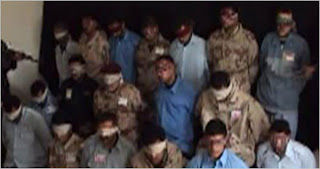
The web posting included a photo that showed the 18 men, blindfolded and with their hands apparently tied behind their backs. Seven wore Iraqi army uniforms.
Late in the day, the group announced that it would kill the men because the Iraqi government had failed to meet its demands.
The Interior Ministry said that the bodies were found today of 14 police officers who disappeared late Thursday as they traveled from Baqouba to Khalis. It was unclear whether the 14 were among the group of 18 abductees claimed by the militant group, or represented a separate incident.
Diyala has become a center of the sectarian conflict in Iraq, especially in the days since Iraqi and American forces began a stepped-up effort to secure Baghdad. Some 42 Americans have been killed in Diyala in the last six months, in contrast with just two over the six-month period before that, according to icasualties.org, which tracks military deaths by province.
The mass kidnapping is the latest incident in a long-running and bloody battle between Sunni Arab insurgents and gangs, who effectively control much of Diyala, and the Shiite militias and Shiite-dominated Iraqi security forces, which the insurgents regard as one and the same.
Diyala’s population of about 1.4 million is half Sunni Arab, but the levers of power are controlled by Shiites who, according to American military officials, have made plain their intention to hold sway over the strategic province permanently.
Fighting near the largely Sunni city of Falluja continued today, and a car bomb detonated near a used-car market in the Shiite-dominated eastern side of Baghdad killed 4 and injured 20.
Two soldiers and their Iraqi interpreter who were attached to Multinational Division Baghdad died today when a roadside bomb exploded as they searched for improvised explosives on a heavily traveled route to the northwestern part of the capital.
These events, as well as signals of likely resistance to the new Baghdad security plan in the largely Shiite, densely populated Sadr City neighborhood, emphasized again the difficulties that Iraqis and Americans face in trying to bring even a semblance of stability to the populous central swath of the country.
BAGHDAD, Mar. 2 — Two soccer players were murdered in front of their teammates in Ramadi, witnesses said, and a group of Interior Ministry employees were abducted in Diyala province as brutal sectarian violence continued to rage across much of Iraq.
Witnesses said that the masked gunmen who shot the two soccer players execution-style accused the two men of collaborating with a Sunni group with ties to the American occupation authorities.
As the sun set on Thursday, three cars carrying 10 men drove up to a community playground a few hundred feet from Ramadi’s main government building, where a friendly soccer match was underway between two neighborhood teams. The men poured out of the cars and seized the two players — Muhammad Hammed Nawaf and Muhammad Meshaan, both in their 20s.
The assailants tied the players’ hands and tried to drag them toward the cars, but the players resisted and struggled.
“Muhammad tried to run away, but he stumbled on a rock, fell on the ground, and the armed men shot him dead at once,” said Khalid Al-Ghargholi, the manager of the Ramadi team, speaking of Mr. Meshaan. “They started yelling, ‘This is the destiny of anyone who works with secret police.’ ”
Mr. Ghargholi said that the gunmen were referring to the Salvation Council of Anbar, a group led by a Sunni sheik, Abdul Sattar Buzaigh al-Rishawi, who has opposed armed groups in the area and has ties with the Iraqi government and the Americans.
After his teammate was killed, Mr. Nawaf challenged the men to free him. “He said, ‘If you have anything against me, shoot me, but if not, leave me alone,’ ” Mr. Ghargholi related.
Spectators at the soccer match froze, fearing for their own lives, as the gunmen grabbed the two players, according to Mr. Nawaf’s father, Hameed Nawaf Al-Zuali. “They killed them before the audience,” he said through tears, “and nobody moved to help them.”
Maj. Tareq Yussef of the Ramadi police corroborated the witnesses’ reports and said, “The killers are from Ramadi for certain.” It was not clear whether there would be any effort made to apprehend them.
Revenge was the stated motive in the kidnapping of 18 employees of the Iraqi Ministry of Interior in Diyala Province.
A Sunni Arab militant group called the Islamic State of Iraq posted a statement on a militant web site today claiming responsibility for the kidnappings, and said they were in retaliation for the rape of a Sunni Arab woman by members of the Shiite-dominated police force. The group demanded that the government immediately turn over the men responsible for the rape and free all Sunni women prisoners.

An Al Qaeda-led group posted photographs on a web site showing a group of Iraqi Interior Ministry employees abducted in Diyala province.
The web posting included a photo that showed the 18 men, blindfolded and with their hands apparently tied behind their backs. Seven wore Iraqi army uniforms.
Late in the day, the group announced that it would kill the men because the Iraqi government had failed to meet its demands.
The Interior Ministry said that the bodies were found today of 14 police officers who disappeared late Thursday as they traveled from Baqouba to Khalis. It was unclear whether the 14 were among the group of 18 abductees claimed by the militant group, or represented a separate incident.
Diyala has become a center of the sectarian conflict in Iraq, especially in the days since Iraqi and American forces began a stepped-up effort to secure Baghdad. Some 42 Americans have been killed in Diyala in the last six months, in contrast with just two over the six-month period before that, according to icasualties.org, which tracks military deaths by province.
The mass kidnapping is the latest incident in a long-running and bloody battle between Sunni Arab insurgents and gangs, who effectively control much of Diyala, and the Shiite militias and Shiite-dominated Iraqi security forces, which the insurgents regard as one and the same.
Diyala’s population of about 1.4 million is half Sunni Arab, but the levers of power are controlled by Shiites who, according to American military officials, have made plain their intention to hold sway over the strategic province permanently.
Fighting near the largely Sunni city of Falluja continued today, and a car bomb detonated near a used-car market in the Shiite-dominated eastern side of Baghdad killed 4 and injured 20.
Two soldiers and their Iraqi interpreter who were attached to Multinational Division Baghdad died today when a roadside bomb exploded as they searched for improvised explosives on a heavily traveled route to the northwestern part of the capital.
These events, as well as signals of likely resistance to the new Baghdad security plan in the largely Shiite, densely populated Sadr City neighborhood, emphasized again the difficulties that Iraqis and Americans face in trying to bring even a semblance of stability to the populous central swath of the country.
Subscribe to:
Posts
(
Atom
)