Showing posts sorted by relevance for query amriya. Sort by date Show all posts

Thursday, November 19, 2009

The sectarian segregation of Baghdad

Baghdad has been increasingly segregated by sect over the last six years as a result of the conflict. I read Joel Wng's post in which he mentioned that Amriya was listed as Shiite-majority in 2003, which struck me as odd. My uncles moved to Amriya with my grandparents in the late 60s and my impression was that Amriya was always a Sunni majroity neighborhood, especially after my uncles were evicted from their homes in 2005. But in reality Amriya must have been a mixed neighborhood, because other distant relatives of mine, also Shia, lived there and prospered there for many years.

I wrote this in March 2007: 'In the 1960s my grandparents moved from Nejef to Amriya, a neighborhood in western Baghdad. After my grandparents died, two of my uncles continued to live in their parent's house without problems until 2004, when 'mujahideen' started taking over the neighborhood. In the summer of 2005 my uncles received a letter telling them to leave or they would be killed. Fearing for their lives, my uncles took their wives and kids to Nejef, where they are lucky to have places to stay. I don't think any Shia live in Amriya anymore.'

For this reason I thought Amriya was a Sunni neighborhood, but according to a map by Dr. Michael Izady of Columbia’s School of International and Public Affairs, Amriya was a Shia-majority neighborhood in 2003.

Baghdad by sect in 2003:


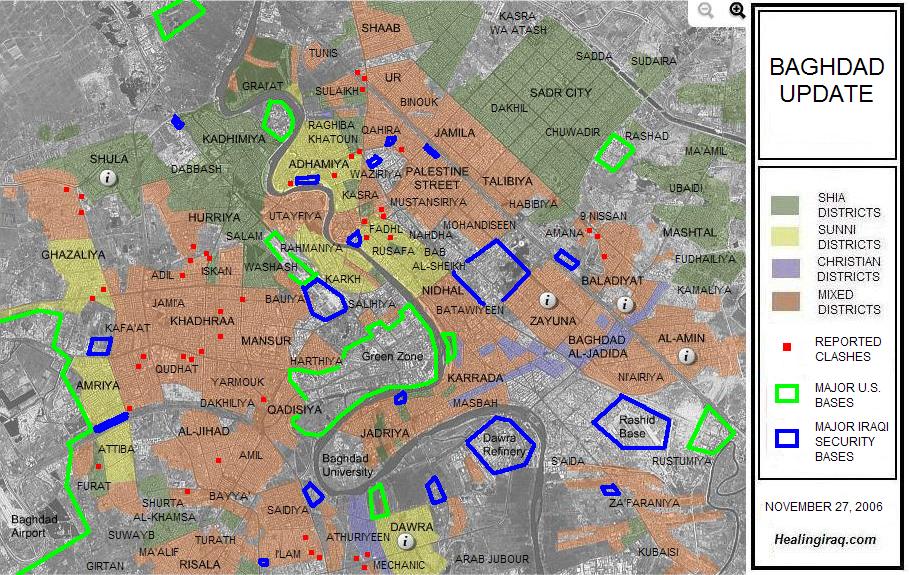
By 2006, Amriya was turned into a Sunni-majority neighborhood:


In late 2006 Zeyad of Healing Iraq also showed Amriya as a Sunni district.

How the hell did Armiya go from a Shia-majority district to a Sunni-majority district in three years? Here are some clues:

'Al Amriya is considered amongst most sect-driven areas in the capital and the Takfiris - with short dishdash and Afghan style dreadlocks were quite active and until one month ago.

Before, the Takfiris were usually seen in the streets shooting at any unidentified passersby and would slaughter - with the literal meaning of the word, anyone in its home if they ‘deem’ that he/she worked for the invaders authority. Also, they would target the police forces (mainly Shiites) and abduct cops and later would chop their heads off and dumb them in the trash. And they too planted road bombs to get the invaders forces.'


This explains how many Shia, including my two uncles and distant relatives, were expelled by violence and threats of violence in Amriya.

Saturday, July 05, 2008

Reminder: NONE of my relatives murdered by US

On the Palestinian Pundit this comment was addressed to me: "If only Mojo attacked the US crimes & Sectarian death squads in the same manner/passion he attacks the resistance."

I responded: 'Sorry Zara, but none of my relatives have been murdered by the US or "sectarian death squads" (as if Al Qaeda and the "Islamic" Army of Iraq are not sectarian death squads).

Still, I've written about Blackwater and the Dogs of the Shia on my blog. Perhaps you have difficulty with my blaming the Sunni Arabs who incited the civil war in Iraq. I don't blame all Sunni Arabs, but you are sensitive to the truth, and you are sensitive to my attacks on the slime who mass murder Iraqis. I'm sorry if you are offended.

I've written on my blog about my distant relatives who were murdered by a Sunni Arab death squad - they were criminals who stole $20k from our relatives who'd lived in Amriya all their lives, and after taking the money the criminals murdered the father and his son in front of the mother and the son's Sunni Arab wife. She begged for her husband's life, telling the sectarian criminals that she is Sunni. They told her they should kill her too, for marrying an apostate. Then they took off with the family's two cars.

In 2005 my uncles, who grew up in Amriya, received letters from the local "mujahideen" warning them to leave Amriya or be killed. They moved to Najaf, along with their families, where they still live. My uncle's wife's sister was married to a translator and they decided to stay in Baghdad. Just a few weeks after my uncles moved to Najaf, the translator was shot dead in front of his family while buying bread. That happened months before Shia death squads began drilling holes in Sunni heads.

Read my first post to learn what Saddam's regime did to my two cousins in 1980 and my dad's Sunni Arab friend a few years later.

This is the truth, this is what happened to my relatives and our friends. And here you are wanting me to condemn the crimes of the US, as if I'm ok with US crimes in Iraq.'

For the record, and because I've never discussed this specific crime on my blog, even though I've discussed it in the comments: I was horrified by the gang rape and murder of Abeer Hamza al Janabi, but I do not believe all US troops should be punished for the crimes of the sick and twisted soldiers who committed that crime. By the same token, I do not blame all Sunni Arabs for the crimes of Al Qaeda in Iraq, and I don't blame all Iranians, or all Shia, for the crimes of JAM and Badr. I still believe that nonviolence is the way to go, the best way to end the US presence in Iraq, and for Iraq to succeed as a peaceful and prosperous nation.

Saturday, June 09, 2007

Murdered for being Shi'a

Yesterday I spoke with my mother, who told me a very sad story about her friend Fawziya in Baghdad. Khala (Aunt) Fawziya is a distant relative of my mother's cousin, the one whose family was jailed for 4 years in the early 80s because one of her sons deserted the army - I wrote about that story in my first post. So I guess this makes Khala Fawziya a distant relative of mine, even tough I don't remember her very well. About 6 months ago, Khala Fawziya and her family were sleeping in their large house in an upscale neighborhood of Amriya, a Sunni Arab-dominated district in western Baghdad. Khala Fawziya's son and his wife, a Sunni Arab woman he had married just 20 days earlier, were staying with his parents and were sleeping in their own room. Very early in the morning while they were still asleep, a group of armed men stormed into the house and dragged the newlywed couple out of their room, and of course this woke everybody else. Khala Fawziya's husband begged the men not to harm his son and told them that he had $20,000 in the house and that he would give it to them if they just leave the house without harming anybody. They agreed, but as soon as the money was handed over, the men shot and killed Fawziya's husband. They then turned their guns on Fawziya's son, whose wife pleaded with the men not to kill her husband. She told them that she is Sunni. They told her that they should kill her too because she married a Shi'i. Then they shot and killed the young man and left with the money. The following week, Khala Fawziya took the remainder of her family and moved to Dubai, where her eldest son lives. My mother recently spoke to Khala Fawziya and says that she is distraught over the murder of her husband and son.

So this is what has befallen the Shi'a in places like Amriya. Amriya is the same district where my grandparents owned a house, and where another distant relative of mine was murdered in January 2006, presumably for being a translator for the Americans - I wrote about that story too. The people who murder Shi'a just for being Shi'a must be the Wahhabi scum from outside Iraq - I cannot imagine that even Ba'thists would commit these kinds of crimes. But even if the murderers are non-Iraqi Wahhabis, they could not have known where the Shi'a live in Baghdad without the help of locals, so the Iraqi Ba'thists are at least accomplices in these crimes. I cannot fathom how the Iraqi Shi'a can reconcile with Iraqis who have aided Al Qaeda in their pursuit to murder Shi'a.

Whenever I had a bad fever as a child, I had trouble sleeping - I would always wake up from a recurring nightmare in which I imagined enraged human beings killing each other in horrible ways. This nightmare was accompanied by the scariest feelings, as if the world was going to end soon. At 3 am this morning I woke up from this same nightmare and had these scary feelings. I kept thinking about Khala Fawziya and this war that has torn Iraq apart. Even after the Wahhabi murderous scum are driven out of Iraq, I cannot imagine how the Iraqi Shi'a can live peacefully with the hardcore Ba'thists - I'm afraid it's impossible after all that's happened.

Sunday, November 22, 2009

No peace in Iraq since 1970s

I have been thinking about this post for a few days and I thought about titling it “Ugly Peace in Iraq since 1980”. Some Iraqis (especially Kurds) would argue that even in the 1970s Iraq did not have real peace.

Recently I have read a few articles that have tried to summarize the last six years in Iraq and the surge in particular.  Some authors have attributed the reduction in violence in Iraq more to Iraqis than to Americans. Part 1 of Nir Rosen’s “Ugly Peace” focuses on Washash, a Shia-majority district of Baghdad that saw its Sunni Arab residents expelled by Shia militias in 2006. Rosen got the "ugly" part right, but I'm not sure about the peace. He seems to minimize and even disregard the worst violence committed by Sunni extremists, which is ongoing. It seems that not only Rosen but many fine journalists have been ignoring or minimizing the events of 2004 and 2005, when Sunni extremists attacked Shia all over Iraq in the most brutal ways.

Rosen exposes the injustices committed by Shia militias, as every journalist should, and I'm glad he makes a distinction between criminal elements of Jaish al Mahdi and those who only wanted to protect Shia from Sunni extremists, but he writes as if Shia militias started the sectarian violence after the bombing of the Askari shrine in Samarra in 2006. He explains that after the Samarra bombing, JAM began killing innocent Sunni Arabs, without really explaining what happened to the Shia in 2003, 2004, and 2005.
 
Rosen summarizes the explanation for the fall in violence: “the increasing calm stemmed from the ‘exhaustion of sectarian violence’ and a ‘Sunni return to politics,’ among other factors.”
 
Sounds like good news, but I do not know what Rosen means by “exhaustion of sectarian violence”. Maybe he means Shia militias stopped attacking Sunni Arabs. Sunni extremists continue to attack Shia. Maybe he did not read about the dozens of suicide bombings that have been carried out this year by AQI, which has always been the worst of the sectarian militias.

Nir Rosen:
“One explanation that few are prepared to discuss openly is that Iraq’s civil war ended because Shias won: violence against Sunnis ceased after Sunnis were brutally cleansed from Basra and large swaths of Baghdad, and Shias gained firm control of government ministries and local police. Sunnis knew they were defeated and Shias no longer worried that Ba’athist oppression would resume. With no external enemy, Shia militias began to fight each other and turned into criminal gangs terrorizing their own communities. The defeat of the Sunnis and divisions among Shias created space for new possibilities, and the government and American forces occupied that space.”


The Sunnis were “brutally cleansed” from Baghdad, as if Shia were not treated brutally before Shia militias began their murderous rampages. It is as if all of Iraq’s Sunni Arabs have been kicked out of Iraq, as if they have no representation in the Iraqi government. The violence stopped because there are no Sunnis left to kill, and hence the "ugly peace".

Here is a map of Baghdad in mid 2008, showing many districts dominated by Sunnis:


In his article Rosen summarized some of the violence of 2003 and 2004, but he did not elaborate on the incredible violence aimed at Iraq’s Shia, except to call it simply a civil war and to write “by the middle of 2005 sectarian violence was endemic”, hinting that Shia too were innocent victims. But he does not go into detail about the ugly crimes of Sunni extremists. Instead he emphasizes the brutality of the Mahdi Army and gives examples of evidence of their crimes in Washash and other areas.

Here he details the violence aimed at Sunnis in 2003 and 2004, as if to rationalize subsequent Sunni attacks on Shia:

“In October 2003 a Sunni Sheikh, his brother, and a teenage assistant were riddled with bullets as they walked home from mosque. In August 2004 a police chief and a patrolman were killed in an explosion. In December 2004 several members of a Sunni Salafist group were killed. Sunni and Shia clerics issued a futile joint edict banning sectarian fighting, and by the middle of 2005 sectarian violence was endemic.

American soldiers raiding a house in 2006 found evidence that Shia militias were cleansing Sunnis from Washash. There was a list of nearly 70 homes where Sunni families were expelled and a list of “good” families who were not be disturbed. There were letters threatening Sunnis, as well as copies of a DVD with a message from the Mahdi Army: images of exploding houses.”

 
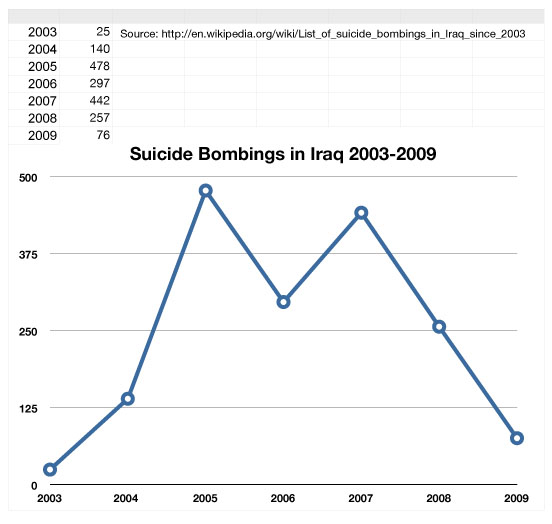
Not a single mention of the Sunni violence that was intended to destroy the new Iraq from the very beginning. No mention of the hundreds of Sunni suicide bombers who targeted Iraq’s security forces and ordinary Shia between 2003 and the 2006 bombing of the Askari shrine.  Suicide bombings are a good indication of violence perpetuated by Sunni extremists; Shia do not participate in suicide bombings that target Iraqi civilians or security forces. The largest number of suicide bombings in the war occurred in 2005:


There have been more than 1700 suicide bombings in Iraq, many involving more than one bomber. This extraordinary statistic, which is symbolic of the violence perpetuated by Sunni extremists and is unprecedented in the history of the world, does not receive mention in Nir Rosen’s “ugly peace” analysis. Instead Mr. Rosen highlighted the crimes of the Shia militias and ignored the mostly one-sided sectarian violence aimed at Iraq’s Shia before 2006.
 
My uncles who lived most of their lives in Amriya, a neighborhood of western Baghdad, were expelled from their homes in the summer of 2005.  From my perspective, it was Sunni extremists who began expelling Shias from their homes in Sunni-dominated neighborhoods and even turned Amriya, which according to Columbia University had a Shia majority in 2003 (I will call it “mixed” in 2003), into a Sunni majority district by 2006.

Maybe I should not be so critical of Nir Rosen, who is an excellent journalist and with “Ugly Peace” he has shed some light on the sectarianism that is the root of Iraq’s political problems. It’s just sad for me, as a liberal Iraqi American, to see liberal journalists seemingly taking sides and ignoring history.

Nir Rosen is not the only one who seems to be biased. Even in the documentary “Understanding the Surge”, which I posted last week, it is suggested that Iraq’s Sunni Arabs turned to Al Qaeda because Shia militias were expelling Sunnis from their homes, implying that Sunni Arabs allied themselves with AQI in 2006, after the Samarra bombing.  Sunni militia actually began joining forces with AQI in 2004, after Saddam was captured, when it became clear that the US was determined to prevent hardcore Baathists from regaining power and to ensure a democratic government was established in Baghdad.

People who insist that Baathists, being secular, could not possibly ally themselves with Salafi (fundamentalist) groups should remember Saddam’s alliance with Saudi Arabia in the 80s and they should understand that hardcore Baathists would do anything to gain and retain power. Saddam and his cronies were experts at manipulating Islam for political gain. They called their attempt to exterminate Iraq’s Kurds the “Anfal”, a Qur’anic term that refers to the spoils of war belonging to Allah and his messengers. Saddam and his henchmen played God and the Wahhabi Arabs supported them in the 80s, so why would one be surprised by an alliance between Baathists and Salafi groups today? In the 1980s Saddam's regime also expelled tens of thousands of Iraqi Shia - today this is known as "ethnic cleansing", so they already had experience in that area too. Some might even dare to call it "sectarian violence". But in the eyes of many journalists, it seems that "sectarian violence" happens only when Shia militias attack innocent Sunnis.
 
Rosen did offer this bit of truth about the pre-2006 violence aimed at Shia, quoting an Iraqi Army Captain who commented on the security situation in 2004: 

“At the time,” he told me, “there was only al Qaeda, not the Mahdi Army. We confiscated a lot of weapons and car bombs. This was before the sectarianism started.”

 
I should thank Rosen for quoting the Iraqi Army Captain who said there was only Al Qaeda in 2004 and no JAM. He also mentioned Baathist oppression, but he does not mention the expulsion of Shias from Sunni neighborhoods before the spike in sectarian violence of 2006.  Perhaps he did not know about the expulsion of Shias from Sunni neighborhoods before 2006, or maybe I'm taking this too personally, or maybe with “Ugly Peace” he wanted to focus only on the sectarianism in Washash. Maybe Part 2 of "Ugly Peace" will be different from Part 1.
 
Rosen also quoted another Iraqi who said this: “most Sunnis supported al Qaeda and turned on them because of pressure from the government.”
 
So Rosen did offer bits of truth about the violence aimed at Shia before the Samarra bombing, but in the entire article he did not elaborate on the violence directed at Shia except to quote an Iraqi who said that there was only AQI in 2004. What did AQI do in 2004? What did Saddam's ousted leaders do? I suppose it is not worth mentioning or researching, or it would have made the article too long to read.

Many journalists’ accounts of recent history in Iraq read as if Iraqi Baathists were fighting a legitimate war against occupation, as if Baathists did not engage in sectarian violence against Iraqis. It is as if Rosen is afraid or unwilling to put Iraq’s Sunni Arabs in a bad light.  The people who expelled my Shia relatives from Amriya in 2005 may not have been Iraqi, but the people who committed those crimes could not have known where the Shia lived in Amriya if they had not received help from locals, from Iraqis.

It seems that this Wikepedia entry, also the source for the numbers of suicide bombings since 2003, has it right:
 
‘A 2005 Human Rights Watch report analysed the insurgency in Iraq and highlighted, "The groups that are most responsible for the abuse, namely al-Qaeda in Iraq and its allies, Ansar al-Sunna and the Islamic State of Iraq, have all targeted civilians for abductions and executions. The first two groups have repeatedly boasted about massive car bombs and suicide bombs in mosques, markets, bus stations and other civilian areas. Such acts are war crimes and in some cases may constitute crimes against humanity, which are defined as serious crimes committed as part of a widespread or systematic attack against a civilian population."[2]
 
A 2008 RAND Research Brief Counterinsurgency in Iraq: 2003 - 2006 depicts a chart that shows in June and July 2004, Iraqi insurgents began to shift their focus away from attacking U.S. and coalition forces with roadside bombs and instead began targeting the Iraqi population with suicide bombers and vehicle-borne IEDs. By increasing the number of suicide bombings against civilians and accepting their targeting in retribution, the insurgents sought to expose the weakness of the coalition-Iraqi security and reconstruction apparatus, threaten those who collaborated with the government, generate funds and propaganda, and increasingly enact sectarian revenge. The U.S. failure to adapt to this shift had dramatic consequences. By June 2004, U.S. deaths represented less than 10% of overall deaths on the battlefield and Iraqi deaths represented more than 90% - a figure that remained constant for the next 18 months of the War.’


From my perspective based on my experiences and what I have heard and read, the truth about Iraq that most people seem to avoid is the fact that Iraq has been in a state of ethnic and sectarian conflict since 1980. There was a relative peace after the end of the war with Iran 1988, but it lasted only two years. The Arabs don’t like talking about it, but in general the Arabs have seen Iran as an enemy for decades, and Saddam used Iraq to fight that war that Sunni Arab states supported financially. That war with Iran, which Saddam always saw as an extension of the ancient war between Mesopotamia and Persia, continues today.

The war of 1991 and the following Shia rebellion against the dictator resulted in the deaths of hundreds of thousands of Iraqis. Approximately half of my relatives fled Iraq in the 80s and 90s. Journalists did not seem as concerned about those Iraqi refugees. In 2003, after the Liberation, two more of my relatives left Iraq because they finally could without risk of harm to their families. Many Iraqi Shia fled Iraq after 2003, even after they “won”.

There have been 76 suicide bombings in Iraq this year. I consider that to be sectarian violence. Sunni extremists continue to attack the Iraqi government and its security forces, even attacking police in Sunni towns, but primarily targeting the Shia-led government.

Discussing last month's bombings of three Shia-dominated Ministries,
'The top U.S. commander in Iraq, Gen. Ray Odierno, told a news conference last week that he believed a number of insurgent groups, including Baathists and al-Qaida in Iraq, were behind the bombings.

"This is a very complex issue. It's not black and white," he said.'

I would not call the situation in Iraq an “ugly peace”. It is no peace at all. Iraq has been in sectarian conflict since 1980, and the sectarian conflict continues, even as democracy sprouts in Iraq.

The criminal actions of AQI and the Baathists who supported them have shown that democracy and security in Iraq are very difficult to achieve. The hardcore Baathists will always attack the Iraqi government until they become the government. Baathists used violence to gain power in the first place, and they used violence to retain power for three decades.

Even as some of Iraq’s Sunni Arabs continue to support violent attacks against the Iraqi government and security forces, many Iraqi Sunni Arabs are participating in government, showing off their political strength. Tareq al Hashemi, one of Iraq’s Vice Presidents, has vetoed the recently passed election law, which the Iraqi parliament had been arguing about for weeks, because he said it does not include enough parliamentary seats for Sunni Arab refugees. This would be like a Shia VP of Saudi Arabia vetoing an election law because he believes it does not provide enough seats in the Saudi parliament for Saudi Shia (there are no elections and no Shia ‘VP’ in KSA). Like in war, in politics Iraq’s Sunni Arabs are playing hardball.

Even in a state of war, Iraq seems to be more democratic than most Arab countries. And Iraqis want better. Most Iraqis I know are tired of Maliki’s government, and they want to see big changes. I hope Iraqis will vote secular this time, and I hope the outcome of the election will result in true peace in Iraq, not just an “ugly peace”.

Iraqis must resolve their differences, and when they do so, hopefully they will also bring peace, justice, and prosperity to all of Iraq’s districts. Iraqis are making progress towards reconciliation without government efforts. One of my uncles who was expelled from his home in Amriya in 2005 was able to visit that house a few weeks ago and he found living in it a Sunni family, who graciously agreed to pay rent to my uncle. I have also read about Shia families being invited back to Adhamiya. I think that getting the history right, as difficult as it may be, may also contribute to the healing.

The Shia did not “win” in Iraq by expelling Sunni Arabs from Basra and Baghdad. The Shia sorta won by establishing a democracy, or at least a semblance of one, with the help of Americans. Clearly there are hurdles to overcome, and Baghdad is more segregated along sectarian lines than ever before. But there are still large numbers of Sunni Arabs in Baghdad, and it seems the Shia militias' "cleansing" and killing of innocent Sunni Arabs ended many months ago. Iraq’s Shia, after all their struggles, have not won a huge victory, and they will not be victorious until all of Iraq is truly peaceful, like it was before 1980. Real democracy in Iraq, and therefore victory, will be realized when power is passed peacefully from Nouri al Maliki to an Iraqi who will end the era of corruption and sectarianism and lead Iraq to a real peace.

Sunday, March 04, 2007

Why the sectarian violence?

It's interesting to hear some people talk about the sectarian violence in Iraq as if it's Bush's or America's fault. This would not have happened, they argue, had the US not invaded. It's true, but it is exactly what insurgents want you to believe - it is exactly why they murder and threaten to murder. They want to show the world that life for Iraqis was much better before the invasion. The more people claim that the sectarian violence is Bush's fault, the more encouraged the insurgents become. They see direct results of their evil deeds. They defeat the occupiers (and their 'agents') by mass murdering Iraqis and expelling them from their homes.

In the 1960s my grandparents moved from Nejef to Amriya, a neighborhood in western Baghdad. After my grandparents died, two of my uncles continued to live in their parent's house without problems until 2004, when 'mujahideen' started taking over the neighborhood. In the summer of 2005 my uncles received a letter telling them to leave or they would be killed. Fearing for their lives, my uncles took their wives and kids to Nejef, where they are lucky to have places to stay. I don't think any Shia live in Amriya anymore. It appears that in the parts of Baghdad where Sunni Arabs were being expelled by the Mahdi Army, things are beginning to return to normal, and a few hundred Sunni Arab families have returned to their homes in eastern Baghdad. In other parts of Iraq, however, the sectarian cleansing and expulsion continues:


'The Shias have left Quba, pushed out of their homes over two years of gradual, deadly ethnic cleansing that is now almost complete. Sectarian deaths are decreasing because there are few people left available to kill.


Both communities have retrenched in areas where they feel they are safe and which they can defend, sometimes with barricades and armed men. It is a process repeated across Iraq in an endless cycle of displacement that the new efforts to end sectarian violence in Baghdad seem to have done little to diminish.

Yesterday at Youssifiya, 12 miles south of the capital, six Sunni men who had received death threats for mixing with local Shias were killed in execution-style slayings. On Friday at least 14 members of the Shia-led security forces were abducted and believed killed.

The Iraqi government wants tens of thousands of families to return as part of the Baghdad Security Plan, but only a few hundred have done so, many of them to hide behind locked doors. So the cycle continues. Displaced Sunnis push out Shias, who in turn push out the Sunnis in the areas they relocate to. While more than a million have left Iraq, three million have been internally displaced. The displacement has been conducted with ruthless efficiency. A mosque will be attacked, a grenade thrown at a house, men kidnapped and killed, a few houses burnt - delivering the message to get out.

The pattern is recognised by Tammimi. Many Shias displaced from villages near his relocated to Shaab in northern Baghdad, arriving in the middle of a tit-for-tat expulsion. 'Farmers from here were displaced and went to Shaab. They try to remember their homes. I knew all the Shia families in my village. But I do not doubt displaced young men can commit acts of violence - and against the multinational forces - because they believe that the American forces' arrival is the reason for their plight.'

According to Iraq's Migration and Displacement Ministry, nearly 100,000 Iraqi families, about 500,000 individuals, have been displaced since February 2006. It is a Catch-22 situation - every problem that is addressed by US-Iraqi security policies has another in its wake. They are problems so deeply entrenched within Iraq's disastrous decline that the security plan, now in its third week, is struggling to gain a proper traction.

As the US and Iraqi forces clamp down in Baghdad - reducing violence from Shia elements by up to 40 per cent although failing to tackle Sunni bombs - it has seen both factions shift their fight out of the city to other locations.

And as weapons have been confiscated from around Baghdad, it has left some areas - like Ghazaliya, which used to be capable of defending itself from Shia gangs - more vulnerable to attack. So the violence is not eradicated but the balance of power lurches dangerously.

Outside the capital, the problems have become just as complex. In Anbar, the tribal counter-insurgency - backed by Prime Minister Nouri al-Maliki - against jihadist groups who had challenged the power of the sheikhs has spawned a vicious retaliatory war within the Sunni community which last week saw two bombings in Ramadi. In the south, too, where British generals have argued that the presence of UK troops was exacerbating the problem, the prospect of their departure has acted as an accelerator to factional violence.

If there is a metaphor for this struggle, it was one supplied at dusk on Friday evening - the sound of American artillery shelling the palm groves to Baghdad's west, dull thuds as meaningless and regular as a headache.

For the Mahdi Army, blamed for the worst of the death squad violence since the bombing of the Golden Dome at Samarra last year, the security plan operation has allowed it a period of retrenchment - its third tactical withdrawal since the invasion. On both previous occasions it emerged stronger.

'We have been ordered by Muqtada Sadr [the charismatic cleric followed by the Mahdi Army] to co-operate with the Iraqi authorities and avoid friction with the US forces while they are with Iraqi forces,' said a Mahdi squad leader from Sadr City, who is known as Ali al-Yasri.

'US and Iraqi raids launched in Sadr City are against members of the al-Mahdi who have become outlaws,' he said. 'Forty per cent of those operating under the name of the Jaish al-Mahdi - some genuine members and others who have just taken the name - are gangsters.'

'Most of those rogue leaders,' he said, had been 'purged'. 'Each unit of the Mahdi Army belongs to a Sadr Office. Those offices have an intelligence officer in them who answers directly to Muqtada al-Sadr. When a person is blacklisted, his name is sent to the chairman of the office. If the chairman is blacklisted, the office is frozen until a new chairman can be nominated.'

Much of the membership had gone to ground, he said, but remained active in defending holy places. The Mahdi Army's membership, he said, had little to fear from the Iraqi security forces due to the level of cross membership between the two. Mahdi members are still visible around the city, but their controversial religious courts have massively decreased their operations.

Yasri said: 'For this period it is about state law. At present when we arrest a suspected terrorist we hand him over to the security forces.

'Whether we will reappear as a force on Baghdad's streets depends on the success of the security plan. If the bad people are arrested and punished, then that is fine. If not,' he said grimly, 'then we will go back to the old ways.'

Friday, January 26, 2007

The 'Brutality' of Iraqi Soldiers

This is interesting. Channel 4 News of the UK has obtained a video that shows Iraqi soldiers (no doubt Shia) beating three Sunni Arab men who were caught with mortars in their cars. The beating took place in the Sunni Arab neighborhood of Amriya, the same neighborhood my uncles lived in for decades until they received letters from the 'mujahideen' in the summer of 2005 threatening to kill them if they did not leave. The video is being circulated on other blogs and through comments, and many people are pointing to this video as evidence of the brutality of Iraqi soldiers against Sunni Arabs. One commentator on another blog called it a 'genocide' of Sunni Arabs, with American complicity.

Later in the video they show the body of a 16 year old Shii in a formerly mixed neighborhood of west Baghdad. Apparently that's not as brutal as an Iraqi Army soldier beating up Sunni Arabs caught with mortars. After that a Sunni Arab man, married to a Shii woman, is shown talking to US soldiers in Amriya about a letter he received from Sunni insurgents saying that they must leave (final warning!) or the mujahideen will cut out their tongues, behead them, and eradicate their entire family. The letter was signed in the name of 'Allah, the Merciful, the Compassionate' by four Sunni militia groups. It makes me wonder if people who are trying to use this as evidence of the brutality against Sunni Arabs by Iraqi soldiers have seen the entire video. Even the title of the YouTube video (Shia Iraqi soldier beat Sunnis as US trainers watch) suggests that the person who uploaded the video did not watch the whole thing. So if you watch this, watch ALL of it!


Having said this, I'm glad that people are hodling the Iraqi Army to high standards.

Thursday, November 08, 2007

Amriya

I'm glad to read about the turnaround in the western Baghdad neighborhood of Amriya, where my uncles lived until they were expelled by "mujahideen" in 2005 and where two distant relatives were murdered earlier this year. 
 

Troops praise progress in Baghdad enclave that once was al-Qaeda base

12:00 AM CST on Thursday, November 8, 2007

From Wire Reports Douglas Birch, The Associated Press

BAGHDAD – Twilight brings traffic jams to the main shopping district of this once-affluent corner of Baghdad, and hundreds of people stroll past well-stocked vegetable stands, bakeries and butcher shops.

DOUGLAS BIRCH/The Associated Press
Iraqis pass an armored vehicle in Baghdad's Amariyah neighborhood. Violence has sharply declined in the neighborhood, a drop attributed in part to the buildup of U.S. troops.

To many in Amariyah, it seems little short of a miracle.

Just six months ago, this mostly Sunni neighborhood was a base of operations for al-Qaeda in Iraq. The district in western Baghdad was hit by more than a dozen bombings and shootings some days.

On Tuesday, women shopped and men drank tea in sidewalk cafes. Occasionally, U.S. soldiers walking the streets were greeted with salaams and smiles.

What is happening here reflects similar trends across Baghdad and parts of Iraq, where civilian and U.S. military casualties have dropped sharply in the past two months. Maj. Gen. Joseph Fil said Tuesday that all but 12 to 13 percent of Baghdad is under control by the U.S. military and other security forces.

But the speed of the turnaround in Amariyah has taken almost everyone by surprise.

"The progress that we made is almost unbelievable," said Capt. Brendan Gallagher, 29, of Columbia, Md., with the Army's 2nd Brigade, 1st Cavalry Division.

The neighborhood is still nowhere near its former gloss as the Beverly Hills of Baghdad, as it was called before the 2003 U.S. invasion. A six-foot-high concrete wall rings the two-square-mile neighborhood, many villas stand empty, and the streets are littered with trash. There is 70 percent unemployment, military officials say.

But residents are making the first small steps to rebuilding.

"Amariyah was one of the first places where things got real bad," said 1st Lt. Schulyer Williamson, 24, of Pensacola, Fla., part of Capt. Gallagher's unit. "My platoon sergeant and I would pick up six dead bodies a day."

The violence peaked in May, U.S. officials said, as al-Qaeda in Iraq fighters killed 14 U.S. military troops in a series of bombings.

Several U.S. military officials said the most important factor in reducing the violence in Amariyah was the U.S. troop increase, which quadrupled the number of U.S. military forces patrolling the neighborhood in mid-June.

Another key to progress, they said, was the formation in late May of a local anti-insurgent alliance, the Farsan al-Rafidayn, which means "Knights of the Land of the Two Rivers."

Tuesday, August 21, 2007

Is democracy possible in today's Iraq?

This is an interesting interview with Nir Rosen.  I find it ironic that Goodman and Rosen seem to be slamming the democratically elected Iraqi government on a show called Democracy Now.  But the truth must be told and the question must be asked:   Is democracy (the kind we are used to in the West) even possible in today's Iraq?  My comments are in red.
 
Tuesday, August 21st, 2007
"Iraq Does Not Exist Anymore"
 
NIR ROSEN: Outside Iraq, we're approaching three million refugees who have left since 2003. There were, of course, refugees who left before then, due to Saddam and other factors.

Inside, I think you have a similar number of internally displaced Iraqis fleeing their homes in mixed areas and going to more homogenous areas. Sunnis from Basra are heading to Sunni neighborhoods, Baghdad, or all the way up to Kurdistan. Shias from Diyala province are going to safer areas for Shias. Kurds from Mosul going up to Kurdistan, as well.

And a family like the one we just saw on the show is never going to go back to their home again, actually, it seems.

AMY GOODMAN: Why?

NIR ROSEN: Iraq has been changed irrevocably, I think. I don't think Iraq even -- you can say it exists anymore. There has been a very effective, systematic ethnic cleansing of Sunnis from Baghdad, of Shias --from areas that are now mostly Shia. But the Sunnis especially have been a target, as have mixed families like the one we just saw. With a name like Omar, he's distinctly Sunni -- it's a very Sunni name. You can be executed for having the name Omar alone. And Baghdad is now firmly in the hands of sectarian Shiite militias, and they're never going to let it go. [No mention of neighborhoods in western Baghdad like Amriya, which have been taken over by Sunni militias.  Nor does he mention that Sunni militias were the ones who started expelling Shia from Sunni areas - unfortunately the Shia militias responded by doing the same to Sunni Arabs in Shia areas.  I often wonder if my uncle will get his house in Amriya back.  I have noticed that many Americans on the left often blame the Iraqi government and the US for all the violence in Iraq without examining who started the sectarian violence.]

AMY GOODMAN: What do you think of Senator Levin calling for the Maliki and the whole government to disband?

NIR ROSEN: Well, it's stupid for several reasons. First of all, the Iraqi government doesn't matter. It has no power. And it doesn't matter who you put in there. He's not going to have any power. Baghdad doesn't really matter, except for Baghdad. Baghdad used to be the most important city in Iraq, and whoever controlled Baghdad controlled Iraq. These days, you have a collection of city states: Mosul, Basra, Baghdad, Kirkuk, Irbil, Sulaymaniyah. Each one is virtually independent, and they have their own warlords and their own militias. And what happens in Baghdad makes no difference. So that's the first point.

Second of all, who can he put in instead? What does he think he's going to put in? Allawi or some secular candidate? There was a democratic election, and the majority of Iraqis selected the sectarian Shiite group Dawa, Supreme Council of Islamic Revolution, the Sadr Movement. These are movements that are popular among the majority of Shias, who are the majority of Iraq. So it doesn't matter who you put in there. And people in the Green Zone have never had any power. Americans, whether in the government or journalists, have been focused on the Green Zone from the beginning of the war, and it's never really mattered. It's been who has power on the street, the various different militias, depending on where you are -- Sunni, Shia, tribal, religious, criminal. So it just reflects the same misunderstanding of Iraqi politics. The government doesn't do anything, doesn't provide any services, whether security, electricity, health or otherwise. Various militias control various ministries, and they use it as their fiefdoms. Ministries attack other ministries

AMY GOODMAN: Which is the most powerful militia?

NIR ROSEN: Well, the various Shia ones, such as the Mahdi Army, the Badr Corps, the police, the Iraqi police, the Iraqi army. Of course, the American army is also another militia, and it's a very powerful militia in Iraq -- maybe not the most powerful. But the Mahdi Army basically controls the police and the Iraqi army. Of course, in the north the police are more in the hands of various Kurdish militias, and the army is in the hands of Kurdish militias. So it sort of depends where you are.

Monday, March 17, 2008

No we don't miss him

I found this on a facebook group called "I HATE ANYONE WHO LOVES SADDAM HUSSAIN", posted by a guy named Omar. It got me thinking about the Sunni Arabs who don't miss Saddam, and that reminded me of a question on a 2004 poll that was linked to in a comment. The question asked Iraqis to rate their opinion of Saddam Hussein. Only 26% of Sunni Arabs rated Saddam as "Favorable" and 57% rated him as "Unfavorable".

A new poll (Feb 20) shows that Iraqis still have differences in opinion, and they are still divided by sect: "Despite support for cohesion, the country nonetheless is very much divided along sectarian lines. Slightly more than half of Iraqis say they live in Shiite-only or Sunni-only areas (26 percent each); add those who live in predominantly Sunni or Shiite areas and just 15 percent describe themselves as living in mixed locales. This is even though Sunni Arabs account for 30 percent of all Iraqis in this survey, Shiites 51 percent and Kurds (who are Sunnis, but not Arabs) nearly all the rest." My own uncles, who fled Amriya in 2005, still live in Najaf.

Question 8 reveals that from today's perspective and all things considered, 87% of Kurds, 65% of Shia, and just 5% of Sunni Arabs (up from 4% in August) believe the invasion was right. Nobody likes to be invaded by a foreign country. Why do a majority of Kurds and Shia believe the invasion was right? Life must have been horrible for them before 2003, if they believe that a US-led invasion of their country was right. But if Sunni Arabs do not miss Saddam, why do they believe the invasion was wrong? They are no longer dominant. Many of them lost their jobs and have been disenfranchised since the invasion.

Saddam is gone forever, and today Iraqis have other problems to contend with. The Iraqi government must work harder now to reconcile with the Sunni Arabs, so that peace will at long last come to Iraq.

PS: Link to the Most wanted Iraqi cards, for those who don't know where the Ace comes from.

Wednesday, November 28, 2007

Knights of Mesopotamia secure Amriya

By Jim Muir
BBC News, Baghdad


There is general recognition that the security situation in Baghdad and some other parts of Iraq has got significantly better in the past three months or so.

US soldier patrols market in the Dora area of Baghdad -
The US surge has brought calm to previously restive areas of Baghdad
In addition to the current surge of US forces, one of the major factors that is credited with helping the improvement, has been the emergence in Sunni areas, of local fighters recruited by the Americans as a kind of neighbourhood watch.

There are thought to be nearly 80,000 of them nationwide.

Many of them used to fight alongside the insurgents, but now, encouraged by their tribal leaders, they have turned against al-Qaeda and are helping keep it out of their areas.

We went to al-Ameriya, a journey we would not have dreamt of attempting just a few months ago, to see some of the local fighters in action.

This part of Baghdad used to be a stronghold of al-Qaeda or groups linked to it.

Knights of Mesopotamia

Now we are travelling, not with the American army as we might once have done, but with a tribal Sunni sheikh whose followers are now controlling the area along with the Americans, helping to drive al-Qaeda out and to keep it out.

Abdul Abed, Sunni militia leader
People saw al-Qaeda doing terrible things. They were killing Sunnis, Shias, and Christians. There were bodies everywhere, being eaten by dogs. So we had to fight them
Abdul Abed

We are under the protection of the Fursan al-Rafidain, the Knights of Mesopotamia, a force of about 600, and they clearly rule the roost in al-Ameriya.

They are paid and supplied with uniforms by the Americans, and work closely with them. Our first stop was at their headquarters.

Their leader, Abul Abed, meets the Americans every day.

On the wall is a picture of him with General David Petraeus, the top US commander in Iraq.

But it was not always that way. Before turning against al-Qaeda, he used to be in an insurgent group which fought the Americans.

"At the beginning, people saw it as an occupation which had to be resisted. But then they saw that the Americans were working in the interests of the people.

"They saw al-Qaeda doing terrible things. They were killing Sunnis, Shias, and Christians. There were bodies everywhere, being eaten by dogs. So we had to fight them," Abul Abed said.  continued
 
[I have to say this: why didn't they fight Al Qaeda until recently?  Is it because they weren't getting paid?]

Wednesday, January 03, 2007

Man on the Moon

Breaking News!

The Man in the Moon

Website Warns Sunnis not to Believe Saddam Spotting Rumors
By NIR ROSEN 01/02/2007 7:09 PM ET

The Sunni pro-Baathist website Iraqi Rabita today warned Sunnis not to believe rumors that it claims are widespread throughout the Arab world and are being distributed via mobile phone text messages that Saddam’s face appeared on the moon. The website declared that these rumors are false and religiously prohibited. The website also claimed an unnamed satellite television station was spreading these rumors as well. The website asked Sunnis not to believe the rumors about Saddam on the moon because those who would be happy at the Sunni loss, meaning Shias, like Abdel Aziz al Hakim and Nuri al Maliki would laugh at them. Indeed soon after the Shia Buratha website mocked Sunnis. "They could not find him on the earth so they started looking for him in the moon," the site said. It explained that the rumor started in the evening and "some naifs in Abu Ghureib, Amriya, Khadra and Yarmuk (Sunni neighborhoods) stood outside in the cold weather searching for Saddam in the moon."

Tuesday, May 15, 2007

What Nir Rosen Got Wrong on Iraq

I have enjoyed reading Nir Rosen's articles in the past, but I must admit that this one irritated me.  My comments are in red:

What Bremer Got Wrong in Iraq

By Nir Rosen
Wednesday, May 16, 2007; 12:00 AM

I arrived in Iraq before L. Paul Bremer arrived in May 2003 and stayed on long after his ignominious and furtive departure in June 2004 -- long enough to see the tragic consequences of his policies in Iraq. So I was disappointed by the indignant lack of repentance on full display in his Outlook article on Sunday.

In it, the former head of the Coalition Provisional Authority argues that he "was absolutely right to strip away the apparatus of a particularly odious tyranny," including the Baath Party and the Iraqi army. (disbanding the Iraqi army was a mistake, but Iraqis themselves would have sought justice/revenge against the hardcore Baathists who were responsible for atrocious crimes)   He complains about "critics who've never spent time in Iraq" and "don't understand its complexities." But Bremer himself never understood Iraq, knew no Arabic, had no experience in the Middle East and made no effort to educate himself -- as his statements clearly show.

Time and again, he refers to "the formerly ruling Sunnis," "rank-and-file Sunnis," "the old Sunni regime," "responsible Sunnis." (I don't know if Nir realizes that the top brass in Saddam Hussein's regime were Sunni Arabs)   This obsession with sects informed the U.S. approach to Iraq from day one of the occupation, but it was not how Iraqis saw themselves -- at least, not until very recently. Iraqis were not primarily Sunnis or Shiites; they were Iraqis first, and their sectarian identities did not become politicized until the Americans occupied their country, (actually I believe that sect became politicized when Shia mosques and marketplaces were getting bombed and key Sunni Arab MPs were accused of supporting terrorism) treating Sunnis as the bad guys and Shiites as the good guys. (Not true.  If the Sunni Arabs were treated as bad guys, why then are 20% of Iraqi MPs Sunni Arab?  Why is the Iraqi Vice President a Sunni Arab?) There were no blocs of "Sunni Iraqis" or "Shiite Iraqis" before the war, just like there was no "Sunni Triangle" or "Shiite South" (The south has always been primarily Shii) until the Americans imposed ethnic and sectarian identities onto Iraq's regions. (Imposed?  Did the Americans tell the Iraqis that they must be identified as either Shii or Sunni?)

Despite Bremer's assertions, Saddam Hussein's regime was not a Sunni regime (yes it was); it was a dictatorship with many complex alliances in Iraqi society, including some with Shiites. If anything, the old tyranny was a Tikriti regime, led by relatives and clansmen from Hussein's hometown. (Good job, Nir) Hussein punished Sunnis who became too prominent and suppressed Sunni Arab officers from Mosul and Baghdad in favor of more pliable officers from rural and tribal backgrounds. Local Sunni movements that were not pro-Hussein were repressed just as harshly as the Shiites. (True, but Saddam's regime never punished the Sunni Arabs by attacking their towns with mustard gas or bombing them en mass after a failed uprising.)

Bremer was not alone in his blindness here. Just two weeks ago, I interviewed John Bolton, the former U.S. ambassador to the United Nations, about the crisis of Iraqi refugees, who now number more than 2 million. He displayed the same dismal approach to Iraq as Bremer. Bolton claimed that most of the refugees were Sunnis, fleeing because "they fear that Shiites are going to exact retribution for four or five decades of Baath rule."  (Many Shia have also fled the country.  Two of my uncles (Shia) moved to Nejef in the summer of 2005 after receiving death threats from the 'Mujahideen' of Amriya.  My uncle's wife's sister decided to stay in Baghdad with her husband, who was working as a translator for the Americans. A few months later he was murdered in front of his family by the 'brave resistance', perhaps by a hardcore Baathist)

Many Iraqis saw the Americans as new colonists, intent on dividing and conquering Iraq. (If that is the case, why did so many Iraqis allow themselves to be divided?) That was precisely Bremer's approach. When he succumbed slightly to Iraqi demands for democracy and created Interim Governing Council, its members were selected by sectarian and ethnic quotas. Even the Communist Party member of the council was chosen not because he was secular but because he was a Shiite. (And who chose him?)

In Bremer's mind, the way to occupy Iraq was not to view it as a nation but as a group of minorities. So he pitted the minority that was not benefiting from the system against the minority that was, and then expected them both to be grateful to him. (Pitted?  I don't remember anybody pitting the Shia against the Sunni Arabs.  Nir should elaborate on what he means by 'pitted'.  He writes as if Iraqis are pitbulls.)   Bremer ruled Iraq as if it were already undergoing a civil war, helping the Shiites by punishing the Sunnis.  (I seem to recall that up until February of 2006, it was the Shia of Iraq and any pro-democracy Iraqis who were being punished by the 'resistance'.) He did not see his job as managing the country; he saw it as managing a civil war. (It has been a civil war)  So I accuse him of causing one.  (That's what the 'resistance' and their supporters want everybody to believe.  Bombing Shia mosques and marketplaces places don't cause civil war.  Drilling holes in Sunni heads doesn't inflame civil war.  Paul Bremer and his mistakes cause civil war.)

Bremer claims that Hussein "modeled his regime after Adolf Hitler's" (Joseph Stalin would be a better comparison) and compares the Baath Party to the Nazi Party. Set aside the desperation of the debater who reaches immediately for the Nazi analogy and remember that there is no mention of such "modeling" in any of the copious literature about Iraq. This ludicrous Nazi analogy permeates the entire article; it also permeated the proconsul's time in Baghdad, when Bremer imagined himself de-Nazifying postwar Germany, saving the Jews (the Shiites) from the Nazis (those evil Sunnis).

This thoughtless comparison is one of the main reasons why he performed so horribly in Iraq. (Remember, most Baath Party members were Shiites; so in Bremer's analogy, I suppose most of the Iraqi "Nazis" would be "Jews.") (Most Baath Party members were Shia because most Iraqis are Shia.  Iraqis who worked for the government had no choice but to become members of the Baath Party.  Evidently Nir did not ask the Iraqi Shia he stayed with if they were still fond of the Baath Party.)

Bremer claims that Iraqis hated their army at the time of the U.S. invasion. In fact, the army was the most nationalist institution in the country, one that predated the Baath Party. In electing not to fight U.S. forces, the army was expecting to be recognized by the occupation -- and indeed, until Bremer arrived, it appeared that many soldiers and officers were hoping to cooperate with the Americans.

Bremer is wrong to say that Shiites hated the Iraqi army. He treats Iraqis as if they were Hutus and Tutsis, claiming that "Shiite conscripts were regularly brutalized and abused by their Sunni officers." This is just not true. To be sure, Sunnis were overrepresented in the officer corps, and Shiites sometimes felt as if they faced a glass ceiling.  (Good job, Nir)  But just as there were Shiite ministers under Hussein, there were also Shiite generals. At least a third of the famous deck of cards of Iraqi leaders most wanted by the Americans were Shiites. (and they were all a bunch of low cards - the most senior was former Information Minister Mohammad Sa'eed al Sahaf, who was released and is now living comfortably in the Gulf)

Bremer also claims that the "Fallujah Brigade" was a recalled brigade from Hussein's former army. Again, simply not true. I was there. The brigade may have been led by a former Iraqi general, but enlistment was open to all volunteers in Fallujah, as I personally saw. The brigade was not a pre-existing unit that was merely recalled; rather, it was composed of a diverse group of former officers, soldiers, policemen and members of the resistance.

Bremer also exaggerates the numbers of casualties in the 1991 uprisings against Hussein. While the Baathist regime was brutal and killed tens of thousands, there is no evidence that Hussein killed hundreds of thousands of Iraqis, as Bremer claims. (perhaps a poll led by an Ivy League American university asking Iraqis how many family members they lost under Saddam's regime should be done. Many Arabs believe that the Iraqis killed by Saddam's regime somehow deserved it.  It has been estimated that 100,000 Iraqis were killed by the regime during the 1991 uprising alone)   But there is growing evidence that hundreds of thousands of Iraqis have been killed since Bremer first came to power in Baghdad.  (Many Iraqis have been killed by the 'resistance' and terrorists from all over the Arab world since 2003)

Some have indeed pilloried Bremer for his individual errors, such as disbanding the army. But these blunders are not the reasons why most Iraqis hate the American occupation and support violent resistance to it. The main grievance most Iraqis have with America is simply the occupation itself -- an occupation that lingers on years after Bremer waved goodbye.  (hopefully the 'brave resistance' and terrorists will stop mass murdering Iraqis, so the occupiers have no reason to stay in Iraq!)

Thursday, September 20, 2007

The Plight of Displaced Iraqis

A look at where displaced Iraqis have moved to within Iraq and Baghdad in particular. Two of my uncles were forced out of Amriya (insurgent stronghold in west Baghdad) in 2005 - they have been in Najef ever since. Thanks Maury for linking to this article.

Future Look of Iraq Complicated by Internal Migration

By JAMES GLANZ and ALISSA J. RUBIN
Published: September 19, 2007

BAGHDAD, Sept. 18 — A vast internal migration is radically reshaping Iraq’s ethnic and sectarian landscape, according to new data collected by thousands of relief workers, but displacement in the most populous and mixed areas is surprisingly complex, suggesting that partitioning the country into semiautonomous Sunni, Shiite and Kurdish enclaves would not be easy.

The migration data, which are expected to be released this week by the Iraqi Red Crescent Organization but were given in advance to The New York Times, indicate that in Baghdad alone there are now nearly 170,000 families, accounting for almost a million people, that have fled their homes in search of security, shelter, water, electricity, functioning schools or jobs to support their families.

The figures show that many families move twice, three times or more, first fleeing immediate danger and then making more considered calculations based on the availability of city services or schools for their children. Finding neighbors of their own sect is just one of those considerations.

Over all, the patterns suggest that despite the ethnic and sectarian animosity that has gripped the country, at least some Iraqis would rather continue to live in mixed communities.

The Red Crescent compiled the figures from reports filed as recently as the end of August by tens of thousands of relief workers scattered across all parts of Iraq who are straining to provide aid for an estimated 280,000 families swept up nationwide in an enormous and complex migration.

A bird’s-eye view of the data suggests that since the bombing of a revered Shiite mosque in February 2006 triggered severe sectarian strife, Sunnis generally have been moving north and west, Shiites south, and Christians to the far north. But the picture in the mixed and highly populous center of the country is, if anything, becoming more complicated.

It is this mixed population center, the often violent interface between more homogeneous Sunni and Shiite regions, that some advocates of partition have suggested would separate into more homogeneous areas as Iraqis seek safety among members of their own sects.

But the new figures show that the migration is not neatly dividing Baghdad along the Tigris, separating Sunnis who live predominantly on the west bank from Shiites, who live predominantly on the east. Instead, some Sunnis are moving to the predominantly Shiite side of the river, into neighborhoods that are relatively secular, mixed and where services are better, according to Red Crescent staff.


Just last week within Baghdad itself, a Sunni tribe of 250 families that lived in Dora, one of the most violent neighborhoods, was forced to flee. Rather than going to an area where they would be with others of their sect, they went to their neighbors to the south, in Abu Dshir, a Shiite area. They were welcomed by the local tribe and given places to stay in people’s homes, according to field staff both for the Red Crescent and the International Organization for Migration, an intergovernmental agency.

Still, some poor Iraqis, for example those fleeing ethnic cleansing by Al Qaeda in Mesopotamia in villages in the eastern province of Diyala, make the only choice available to them: head for Baghdad and stop in one of the refugee camps on the fringes of the city amid the other desperately poor.

The size and scope of the migration has elicited deep concern on the part of aid officials. Relief workers “have a mammoth task to alleviate the sufferings of this vast number of Iraqis,” a draft report on the Red Crescent figures says.

Although Iraqis of every income level, sect, ethnicity and region of the country have been caught up in this migration, perhaps the most tragic consequences turn up where enormous numbers of poor Iraqi villagers have collected in camps, shantytowns and urban slums after leaving behind almost everything they owned, said Dr. Said Hakki, a physician who is the president of the Red Crescent.

“It’s tragic, absolutely tragic,” Dr. Hakki said. “I have been a surgeon all my life, and I have seen death many times; that never scared me, never shook me. But when I saw the toll here in Iraq,” he said, referring to the groups of displaced people, “that definitely shook me.”

“How could a human let human beings suffer so much for so long?” Dr. Hakki said.

Continued

Sunday, December 10, 2006

Displacement

I just read this piece that Christian Sunni linked to (thanks CS!) and it reminded me of my uncle and his story. More than a year ago my uncles, who lived in Amriya (a Sunni neighborhood in west Baghdad) for many years, received letters from 'mujahideen' threatening to kill them and all other Shia if they did not leave the neighborhood. All my uncles left, mostly for Nejef. One of my uncles is married to a woman whose sister was married to a man who worked as a translator for the Americans - they decided to stay in Baghdad. Earlier this year he (the translator) took his family to the market one Friday morning, and as he got out of his car, a man approached him and shot him in the head, killing him in front of his family.