This is another good article (thanks AS) that discusses the history of the conflict between the Shia and Sunni Arabs of Iraq and how it has escalated in the last few years, especially since the Samarra bombing a year ago.
"It has come to this: the hatred between Iraq's warring sects is now so toxic, it contaminates even the memory of a shining moment of goodwill. On Aug. 31, 2005, a stampede among Shi'ite pilgrims on a bridge over the Tigris River in Baghdad led to hundreds jumping into the water in panic. Several young men in Adhamiya, the Sunni neighborhood on the eastern bank, dived in to help. One of them, Othman al-Obeidi, 25, rescued six people before his limbs gave out from exhaustion and he himself drowned. Nearly 1,000 pilgrims died that afternoon, but community leaders in the Shi'ite district of Khadamiya, on the western bank, lauded the "martyrdom" of al-Obeidi and the bravery of his friends. Adhamiya residents, for their part, held up al-Obeidi's sacrifice as proof that Sunnis bore no ill will toward their Shi'ite neighbors across the river.
Eighteen months on, one of the men who jumped into the river to help the Shi'ites says al-Obeidi "wasted his life for those animals." Hamza Muslawi refuses to talk about how many he himself saved, saying it fills him with shame. "If I see a Shi'ite child about to drown in the Tigris now," says the carpenter, "I will not reach my hand out to save him." In Khadamiya, too, the narrative about Aug. 31 has changed. Karrar Hussein, 28, was crossing the bridge when the stampede began. Ask him about al-Obeidi, and his cheerful demeanor quickly turns sour. "That is a myth," hisses the cell-phone salesman. "That person never existed at all. He was invented by the Sunnis to make them look good." Rather than jumping in to help, he claims, the people of Adhamiya laughed and cheered as Shi'ites drowned.
The bridge connecting the two neighborhoods is now closed for security reasons--just as well, since the chasm between them is too wide for any man-made span. Mortars fired from the cemetery behind Abu Hanifa, a Sunni shrine in Adhamiya, have caused carnage in the bustling markets of the western bank. There are more mortars going in the opposite direction; on a recent afternoon, the sound of an explosion on the Sunni side of the river is greeted with cheers by worshippers at a Shi'ite shrine in Khadamiya.
Those cheers are just one sign of how much venom has seeped into Sunni-Shi'ite relations in the year since their simmering conflict was brought to a boil by the bombing of Samarra's golden-domed shrine. The bloodlust is no longer limited to extremists on both sides. Hatred has gone mainstream, spreading first to victims of the violence and their families--the hundreds of thousands of Iraqis who have lost loved ones, jobs, homes, occasionally entire neighborhoods--and then into the wider society. Now it permeates not only the rancorous political discourse of Baghdad's Green Zone but also ordinary conversations in homes and marketplaces, arousing a fury even in those who have no obvious, pressing grievance. Neither Muslawi nor Hussein has suffered personal loss, but they are relatively able to tap into the same loathing that motivates the Shi'ite militias and Sunni jihadis. "The air has become poisoned [by sectarianism], and we have all been breathing it," says Abbas Fadhil, a Baghdad physician. "And so now everybody is talking the same language, whether they are educated or illiterate, secular or religious, violent or not."
Worse, there are clear signs that Iraq's malice has an echo in other parts of the Middle East, exacerbating existing tensions between Sunnis and Shi'ites and reanimating long-dormant ones. In Lebanon, some Hizballah supporters seeking to topple the government in Beirut chant the name of radical Iraqi cleric Muqtada al-Sadr, whose militia is blamed for thousands of Sunni deaths. In Sunni Arab countries like Saudi Arabia, Kuwait and Egypt, sympathy for Sunnis in Iraq is spiked with the fear, notably in official circles, of a Shi'ite tide rising across the Middle East, instigated and underwritten by an ancient enemy of the Arabs: Iran.'
Read the entire article. It's not that long.
Showing posts sorted by relevance for query adhamiya. Sort by date Show all posts
Showing posts sorted by relevance for query adhamiya. Sort by date Show all posts
Monday, February 26, 2007


Monday, August 18, 2008
Suicide bombings in Israel vs. Iraq
I am surprised that no journalists except Robert Fisk have compared the number of suicide bombings in Israel to the number of suicide bombings in Iraq. Between 2000 and 2002 there were 70 suicide bombings in Israel, the country that has been hated by most Arabs for 60 years. In Iraq, it has become difficult to keep count of the number of suicide bombings and the number of victims. In March Robert Fisk and The Independent published an article that estimated the number of suicide bombers in Iraq at the time to be an astounding 1,121:
The mind boggling number of suicide bombings in Iraq, when compared to the number of suicide bombings in Israel, is symbolic of what Arab extremists think of Iraqis. To these Arabs, Iraqis are expendable, if not apostates or traitors who deserve violent death. Iraqi Shia are "worse than the Jews", according to many takfiri Arabs. The number of suicide bombings in Iraq and the celebration of such bombings proves the Arab hatred of Shia in Iraq.
Why did takfiri Arabs not mass murder Iraqi Shia before 2003? Because in general Sunni Arabs were reasonably happy with Saddam. They had nothing to complain about. Saddam was oppressing Iraq's Shia and non-Iraqi Sunni Arabs did not seem to mind. Since 2003 Iraqis have been cooperating with Americans in setting up a democracy in Iraq, as flawed as it may be, and for this they are mass murdered by our Arab "brothers". Iraqi Sunni Arabs who support democracy have been murdered as well. As more of Iraq's Sunni Arabs turn against Al Qaeda and work with Americans, Al Qaeda in Iraq has murdered more Iraqi Sunni Arabs - just yesterday a suicide bomber blew himself up among worshipers in the Abu Hamifa mosque in Adhamiya, killing the deputy commander of Adhamiya's Sahwa.
So this is what our Arab "brothers" think of Iraqis. Arabs have traveled from near occupied Palestine to fight US occupation and ended up mass murder Iraqis, apparently because it's easier than entering Israel and killing civilians there. Gulfie Arabs mass murder Iraqis for working with Americans as US companies do big business in Saudi Arabia, Kuwait, and Qatar. Arabs complain about US military bases in Iraq as US bases and embassies are scattered throughout the Arab world, including the US CENTCOM in Doha. Yet we do not read about suicide bombings in Doha, no bombings of markets in Riyadh. Only Iraqis are murdered in these horrific ways and in such large numbers.
'But a month-long investigation by The Independent, culling four Arabic-language newspapers, official Iraqi statistics, two Beirut news agencies and Western reports, shows that an incredible 1,121 Muslim suicide bombers have blown themselves up in Iraq. This is a very conservative figure and – given the propensity of the authorities (and of journalists) to report only those suicide bombings that kill dozens of people – the true estimate may be double this number. On several days, six – even nine – suicide bombers have exploded themselves in Iraq in a display of almost Wal-Mart availability. If life in Iraq is cheap, death is cheaper.
This is perhaps the most frightening and ghoulish legacy of George Bush's invasion of Iraq five years ago. Suicide bombers in Iraq have killed at least 13,000 men, women and children – our most conservative estimate gives a total figure of 13,132 – and wounded a minimum of 16,112 people. If we include the dead and wounded in the mass stampede at the Baghdad Tigris river bridge in the summer of 2005 – caused by fear of suicide bombers – the figures rise to 14,132 and 16,612 respectively. Again, it must be emphasised that these statistics are minimums. For 529 of the suicide bombings in Iraq, no figures for wounded are available.
...Never before has the Arab world witnessed a phenomenon of suicide-death on this scale. During Israel's occupation of Lebanon after 1982, one Hizbollah suicide-bombing a month was considered remarkable. During the Palestinian intifadas of the 1980s and 1990s, four per month was regarded as unprecedented. But suicide bombers in Iraq have been attacking at the average rate of two every three days since the 2003 Anglo-American invasion.
The mind boggling number of suicide bombings in Iraq, when compared to the number of suicide bombings in Israel, is symbolic of what Arab extremists think of Iraqis. To these Arabs, Iraqis are expendable, if not apostates or traitors who deserve violent death. Iraqi Shia are "worse than the Jews", according to many takfiri Arabs. The number of suicide bombings in Iraq and the celebration of such bombings proves the Arab hatred of Shia in Iraq.
Why did takfiri Arabs not mass murder Iraqi Shia before 2003? Because in general Sunni Arabs were reasonably happy with Saddam. They had nothing to complain about. Saddam was oppressing Iraq's Shia and non-Iraqi Sunni Arabs did not seem to mind. Since 2003 Iraqis have been cooperating with Americans in setting up a democracy in Iraq, as flawed as it may be, and for this they are mass murdered by our Arab "brothers". Iraqi Sunni Arabs who support democracy have been murdered as well. As more of Iraq's Sunni Arabs turn against Al Qaeda and work with Americans, Al Qaeda in Iraq has murdered more Iraqi Sunni Arabs - just yesterday a suicide bomber blew himself up among worshipers in the Abu Hamifa mosque in Adhamiya, killing the deputy commander of Adhamiya's Sahwa.
So this is what our Arab "brothers" think of Iraqis. Arabs have traveled from near occupied Palestine to fight US occupation and ended up mass murder Iraqis, apparently because it's easier than entering Israel and killing civilians there. Gulfie Arabs mass murder Iraqis for working with Americans as US companies do big business in Saudi Arabia, Kuwait, and Qatar. Arabs complain about US military bases in Iraq as US bases and embassies are scattered throughout the Arab world, including the US CENTCOM in Doha. Yet we do not read about suicide bombings in Doha, no bombings of markets in Riyadh. Only Iraqis are murdered in these horrific ways and in such large numbers.
Tuesday, January 19, 2010
5 Humanitarian aid workers killed in Adhamiya
"Gunmen killed four or five people at the office of an Iraqi humanitarian group in a Sunni neighborhood in Baghdad at midday on Monday, and left a bomb for police responders, in a rare attack on a nongovernmental organization here.
Accounts of the attack, in the Adhamiya neighborhood, remained inconsistent on Monday. A police officer, speaking on the condition of anonymity because he was not authorized to comment, said the gunmen killed four employees of the organization, Mawteny, and wounded a fifth. They left a bomb inside the office, which police and army officers disarmed, the police officer said.
But a source at the Interior Ministry said the gunmen killed all five people inside the office and left a bomb in a car outside, which wounded two police officers. The dead include two women, according to both accounts."
Rare attack on an NGO? Remember Margaret Hassan? Remember the 2003 bombing of the Red Cross in Baghdad?
Accounts of the attack, in the Adhamiya neighborhood, remained inconsistent on Monday. A police officer, speaking on the condition of anonymity because he was not authorized to comment, said the gunmen killed four employees of the organization, Mawteny, and wounded a fifth. They left a bomb inside the office, which police and army officers disarmed, the police officer said.
But a source at the Interior Ministry said the gunmen killed all five people inside the office and left a bomb in a car outside, which wounded two police officers. The dead include two women, according to both accounts."
Rare attack on an NGO? Remember Margaret Hassan? Remember the 2003 bombing of the Red Cross in Baghdad?
Wednesday, April 18, 2007
Death Squads Slowly Resurging in Baghdad
Death Squads Slowly Resurging in Baghdad
Sadrist Movement Sacks Two Officials; Kurdish Editor Released by KRG Authorities
By ZEYAD KASIM
In a new sign of the resurgence of death squads, both Sunni and Shia, despite an ongoing U.S.-Iraqi security operation, several dozen people were found dead across the country Monday. In Ramadi, west of Baghdad, Iraqi police uncovered 17 decomposed bodies buried beneath two schoolyards, all thought to be victims of Al-Qaeda and Islamic State of Iraq militants, who until recently controlled the turbulent city in the heart of the Anbar governorate, west of Iraq. An Iraqi police source said that one body had not yet been removed because it was thought to be booby-trapped.
In Baghdad, 25 bodies with signs of torture were found dumped in different areas yesterday, bringing the total over the last three days to 67, the highest number since the start of the U.S.-led Imposing Law security operation. Anecdotal evidence from local sources in Baghdad suggest the numbers are much higher, since many corpses are left on the street for days without being picked up by authorities.
Residents in the Sunni-majority district of Adhamiya reported several bodies in their area, including one in the middle of the commercial Dhubat Street left by insurgents who were described as “Al-Qaeda” by locals. Almost all victims are Sunni, some of them members of rival insurgent groups, local council members, or Islamic Party members and other Sunnis who have participated in the political process, according to residents. They said anyone who dares even look at the body, let alone touch it or remove it, would risk immediate execution by militants. U.S. and Iraqi forces are just a few hundred meters away at the newly renovated Adhamiya police station, residents said, but they are usually oblivious to what is going on around them behind the concrete blast walls when they are not out on patrol. Similar scenes are described in many parts of western and southern Baghdad.
Sadrist Movement Sacks Two Officials; Kurdish Editor Released by KRG Authorities
By ZEYAD KASIM
In a new sign of the resurgence of death squads, both Sunni and Shia, despite an ongoing U.S.-Iraqi security operation, several dozen people were found dead across the country Monday. In Ramadi, west of Baghdad, Iraqi police uncovered 17 decomposed bodies buried beneath two schoolyards, all thought to be victims of Al-Qaeda and Islamic State of Iraq militants, who until recently controlled the turbulent city in the heart of the Anbar governorate, west of Iraq. An Iraqi police source said that one body had not yet been removed because it was thought to be booby-trapped.
In Baghdad, 25 bodies with signs of torture were found dumped in different areas yesterday, bringing the total over the last three days to 67, the highest number since the start of the U.S.-led Imposing Law security operation. Anecdotal evidence from local sources in Baghdad suggest the numbers are much higher, since many corpses are left on the street for days without being picked up by authorities.
Residents in the Sunni-majority district of Adhamiya reported several bodies in their area, including one in the middle of the commercial Dhubat Street left by insurgents who were described as “Al-Qaeda” by locals. Almost all victims are Sunni, some of them members of rival insurgent groups, local council members, or Islamic Party members and other Sunnis who have participated in the political process, according to residents. They said anyone who dares even look at the body, let alone touch it or remove it, would risk immediate execution by militants. U.S. and Iraqi forces are just a few hundred meters away at the newly renovated Adhamiya police station, residents said, but they are usually oblivious to what is going on around them behind the concrete blast walls when they are not out on patrol. Similar scenes are described in many parts of western and southern Baghdad.
Monday, January 08, 2007
Duleimi Iraq's Most Sectarian Politician
In-Depth Report
By NIR ROSEN Posted 13 hr. 53 min. ago

The Conference in Support of the Iraqi People
In a December 22nd interview with the American sponsored Radio Sawa, Iraqi Sunni politician Adnan al Duleimi continued to show his true sectarian colors. Duleimi, who heads the Islamist Iraqi Accord Front, angered Shia politicians when he spoke at the Istanbul conference of Sunni Iraqi politicians held on the 13th and 14th of December. Duleimi angrily condemned the "Safavid threat" to Iraq, referring to the Persians and implying that the Shias of Iraq were in league with them. His tearful outburst not only incensed Shias but even the Islamic Party of Iraq was upset. Duleimi taught at the University of Zarqa in Jordan while he was in exile prior to the overthrow of Saddam Hussein's regime. Zarqa's most famous son is Abu Musab al Zarqawi. Although there is no evidence that Duleimi was ever linked to Jihadist Salafis such as Zarqawi who were engaged in acts of terrorism against civilians, Duleimi and his movement are close to other groups in the resistance. The Istanbul conference may have been intended merely to raise funds for the resistance but during Duleimi's speech several audience members interrupted him and stormed out.
The Radio Sawa interviewer pressed Duleimi on why he avoided criticizing al Qaeda in Iraq but regularly criticized the Shia Mahdi Army militia. "Is al Qaeda a terrorist organization or not?" demanded the interviewer. "I will not and will never answer this question," said Duleimi, "and if you ask me again I will hang up the phone." The interviewer persisted and asked the question once more. "Al salamu aleikum," Duleimi said, or 'peace be upon you,' and he hung up the phone.
In his December 13th speech in Istanbul , Duleimi thanked the hosts for inviting them and asked God to help them make decisions that would lead Iraq's Sunnis to believe that they have brothers supporting them. He told the audience they should have named the conference "the conference for supporting Sunnis in Iraq." Iraq is worth nothing without Sunnis, he said, because Sunnis are the owners of Iraq and are the people behind Iraqi unity. Iraq's Sunnis built Iraq. Again he demanded that the conference's title should have been "supporting Sunnis" and mocked their fear of being called sectarian. "Yes we are sectarian," he said, "if you do not take care and awaken then Iraq will be gone and Baghdad will be gone too. It is a sectarian war. It is a sectarian struggle aiming to exterminate all Sunnis. And if anyone does not believe that then he is wrong and must rethink it and must study all the daily events in Iraq. We are suffering in Iraq. Be careful Arabs be careful Muslims. Your brothers in Iraq and especially in Baghdad will be destroyed and will be trampled by the Shias. And Baghdad is emptied of Sunnis. This is the exclusion of Sunnis, be careful."
In the background a voice chanted: "Iran, Iran, you Jews. Iraq's army will return".
Duleimi continued: "These slogans are worth nothing. We want your support. Where is your support? Where are you, sons of Islam? Baghdad is going to be lost if you do not get up in the right time and stop the threat, exclusion and destroying of Sunnis. We live a tragedy everyday. Our last tragedy was Hurriya, before that was Shuula, before that was Thawra (1), before that was Shaab and Hai Ur. Sunnis have been swept out of all these cities and you are here saying the struggle is not sectarian. I swear it is a sectarian struggle and a very sectarian struggle. It is not a basic political struggle but it is a sectarian struggle veiled as a political struggle. Get ready to defend Iraq, to defend Sunnis and if you do not do so, they will be crushed by the Mahdi Army and the likes of the Mahdi Army. Our mosques have been burned, destroyed and they call it the mosques of the Nawasib (2) which must be burned and destroyed. You are inattentive saying this is not a sectarian struggle. I swear it is the ultimate sectarian struggle. Awake and arise oh Arabs, the danger has flooded you up to your knees (3). We are suffering, our cities have been hit by mortars. Do you know what is happening to Adhamiya? Sliekh, Fadhil, Hai Al-Adil and Hai Al-Jamia are hit daily by artillery. And we are here saying it is not a sectarian struggle! It is a sectarian struggle and it is the peak of sectarian struggle and you are calling this conference to support Iraqis! Which Iraq? The Shia's Iraq? Iraq is going to be Shia and this will expand to the lands surrounding Iraq. Then you will all regret it but your regret will be worth nothing because it will be too late. Where is Saudi Arabia? Where is Kuwait? Where is Jordan? Where is Pakistan? And where are the Muslims? Sleep and keep sleeping while Iraq is destroying. You sleep while Sunnis mosques in Iraq are being destroyed. Sleep while Sunnis mosques in Iraq are burning. Is not this sectarianism? It is the maximum sectarianism."
"My brothers ... who do you depend on? The Sunnis in Iraq will be destroyed, will be killed. What you have just saw in the film (Duleimi points to a screen inside the hall) is a small part of what is happening in Iraq. What have you offered to Iraq? What have you offered to your brothers in Iraq? Sleep and keep sleeping but the fire of Iraq will expand to you. What is happening in Iraq has been planned for over fifty years in order to convert the region into Shiism and create the Persian Empire under a Shia cover or under the cover of Islam while Islam is free of them (4)."
"There is an agony in my heart. We in Iraq live a scathing life. We are suffering to keep our composure, and you are here. What have you offered us? Conferences, decisions and advice. What are we going to do with these things you have offered? My dearest brothers, I do not want to speak more to increase your anxieties but I cannot turn off the fire in my heart. There is an agony in my heart about Iraq and about Baghdad which is going to be lost. Baghdad of Abu Hanifa (5), Baghdad of Al Mansur (6) and Baghdad of Harun al Rashid (7). Baghdad of Ahmed bin Hanbal (8) is going to be Baghdad of the Safavids (9), Baghdad of the Buwayhids (10), and Baghdad of the new Qarmatians (11). Why are you saying it is not a sectarian war? It is a sectarian war. Everyone who says it is not a sectarian war is wrong and must change his opinion."
Notes:
(1) Thawra was the old name for the Shia slums known as Sadr City in Baghdad. Saddam then changed the name to Saddam City. Following the Samara Shrine attack of February 2006 and the intensification of the civil war, Sunnis began calling it by its old name, Thawra, or Revolution, City.
(2) Nawasib is a pejorative term for Sunnis
(3) This is a reference to the 19th century poet Ibrahim al Yaziji, who issued the first call to Arab nationalism. Al Yaziji's poem was one of the first expressions of proto-nationalism as a political identity in an Arab world then dominated by the Ottoman empire.
(4) Meaning that Shias are not Muslims
(5) Abu Hanifa is the Islamic scholar who founded the Hanafi school, one of the main schools of Sunni Islam. His tomb lies in Baghdad's Adhamiya district, in the Abu Hanifa mosque.
(6) Abu Jaafar al Mansur is the Abbasid caliph who built Baghdad
(7) Al Rashid is an Abbasid caliph associated with the idea of the "golden age" of the Arab-Islamic civilization
(8) Ahmad bin Hanbal is the founder of the most austere of Sunni schools, Hanbalism, Wahhabism is an offshoot of Hanbalism
(9) The Safavids are a 16th-17th century Azeri Dynasty that ruled Iran and converted its population to Shiism
(10) The Buwayhids are a Shia dynasty that submitted the Abbasid caliphate into a state of de facto protectorate and ruled large parts of modern-day Iran
(11) The Qarmatians (Qaramita in Arabic) are an Ismaili sect that built what is sometimes called the first communist society in history, extremely radical, rejected contemporary notions and institutions of Islam, attacked the Abbasid state and raided Basra several times. They were based in the Eastern Arabian peninsula (today's Saudi Arabia and Bahrain) and raided Mecca and destroyed the Kaaba.
Monday, March 26, 2007
Baghdad's Sunnis live in a land of silent ruin
Baghdad's Sunnis live in a land of silent ruin (Thanks Molly)
BAGHDAD: The cityscape of this capital tells a stark story of the toll the past four years have taken on Iraq's once powerful Sunni Arabs.
Theirs is a world of ruined buildings, damaged mosques, streets pitted by mortar shells, uncollected trash and so little electricity that many people have abandoned using refrigerators altogether.
The contrast with Shiite neighborhoods is sharp. Markets there are in full swing, community projects are under way and, while electricity is scarce throughout the city, there is less trouble finding fuel for generators in those areas.
When the government cannot provide services, civilian arms of the Shiite militias step in to try to fill the gap.
But in Adhamiya, a community with a Sunni majority, any semblance of normal life vanished more than a year ago. Its only hospital, Al Numan, is so short of basic items like gauze and cotton pads that when mortar attacks hit the community last autumn, the doctors broadcast appeals for supplies over local mosque loudspeakers.
Here, as in so much of Baghdad, the sectarian divide makes itself felt in its own deadly and destructive ways. Far more than in Shiite areas, sectarian hatred has shredded whatever remained of community life and created a cycle of violence that pits Sunni against Sunni as well as Sunni against Shiite.
Anyone who works with the government, whether Shiite or Sunni, is an enemy in the eyes of the Sunni insurgents, who carry out attack after attack against people they view as collaborators. While that chiefly makes targets of the Shiite-dominated Iraqi Army and the police, the militants also kill fellow Sunnis from government ministries who come to repair water and electrical lines in Sunni neighborhoods.
The result of such attacks is that government workers of either sect refuse to deliver services to most Sunni areas. For ordinary Sunnis, all this deepens the sense of political impotence and estrangement. U.S. military leaders and Western diplomats are unsure the cycle can be stopped.
"The Sunnis outside the political process say, 'What's the point of coming in when those involved in the government can do nothing for their own community?' " said a Western diplomat who was not authorized to speak publicly.
Militant religious groups, known as takfiris, "have taken these Sunni neighborhoods as bases, which made these areas of military operation," which stopped the delivery of services, said Nasir al-Ani, a Sunni member of Parliament who works on a committee that is hoping to win popular acceptance of the Baghdad security plan.
"Now the ministries are trying to make services available," Ani said, "but the security situation prevents it. Part of the aim of the takfiris is to keep people disliking the government."
It adds up to a bleak prognosis for Sunnis. Until the violence is under control, there is unlikely to be any progress. But it is hard to persuade Sunnis to take a stand against the violence when they receive so little in return.
"We want to highlight that when the government is denying services to Sunnis, they are pushing them toward the Sunni extremists who attack the Shiite-dominated security forces," said Major Guy Parmeter, an operations officer for the 1st Battalion, 5th Cavalry, of the U.S. military, which operates in the Sunni areas on the west side of Baghdad. "And when that happens, it makes it harder to deliver services to those areas."
Government leaders admit that there has been outright obstruction on the part of some Shiite ministries. The Health Ministry, dominated by Shiites loyal to the militant cleric Moktada al-Sadr, has failed to deliver needed services to Sunni areas, said Ali al-Dabbagh, a government spokesman.
"This is part of the lack of efficiency in the ministry, which didn't improve this year," Dabbagh said. He added, however, that he did not see any remedy in the near term.
But government officials also emphasized that many of the skilled Sunnis who used to keep the ministries going have fled, so the ministries are not delivering services to anyone. Again, security has to come first, they said.
Ahmad Chalabi, a secular Shiite whose most recent role is to lead the committee working to win popular acceptance of the security plan, said he saw four problems particularly plaguing Sunni areas: food distribution, electricity, fuel and health services.
Chalabi said he might have found a solution for the first by ensuring that food agents have members of the Iraqi Army escort them to warehouses.
The other problems are deeper and the solutions will take far longer to find, he said.
BAGHDAD: The cityscape of this capital tells a stark story of the toll the past four years have taken on Iraq's once powerful Sunni Arabs.
Theirs is a world of ruined buildings, damaged mosques, streets pitted by mortar shells, uncollected trash and so little electricity that many people have abandoned using refrigerators altogether.
The contrast with Shiite neighborhoods is sharp. Markets there are in full swing, community projects are under way and, while electricity is scarce throughout the city, there is less trouble finding fuel for generators in those areas.
When the government cannot provide services, civilian arms of the Shiite militias step in to try to fill the gap.
But in Adhamiya, a community with a Sunni majority, any semblance of normal life vanished more than a year ago. Its only hospital, Al Numan, is so short of basic items like gauze and cotton pads that when mortar attacks hit the community last autumn, the doctors broadcast appeals for supplies over local mosque loudspeakers.
Here, as in so much of Baghdad, the sectarian divide makes itself felt in its own deadly and destructive ways. Far more than in Shiite areas, sectarian hatred has shredded whatever remained of community life and created a cycle of violence that pits Sunni against Sunni as well as Sunni against Shiite.
Anyone who works with the government, whether Shiite or Sunni, is an enemy in the eyes of the Sunni insurgents, who carry out attack after attack against people they view as collaborators. While that chiefly makes targets of the Shiite-dominated Iraqi Army and the police, the militants also kill fellow Sunnis from government ministries who come to repair water and electrical lines in Sunni neighborhoods.
The result of such attacks is that government workers of either sect refuse to deliver services to most Sunni areas. For ordinary Sunnis, all this deepens the sense of political impotence and estrangement. U.S. military leaders and Western diplomats are unsure the cycle can be stopped.
"The Sunnis outside the political process say, 'What's the point of coming in when those involved in the government can do nothing for their own community?' " said a Western diplomat who was not authorized to speak publicly.
Militant religious groups, known as takfiris, "have taken these Sunni neighborhoods as bases, which made these areas of military operation," which stopped the delivery of services, said Nasir al-Ani, a Sunni member of Parliament who works on a committee that is hoping to win popular acceptance of the Baghdad security plan.
"Now the ministries are trying to make services available," Ani said, "but the security situation prevents it. Part of the aim of the takfiris is to keep people disliking the government."
It adds up to a bleak prognosis for Sunnis. Until the violence is under control, there is unlikely to be any progress. But it is hard to persuade Sunnis to take a stand against the violence when they receive so little in return.
"We want to highlight that when the government is denying services to Sunnis, they are pushing them toward the Sunni extremists who attack the Shiite-dominated security forces," said Major Guy Parmeter, an operations officer for the 1st Battalion, 5th Cavalry, of the U.S. military, which operates in the Sunni areas on the west side of Baghdad. "And when that happens, it makes it harder to deliver services to those areas."
Government leaders admit that there has been outright obstruction on the part of some Shiite ministries. The Health Ministry, dominated by Shiites loyal to the militant cleric Moktada al-Sadr, has failed to deliver needed services to Sunni areas, said Ali al-Dabbagh, a government spokesman.
"This is part of the lack of efficiency in the ministry, which didn't improve this year," Dabbagh said. He added, however, that he did not see any remedy in the near term.
But government officials also emphasized that many of the skilled Sunnis who used to keep the ministries going have fled, so the ministries are not delivering services to anyone. Again, security has to come first, they said.
Ahmad Chalabi, a secular Shiite whose most recent role is to lead the committee working to win popular acceptance of the security plan, said he saw four problems particularly plaguing Sunni areas: food distribution, electricity, fuel and health services.
Chalabi said he might have found a solution for the first by ensuring that food agents have members of the Iraqi Army escort them to warehouses.
The other problems are deeper and the solutions will take far longer to find, he said.
Monday, December 11, 2006
Meanwhile in Iraq
At least 26 killed in Iraq as pregnant mother murdered: The US military also reported that two powerful roadside bombs had killed four of its soldiers on Sunday, keeping December on track to be one of the deadliest months for American soldiers so far this year.
Iraqi leader criticises US report: Mr Talabani rejected the Iraq Study Group's proposal to withdraw US troops if Iraq failed to strengthen security. He also objected to including former regime members in reconciliation talks.
Police: Saddam’s nephew escaped from prison: A nephew of Saddam Hussein serving a life sentence for financing insurgents and possessing bombs escaped from prison Saturday in northern Iraq with the help of a police officer, authorities said.
The Americans don't see how unwelcome they are, or that Iraq is now beyond repair: Manipulation of facts was often very crude. As an example of the systematic distortion, the Iraq Study Group revealed last week that on one day last July US officials reported 93 attacks or significant acts of violence. In reality, it added, "a careful review of the reports ... brought to light 1,100 acts of violence".
At least 22 killed in another bloody day in Iraq: Gunmen stormed a house, killing six members of the same family and wounding the father in a village near Tuz Khurmato, 70 km (40 miles) south of Kirkuk, police said.
60 Bodies Found as Iraq bomb attacks kill 4 US occupation soldiers: Roadside bombs have killed four more American occupation soldiers in Iraq, three of them in a single attack in north Baghdad, the US military said Monday.
650,000 Iraqi dead given voice in Congress: The briefing was to discuss the October 2006 study Mortality after the 2003 invasion of Iraq: a cross-sectional cluster sample survey, which appeared in the British medical journal The Lancet. This study estimated that 655,000 more Iraqis had died (”excess deaths”) since the invasion than would have died if the prewar rate of death (mortality) had continued. It further estimated that about 600,000 of these had died from violence.
Prominent Saudi Muslim clerics urge Muslims to support Iraqi Sunnis against Shiites: Over 30 prominent Islamic clerics from Saudi Arabia on Monday called on Sunni Muslims around the Middle East to support their brethren in Iraq against Shiites and praised the insurgency.
Car Bomb Survivors, No Longer Statistics: Video: The victims in this story survived a car bombing this summer in the Adhamiya neighborhood. These images are graphic, but they depict an aspect of daily life in Baghdad.
Sunni and Shiite Insurgents Remain Mystery to U.S., Iraq Report Charges : Nearly four years after the invasion of Iraq, the United States still does not understand the enemy that American troops are fighting, according to last week’s report by the Iraq Study Group.
Lawmakers seek to oust Iraqi prime minister: The talks are aimed at forming a new parliamentary bloc that would seek to replace the current government and that would possibly exclude supporters of the radical Shi'ite cleric Moqtada al-Sadr, a vehement opponent of the US military presence.
White House denies move to oust al-Maliki: The White House is flatly denying a report that key Shiite leaders are maneuvering to oust Iraq's prime minister.
Iraqi President Calls U.S. Security Training a Failure : President Jalal Talabani said Sunday that the American program to train Iraq’s security forces had been a repeated failure and he denounced a plan to increase the number of American advisers working with the Iraqi Army, saying it would subvert the country’s sovereignty.
'Iraq insurgent attacks to rise: A British military commander has warned that insurgent attacks on multi-national troops in Iraq would rise ahead of the planned security handover to local forces in the Basra area next year.
Iraqi leader criticises US report: Mr Talabani rejected the Iraq Study Group's proposal to withdraw US troops if Iraq failed to strengthen security. He also objected to including former regime members in reconciliation talks.
Police: Saddam’s nephew escaped from prison: A nephew of Saddam Hussein serving a life sentence for financing insurgents and possessing bombs escaped from prison Saturday in northern Iraq with the help of a police officer, authorities said.
The Americans don't see how unwelcome they are, or that Iraq is now beyond repair: Manipulation of facts was often very crude. As an example of the systematic distortion, the Iraq Study Group revealed last week that on one day last July US officials reported 93 attacks or significant acts of violence. In reality, it added, "a careful review of the reports ... brought to light 1,100 acts of violence".
At least 22 killed in another bloody day in Iraq: Gunmen stormed a house, killing six members of the same family and wounding the father in a village near Tuz Khurmato, 70 km (40 miles) south of Kirkuk, police said.
60 Bodies Found as Iraq bomb attacks kill 4 US occupation soldiers: Roadside bombs have killed four more American occupation soldiers in Iraq, three of them in a single attack in north Baghdad, the US military said Monday.
650,000 Iraqi dead given voice in Congress: The briefing was to discuss the October 2006 study Mortality after the 2003 invasion of Iraq: a cross-sectional cluster sample survey, which appeared in the British medical journal The Lancet. This study estimated that 655,000 more Iraqis had died (”excess deaths”) since the invasion than would have died if the prewar rate of death (mortality) had continued. It further estimated that about 600,000 of these had died from violence.
Prominent Saudi Muslim clerics urge Muslims to support Iraqi Sunnis against Shiites: Over 30 prominent Islamic clerics from Saudi Arabia on Monday called on Sunni Muslims around the Middle East to support their brethren in Iraq against Shiites and praised the insurgency.
Car Bomb Survivors, No Longer Statistics: Video: The victims in this story survived a car bombing this summer in the Adhamiya neighborhood. These images are graphic, but they depict an aspect of daily life in Baghdad.
Sunni and Shiite Insurgents Remain Mystery to U.S., Iraq Report Charges : Nearly four years after the invasion of Iraq, the United States still does not understand the enemy that American troops are fighting, according to last week’s report by the Iraq Study Group.
Lawmakers seek to oust Iraqi prime minister: The talks are aimed at forming a new parliamentary bloc that would seek to replace the current government and that would possibly exclude supporters of the radical Shi'ite cleric Moqtada al-Sadr, a vehement opponent of the US military presence.
White House denies move to oust al-Maliki: The White House is flatly denying a report that key Shiite leaders are maneuvering to oust Iraq's prime minister.
Iraqi President Calls U.S. Security Training a Failure : President Jalal Talabani said Sunday that the American program to train Iraq’s security forces had been a repeated failure and he denounced a plan to increase the number of American advisers working with the Iraqi Army, saying it would subvert the country’s sovereignty.
'Iraq insurgent attacks to rise: A British military commander has warned that insurgent attacks on multi-national troops in Iraq would rise ahead of the planned security handover to local forces in the Basra area next year.
Friday, December 30, 2011
Sunni Arabs in Adhamiya celebrate US withdrawal
'Hundreds of Sunni Muslims gathered in Baghdad Friday to celebrate the withdrawal of American forces, but in a sign of the sectarian divisions that re-emerged immediately after their departure, Shiite Muslims did not join the event.
The celebration took place near the Abu Hanifa mosque, the main house of worship in the primarily Sunni neighborhood of Azamiyah in northern Baghdad. To secure the event, Iraqi troops blocked traffic on roads leading to the mosque and searched people approaching the area.
During the rally, men and children waved Iraqi flags and raised banners praising those who resisted the U.S. presence in Iraq.'
The celebration took place near the Abu Hanifa mosque, the main house of worship in the primarily Sunni neighborhood of Azamiyah in northern Baghdad. To secure the event, Iraqi troops blocked traffic on roads leading to the mosque and searched people approaching the area.
During the rally, men and children waved Iraqi flags and raised banners praising those who resisted the U.S. presence in Iraq.'
Wednesday, September 10, 2008
Daughters of Iraq

Thanks C.H.
Daughters of Iraq: front-line guards against suicide bombers
Iraqi women take on key security role as attacks by female suicide bombers rise.
By Tom A. Peter | Staff writer of The Christian Science Monitorfrom the September 11, 2008 edition
Reporter Tom A. Peter talks about the potential future of community policing in Iraq.
Baghdad - Although the overall level of violence in Iraq has decreased to a four- year low, the country has recently witnessed a sharp rise in a violent trend that alarms many Iraqis: female suicide bombings. This year the number of suicide bombings carried out by women has more than tripled to 29 attacks, say US military officials.
Al Qaeda and other insurgent groups have turned to women to exploit cultural practices that do not allow men to search women. As a result, females can pass through most checkpoints in Iraq without someone so much as looking in their handbags.
To combat this threat, Iraqis have begun recruiting women for the Daughters of Iraq, a female counterpart to the Sons of Iraq community policing program largely credited with reducing violence in Iraq. While female security guards remain a small minority, they've stopped many female insurgents. And, some say their example could help change perceptions about the role of women in Iraq.
"Right now women [suicide bombers] are more dangerous than men," says Sheikh Zaid Ahmed Al-Wan, an Awakening Council leader in Adhamiya, a Baghdad neighborhood. "You can't see anything on a woman's body, especially when she's wearing an abaya [a traditional Islamic gown] or a long dress. In the summer you can see everything on a man, you can even see if there's something in his pocket and even in the winter you can tell if he's carrying a big weapon or a bomb."
The most recent female suicide attack killed 18 people and injured 75 on Aug. 14. The bomber targeted Shiite pilgrims in a rest area in Iskandariyah in Iraq's Babil Province.
The bombing highlights how females can often inflict more damage than males. The majority of women bombers wear explosive vests or belts covered by abayas and are sometimes made to look pregnant, according to US military officials who track suicide bombing trends. This allows women easy access to crowded areas where they can cause the most damage.
Identifying a common profile for female bombers can be difficult, with one as young as 13. There is also speculation that bombing cells have used mentally handicapped women to carry out some attacks.
While the motives of each bomber varies, US military officials say most female suicide bombers share at least one of the following characteristics or circumstances: dishonor through sexual indiscretion, loss of a family member and a desire for revenge, desire to attain heroic status, inability to produce children, or an interest in demonstrating gender equality.
Wednesday, January 24, 2007
Securing Baghdad
Alaa the Mesopotamian has made a few suggestions on how to improve the security situation in Baghdad. Alaa has long argued that the US military should focus its efforts on securing Baghdad, and the goal should have been from the beginning to make Baghdad one big Green Zone. It's too bad that US military strategists were not reading Alaa the Mesopotamian two years ago and taking him seriously. Here are a few of Alaa's key recommendations:
'4- Lock down of the city of Baghdad at carefully studied points. The question as to where Baghdad boundaries actually are, is a crucial matter and requires very careful strategic consideration. For instance, should Abu Graib, be within or outside the protected periphery? This hotbed area is one of the havens of terrorism and the source of much of the action that afflicts central Baghdad. Likewise are the areas nearer to the center in West Baghdad. The objective is to work towards the goal of “Green Zone Baghdad” that I have proposed long time ago.
5- Recognition of the main threat and avoidance of engaging in secondary efforts that can only distract from the main objectives and open up unnecessary fronts that only serve to increase the risk to the troops and divert their attention. This point, I mention specifically concerning Shiite areas and the so-called Sadrists. These are not the main threat, and could be dealt with politically. Of course they must be controlled, but I believe the task is more political and social than military there.
6- Respect of the lives [Alaa's cousin was recently killed by US troops - apparently they thought he was a suicide bomber] and property of ordinary citizen, and adoption of the principle of courteous and respectful approach to searches and information gathering. Avoid breaking of furniture and the various acts of vandalism, not to mention downright theft, that have been so common.
7- To distinguish community and tribal leaders in each area and convoke them before embarking on action in any neighborhood. Saddam was very effective using this method, holding these leaders responsible for what happens in their communities, recompensing them generously when cooperative otherwise punishing them severely when things go wrong.
8- Recognition that there are virtually closed neighborhoods completely under “insurgent” control (the Sods) where they can rig their car bombs, suicide men, I.E.D’s etc. etc. with complete impunity, especially after the thorough ethnic and sectarian cleansing that is almost completed by now. These areas comprise many parts of West Baghdad, Adhamiya, and in the entirety of the farmland belt around Baghdad etc. Unless there is preparedness and determination to go into these areas clean them and hold them, there is little chance of success.
These are just a few points purely on the military technical side, which does not mean that we underestimate the other more important political, sociological and economic factors, but these require volumes of research which is not within my capability at the present. But still the points above are of urgency in the immediate short term.' --Alaa
'4- Lock down of the city of Baghdad at carefully studied points. The question as to where Baghdad boundaries actually are, is a crucial matter and requires very careful strategic consideration. For instance, should Abu Graib, be within or outside the protected periphery? This hotbed area is one of the havens of terrorism and the source of much of the action that afflicts central Baghdad. Likewise are the areas nearer to the center in West Baghdad. The objective is to work towards the goal of “Green Zone Baghdad” that I have proposed long time ago.
5- Recognition of the main threat and avoidance of engaging in secondary efforts that can only distract from the main objectives and open up unnecessary fronts that only serve to increase the risk to the troops and divert their attention. This point, I mention specifically concerning Shiite areas and the so-called Sadrists. These are not the main threat, and could be dealt with politically. Of course they must be controlled, but I believe the task is more political and social than military there.
6- Respect of the lives [Alaa's cousin was recently killed by US troops - apparently they thought he was a suicide bomber] and property of ordinary citizen, and adoption of the principle of courteous and respectful approach to searches and information gathering. Avoid breaking of furniture and the various acts of vandalism, not to mention downright theft, that have been so common.
7- To distinguish community and tribal leaders in each area and convoke them before embarking on action in any neighborhood. Saddam was very effective using this method, holding these leaders responsible for what happens in their communities, recompensing them generously when cooperative otherwise punishing them severely when things go wrong.
8- Recognition that there are virtually closed neighborhoods completely under “insurgent” control (the Sods) where they can rig their car bombs, suicide men, I.E.D’s etc. etc. with complete impunity, especially after the thorough ethnic and sectarian cleansing that is almost completed by now. These areas comprise many parts of West Baghdad, Adhamiya, and in the entirety of the farmland belt around Baghdad etc. Unless there is preparedness and determination to go into these areas clean them and hold them, there is little chance of success.
These are just a few points purely on the military technical side, which does not mean that we underestimate the other more important political, sociological and economic factors, but these require volumes of research which is not within my capability at the present. But still the points above are of urgency in the immediate short term.' --Alaa
Tuesday, February 06, 2007
Jaish El Mehdi: Good or Bad?
There have been rogue and criminal elements of the Mehdi Army, but clearly they have become a necessary force in securing Shia neighborhoods. It is unfortunate that the responsibility of security has been taken up by militias, but these militias would have been unnecessary if the authorities had been able to provide security on their own. Even an Iraqi Sunni admits that the "Jaish al-Mehdi are like protectors." It is difficult to tell between 'rogue elements' of the Mehdi Army and guys who are only interested in defending their neighborhoods, but it will be important for US troops to not aggravate the situation by killing or scaring away all Mehdi Army members. At some point the US must acknowledge that the Mehdi Army provides an essential role in securing Shia neighborhoods.

After bombing, Iraqis say security has decreased
By Damien Cave and Richard A. Oppel Jr.
Published: February 4, 2007
BAGHDAD: Following the deadliest single bomb blast since the U.S.-led invasion in 2003, Shiites on Sunday said that instead of making Baghdad safer, recent American efforts had opened Shiite areas to bombs that have left more than 450 dead in the past three weeks.
The attack on Saturday was the work of a suicide truck bomber who detonated about one ton of explosives in the bustling Sadriya market, in a largely Shiite enclave at 5 p.m., as shoppers finished buying food for dinner and men sipped coffee at cafés nearby, the police said. At least 130 people were killed and hundreds more wounded.
"The terrorists chose this spot three months ago and again yesterday so they could kill as many people as possible," said Naeem Al-Kaabi, Baghdad's deputy mayor and a Shiite from Sadr City. "Trucks are not even allowed in the small alleys of the market. I wonder how the truck made it in."
It was a question that traveled through much of Baghdad on Sunday, and Shiites in particular came prepared with an answer. They said that the looming American-Iraqi security plan for Baghdad had weakened the Mahdi army, the Shiite militia loyal to the radical cleric Moktada Al-Sadr, emasculating the Shiites' only reliable source of security.
"A long time has passed since the plan was announced," said Basim Shareef, a Shiite member of Parliament. "But so far there security has only deteriorated."
An American military official, responding to the Shiite accusations, said that American checkpoints around eastern and central Baghdad last October seemed to reduce the number of car bombs until the checkpoints were removed because of objections from Sadr officials and Prime Minister Nuri Kamal al-Maliki. Major General William Caldwell, a U.S. military spokesman in Iraq, called for patience as the new security plan rolls out.
"Give the government and coalition forces a chance to fully implement it," he said.
His comments, however, came as more than a dozen mortars crashed on Adhamiya, a Sunni area of eastern Baghdad, in what appeared to be an act of retaliation from Shiites. At least 7 people were killed and more than 35 wounded.
And in the streets of Sadriya residents and merchants struggled to control their anger and grief.
"I saw with my own eyes young children flying from the windows of the apartments on top of the shops when the explosion arrived," said Haydar Abdul Jabbar, 28, a car mechanic who was standing near a barber shop when the bomb exploded, sending up a plume of smoke several stories high. "One woman threw herself out of the window when the fire came close to her."
Abdul Jabbar said that he rushed to collapsed buildings, trying to help the wounded, but found mainly hands, skulls and other body parts. At one point, he discovered the remains of his close friend, who was engaged to be married.
"I wish they would attack us with a nuclear bomb and kill us all," he added, "so we will rest and anybody who wants the oil — which is the core of the problem — can come and get it. We can not live this way anymore; we are dying slowly every day."
On Sunday, the crater from the blast looked large enough to hold a sedan, and the truck's gnarled engine block sat more than 100 meters away, tossed like a pebble despite its weight.
While the American military put out a statement saying that an Iraqi Army unit and members of an Iraqi police brigade had secured the bomb site, the area closest to the bomb crater was controlled by the Mahdi Army. Between 8 and 15 men dressed in black, carrying assault rifles, waved reporters away Sunday morning and again in the afternoon.
Uday Ahmed, 31, a Sunni whose three restaurants at the market were obliterated by the blast, along with 20 of his workers, said that until a few weeks ago, Mahdi militiamen were more visible on the streets, checking vehicles, watching, offering to arbitrate disputes. After American and Iraqi officials arrested several top Mahdi commanders last month, he said, many of the Mahdi officers drifted into the shadows or fled.
He said that he believed the increased violence in Shiite neighborhoods was connected to their departure.
"The Jaish al-Mehdi are like protectors, but with the announcement of the start of the security plan the Americans really chased them, so they withdrew from these places and now we don't see them," he said, using the Arabic name for the Mahdi Army. "They don't want to confront the Americans."

After bombing, Iraqis say security has decreased
By Damien Cave and Richard A. Oppel Jr.
Published: February 4, 2007
BAGHDAD: Following the deadliest single bomb blast since the U.S.-led invasion in 2003, Shiites on Sunday said that instead of making Baghdad safer, recent American efforts had opened Shiite areas to bombs that have left more than 450 dead in the past three weeks.
The attack on Saturday was the work of a suicide truck bomber who detonated about one ton of explosives in the bustling Sadriya market, in a largely Shiite enclave at 5 p.m., as shoppers finished buying food for dinner and men sipped coffee at cafés nearby, the police said. At least 130 people were killed and hundreds more wounded.
"The terrorists chose this spot three months ago and again yesterday so they could kill as many people as possible," said Naeem Al-Kaabi, Baghdad's deputy mayor and a Shiite from Sadr City. "Trucks are not even allowed in the small alleys of the market. I wonder how the truck made it in."
It was a question that traveled through much of Baghdad on Sunday, and Shiites in particular came prepared with an answer. They said that the looming American-Iraqi security plan for Baghdad had weakened the Mahdi army, the Shiite militia loyal to the radical cleric Moktada Al-Sadr, emasculating the Shiites' only reliable source of security.
"A long time has passed since the plan was announced," said Basim Shareef, a Shiite member of Parliament. "But so far there security has only deteriorated."
An American military official, responding to the Shiite accusations, said that American checkpoints around eastern and central Baghdad last October seemed to reduce the number of car bombs until the checkpoints were removed because of objections from Sadr officials and Prime Minister Nuri Kamal al-Maliki. Major General William Caldwell, a U.S. military spokesman in Iraq, called for patience as the new security plan rolls out.
"Give the government and coalition forces a chance to fully implement it," he said.
His comments, however, came as more than a dozen mortars crashed on Adhamiya, a Sunni area of eastern Baghdad, in what appeared to be an act of retaliation from Shiites. At least 7 people were killed and more than 35 wounded.
And in the streets of Sadriya residents and merchants struggled to control their anger and grief.
"I saw with my own eyes young children flying from the windows of the apartments on top of the shops when the explosion arrived," said Haydar Abdul Jabbar, 28, a car mechanic who was standing near a barber shop when the bomb exploded, sending up a plume of smoke several stories high. "One woman threw herself out of the window when the fire came close to her."
Abdul Jabbar said that he rushed to collapsed buildings, trying to help the wounded, but found mainly hands, skulls and other body parts. At one point, he discovered the remains of his close friend, who was engaged to be married.
"I wish they would attack us with a nuclear bomb and kill us all," he added, "so we will rest and anybody who wants the oil — which is the core of the problem — can come and get it. We can not live this way anymore; we are dying slowly every day."
On Sunday, the crater from the blast looked large enough to hold a sedan, and the truck's gnarled engine block sat more than 100 meters away, tossed like a pebble despite its weight.
While the American military put out a statement saying that an Iraqi Army unit and members of an Iraqi police brigade had secured the bomb site, the area closest to the bomb crater was controlled by the Mahdi Army. Between 8 and 15 men dressed in black, carrying assault rifles, waved reporters away Sunday morning and again in the afternoon.
Uday Ahmed, 31, a Sunni whose three restaurants at the market were obliterated by the blast, along with 20 of his workers, said that until a few weeks ago, Mahdi militiamen were more visible on the streets, checking vehicles, watching, offering to arbitrate disputes. After American and Iraqi officials arrested several top Mahdi commanders last month, he said, many of the Mahdi officers drifted into the shadows or fled.
He said that he believed the increased violence in Shiite neighborhoods was connected to their departure.
"The Jaish al-Mehdi are like protectors, but with the announcement of the start of the security plan the Americans really chased them, so they withdrew from these places and now we don't see them," he said, using the Arabic name for the Mahdi Army. "They don't want to confront the Americans."
Tuesday, May 22, 2007
Nothing civil about civil war
Attacks in Sunni Areas in Baghdad Kill at Least 29
 BAGHDAD, May 22 — A truck laden with explosives detonated near a market in southwest Baghdad today, killing 25 and wounding more than 100 in the latest in a series of devastating attacks that have set back the American-led effort to stabilize the capital.
The blast destroyed houses and shops, leaving a deep crater and a wide swath of bodies and charred vehicles near the crowded Shaabiya market, in the largely Shia neighborhood of Amil, witnesses said.
Ali Salah, a high school student, said he saw a truck careen into a parked car before detonating near a checkpoint outside the market, one of the new security steps taken by American and Iraqi troops to seal off populated areas as much as possible from such attacks.
“All of a sudden I heard a loud explosion. There was a big cloud of dust and a piece of metal fell in front of my shop. I thought it was part of a vehicle,” said Abu Muhammad, a shop owner.
At least 114 people were wounded, according to an Interior Ministry official, including schoolgirls who had finished exams at a nearby intermediate school, according to a witness interviewed by phone who was shopping at the time with his mother.
Witnesses described a scene of confusion and mayhem as survivors ran in panic and rushed to transport the wounded and remove the dead as water from broken pipes and blood covered the streets.
“We managed to remove corpses of the martyrs. Some were kids and women and some were badly injured. This is a big crime. May God revenge them,” said Ahmed Abu Jasim, a merchant, who broke down in an interview as he described the scene.
Insurgents have stepped up their use of large car bombs, especially in Shia neighborhoods, a tactic that American commanders admit still has the potential to reignite sectarian bloodletting that has shown some signs of diminishing recently.
“Something this large obviously could have been much worse had it been inside the market,” said Lt. Col. Christopher Garver, a spokesman for American forces in Baghdad.
Earlier this month another large truck bomb detonated in the neighboring Baya district, killing at least 35 people and wounding 80 others.
Shortly after today’s attack, witnesses said Mahdi Army members, the Shiite militia loyal to Moktada al Sadr, began firing weapons into the air, apparently to disperse the crowd. They later exchanged gunfire with American troops and Iraqi police who arrived and sealed off the area, the witnesses said.
“The fighters thought that the Americans were here to arrest them,” according to a man who declined to give his name.
Mr. Salah, the high school student, had been taking his six-year cousin for an inoculation before the bomb went off.
Several months earlier, he said, his family had left its home near the Baghdad airport, near some of the worst sectarian fighting, and come to the Amil neighborhood, because it is protected by the Mahdi Army.
When the bomb went off on Tuesday, he and his cousin were hit by shrapnel and flying glass and fell to the ground, their clothes shredded. They climbed into a truck picking up wounded and dead, which included two badly mangled young children.
“It was a horrible scene,” he said.
Later in the day, women in black gathered at the door weeping as men exchanged condolences, while other men from the neighborhood loaded coffins onto a mini bus and headed to the cemetery.
“It is so sad, but what can we do?” said Mr. Muhammad the shop owner. “We leave our homes everyday without knowing if we will return or not.”
In Adhamiya in northern Baghdad today, mortar shells killed four and wounded 25, most of them students at Ibn al-Haitham College, witnesses said.
Talib Najim 23, a student at Ibn al-Haitham College, said three mortars landed inside the college at around 8:50 a.m., before the start of lectures. One of the mortars exploded in the corridor between the biology and physics departments and the other two landed near the computer department, but did not explode, he said.
“I saw a lot of wounded students, their uniforms, the white shirts and gray trousers, stained with blood,” he said.
In Diyala province, terrorists who had set up a roadblock resembling an official checkpoint opened fire on a car with a family inside, killing a man and a woman and their four children, police said.
Ali Adeeb and Khalid al-Ansary contributed reporting.
 BAGHDAD, May 22 — A truck laden with explosives detonated near a market in southwest Baghdad today, killing 25 and wounding more than 100 in the latest in a series of devastating attacks that have set back the American-led effort to stabilize the capital.
The blast destroyed houses and shops, leaving a deep crater and a wide swath of bodies and charred vehicles near the crowded Shaabiya market, in the largely Shia neighborhood of Amil, witnesses said.
Ali Salah, a high school student, said he saw a truck careen into a parked car before detonating near a checkpoint outside the market, one of the new security steps taken by American and Iraqi troops to seal off populated areas as much as possible from such attacks.
“All of a sudden I heard a loud explosion. There was a big cloud of dust and a piece of metal fell in front of my shop. I thought it was part of a vehicle,” said Abu Muhammad, a shop owner.
At least 114 people were wounded, according to an Interior Ministry official, including schoolgirls who had finished exams at a nearby intermediate school, according to a witness interviewed by phone who was shopping at the time with his mother.
Witnesses described a scene of confusion and mayhem as survivors ran in panic and rushed to transport the wounded and remove the dead as water from broken pipes and blood covered the streets.
“We managed to remove corpses of the martyrs. Some were kids and women and some were badly injured. This is a big crime. May God revenge them,” said Ahmed Abu Jasim, a merchant, who broke down in an interview as he described the scene.
Insurgents have stepped up their use of large car bombs, especially in Shia neighborhoods, a tactic that American commanders admit still has the potential to reignite sectarian bloodletting that has shown some signs of diminishing recently.
“Something this large obviously could have been much worse had it been inside the market,” said Lt. Col. Christopher Garver, a spokesman for American forces in Baghdad.
Earlier this month another large truck bomb detonated in the neighboring Baya district, killing at least 35 people and wounding 80 others.
Shortly after today’s attack, witnesses said Mahdi Army members, the Shiite militia loyal to Moktada al Sadr, began firing weapons into the air, apparently to disperse the crowd. They later exchanged gunfire with American troops and Iraqi police who arrived and sealed off the area, the witnesses said.
“The fighters thought that the Americans were here to arrest them,” according to a man who declined to give his name.
Mr. Salah, the high school student, had been taking his six-year cousin for an inoculation before the bomb went off.
Several months earlier, he said, his family had left its home near the Baghdad airport, near some of the worst sectarian fighting, and come to the Amil neighborhood, because it is protected by the Mahdi Army.
When the bomb went off on Tuesday, he and his cousin were hit by shrapnel and flying glass and fell to the ground, their clothes shredded. They climbed into a truck picking up wounded and dead, which included two badly mangled young children.
“It was a horrible scene,” he said.
Later in the day, women in black gathered at the door weeping as men exchanged condolences, while other men from the neighborhood loaded coffins onto a mini bus and headed to the cemetery.
“It is so sad, but what can we do?” said Mr. Muhammad the shop owner. “We leave our homes everyday without knowing if we will return or not.”
In Adhamiya in northern Baghdad today, mortar shells killed four and wounded 25, most of them students at Ibn al-Haitham College, witnesses said.
Talib Najim 23, a student at Ibn al-Haitham College, said three mortars landed inside the college at around 8:50 a.m., before the start of lectures. One of the mortars exploded in the corridor between the biology and physics departments and the other two landed near the computer department, but did not explode, he said.
“I saw a lot of wounded students, their uniforms, the white shirts and gray trousers, stained with blood,” he said.
In Diyala province, terrorists who had set up a roadblock resembling an official checkpoint opened fire on a car with a family inside, killing a man and a woman and their four children, police said.
Ali Adeeb and Khalid al-Ansary contributed reporting.
Saturday, July 10, 2010
Sunni and Shia Arabs do not "kill each other"
"More than 40 people have died and some 100 have been wounded in bomb attacks on Shia pilgrims converging on a shrine in northern Baghdad, say police.
At least 30 died when a suicide bomber targeted a crowd walking through the predominantly Sunni Adhamiya district to the Imam Moussa al-Kadhim mosque."

Saturday, February 03, 2007
"They tried to kill us because we are Shia"
'The bomber struck close to the middle of the narrow market, which stretches for about an eighth of a mile, killing everyone nearby and dozens more in the apartment buildings and coffeehouses that line the market, witnesses said.
"Look at all these buildings," shouted Qadir Ali Ismael, a 41-year-old vegetable seller who escaped the blast, as he angrily waved at the buildings. "There were families living in these apartments and they didn't find anyone alive in there. All of those people were killed!"
Two buildings were flattened and 10 more seriously damaged. The attack left a crater 15 feet long, 10 feet wide and five feet deep. Shock waves seriously damaged some buildings a block away.
Police rushed frantically to rescue wounded people trapped inside buildings only to find that they could not break through damaged doors to get inside. By the time they did, some of the wounded had bled to death, said Abu Ali, who runs a health clinic a few blocks from the market.
"The doors wouldn't open," he said. "The rescuers are getting there too late." He said he alone treated more than 40 people, mostly children and women, and quickly ran out of first aid supplies at his clinic.
As the loudspeaker of a nearby Shiite mosque called for people to donate blood, American Humvees took up positions on a street that leads to a nearby Sunni neighborhood.
Anger spread throughout the crowd that the attack was the work of Sunni insurgents. One elderly man, crying and shouting, was surrounded by younger men.
"They tried to kill us because we are Shia," the older man said. "Why are there no bombs in Adhamiya," he said, referring to a large Sunni district of Baghdad. "Maliki and the Americans are the sons of dogs."
Grieving relatives rushed to hospitals. At the Imam Ali Hospital in Sadr City, the refrigerated portion of the morgue quickly filled and bodies were piled up next to it. People tried to donate blood but were told to go to a blood bank that is in a dangerous area of Baghdad, he said.
One man at the hospital, a Shiite who refused to give his name, said, "These people suffered under Saddam Hussein, and now they are still suffering."
The blast was the largest attack since November, when a series of bombs killed about 200 people in Sadr City. It also appeared to be the deadliest single bomb blast since the invasion, eclipsing even the September 2005 attack in a Shiite area of Baghdad in which a bomber killed more than 120 people seeking work as day laborers.'
"Look at all these buildings," shouted Qadir Ali Ismael, a 41-year-old vegetable seller who escaped the blast, as he angrily waved at the buildings. "There were families living in these apartments and they didn't find anyone alive in there. All of those people were killed!"
Two buildings were flattened and 10 more seriously damaged. The attack left a crater 15 feet long, 10 feet wide and five feet deep. Shock waves seriously damaged some buildings a block away.
Police rushed frantically to rescue wounded people trapped inside buildings only to find that they could not break through damaged doors to get inside. By the time they did, some of the wounded had bled to death, said Abu Ali, who runs a health clinic a few blocks from the market.
"The doors wouldn't open," he said. "The rescuers are getting there too late." He said he alone treated more than 40 people, mostly children and women, and quickly ran out of first aid supplies at his clinic.
As the loudspeaker of a nearby Shiite mosque called for people to donate blood, American Humvees took up positions on a street that leads to a nearby Sunni neighborhood.
Anger spread throughout the crowd that the attack was the work of Sunni insurgents. One elderly man, crying and shouting, was surrounded by younger men.
"They tried to kill us because we are Shia," the older man said. "Why are there no bombs in Adhamiya," he said, referring to a large Sunni district of Baghdad. "Maliki and the Americans are the sons of dogs."
Grieving relatives rushed to hospitals. At the Imam Ali Hospital in Sadr City, the refrigerated portion of the morgue quickly filled and bodies were piled up next to it. People tried to donate blood but were told to go to a blood bank that is in a dangerous area of Baghdad, he said.
One man at the hospital, a Shiite who refused to give his name, said, "These people suffered under Saddam Hussein, and now they are still suffering."
The blast was the largest attack since November, when a series of bombs killed about 200 people in Sadr City. It also appeared to be the deadliest single bomb blast since the invasion, eclipsing even the September 2005 attack in a Shiite area of Baghdad in which a bomber killed more than 120 people seeking work as day laborers.'
Sunday, November 22, 2009
No peace in Iraq since 1970s
I have been thinking about this post for a few days and I thought about titling it “Ugly Peace in Iraq since 1980”. Some Iraqis (especially Kurds) would argue that even in the 1970s Iraq did not have real peace.
Recently I have read a few articles that have tried to summarize the last six years in Iraq and the surge in particular. Some authors have attributed the reduction in violence in Iraq more to Iraqis than to Americans. Part 1 of Nir Rosen’s “Ugly Peace” focuses on Washash, a Shia-majority district of Baghdad that saw its Sunni Arab residents expelled by Shia militias in 2006. Rosen got the "ugly" part right, but I'm not sure about the peace. He seems to minimize and even disregard the worst violence committed by Sunni extremists, which is ongoing. It seems that not only Rosen but many fine journalists have been ignoring or minimizing the events of 2004 and 2005, when Sunni extremists attacked Shia all over Iraq in the most brutal ways.
Rosen exposes the injustices committed by Shia militias, as every journalist should, and I'm glad he makes a distinction between criminal elements of Jaish al Mahdi and those who only wanted to protect Shia from Sunni extremists, but he writes as if Shia militias started the sectarian violence after the bombing of the Askari shrine in Samarra in 2006. He explains that after the Samarra bombing, JAM began killing innocent Sunni Arabs, without really explaining what happened to the Shia in 2003, 2004, and 2005.
Rosen summarizes the explanation for the fall in violence: “the increasing calm stemmed from the ‘exhaustion of sectarian violence’ and a ‘Sunni return to politics,’ among other factors.”
Sounds like good news, but I do not know what Rosen means by “exhaustion of sectarian violence”. Maybe he means Shia militias stopped attacking Sunni Arabs. Sunni extremists continue to attack Shia. Maybe he did not read about the dozens of suicide bombings that have been carried out this year by AQI, which has always been the worst of the sectarian militias.
Nir Rosen:
The Sunnis were “brutally cleansed” from Baghdad, as if Shia were not treated brutally before Shia militias began their murderous rampages. It is as if all of Iraq’s Sunni Arabs have been kicked out of Iraq, as if they have no representation in the Iraqi government. The violence stopped because there are no Sunnis left to kill, and hence the "ugly peace".
Here is a map of Baghdad in mid 2008, showing many districts dominated by Sunnis:

In his article Rosen summarized some of the violence of 2003 and 2004, but he did not elaborate on the incredible violence aimed at Iraq’s Shia, except to call it simply a civil war and to write “by the middle of 2005 sectarian violence was endemic”, hinting that Shia too were innocent victims. But he does not go into detail about the ugly crimes of Sunni extremists. Instead he emphasizes the brutality of the Mahdi Army and gives examples of evidence of their crimes in Washash and other areas.
Here he details the violence aimed at Sunnis in 2003 and 2004, as if to rationalize subsequent Sunni attacks on Shia:
Not a single mention of the Sunni violence that was intended to destroy the new Iraq from the very beginning. No mention of the hundreds of Sunni suicide bombers who targeted Iraq’s security forces and ordinary Shia between 2003 and the 2006 bombing of the Askari shrine. Suicide bombings are a good indication of violence perpetuated by Sunni extremists; Shia do not participate in suicide bombings that target Iraqi civilians or security forces. The largest number of suicide bombings in the war occurred in 2005:

There have been more than 1700 suicide bombings in Iraq, many involving more than one bomber. This extraordinary statistic, which is symbolic of the violence perpetuated by Sunni extremists and is unprecedented in the history of the world, does not receive mention in Nir Rosen’s “ugly peace” analysis. Instead Mr. Rosen highlighted the crimes of the Shia militias and ignored the mostly one-sided sectarian violence aimed at Iraq’s Shia before 2006.
My uncles who lived most of their lives in Amriya, a neighborhood of western Baghdad, were expelled from their homes in the summer of 2005. From my perspective, it was Sunni extremists who began expelling Shias from their homes in Sunni-dominated neighborhoods and even turned Amriya, which according to Columbia University had a Shia majority in 2003 (I will call it “mixed” in 2003), into a Sunni majority district by 2006.
Maybe I should not be so critical of Nir Rosen, who is an excellent journalist and with “Ugly Peace” he has shed some light on the sectarianism that is the root of Iraq’s political problems. It’s just sad for me, as a liberal Iraqi American, to see liberal journalists seemingly taking sides and ignoring history.
Nir Rosen is not the only one who seems to be biased. Even in the documentary “Understanding the Surge”, which I posted last week, it is suggested that Iraq’s Sunni Arabs turned to Al Qaeda because Shia militias were expelling Sunnis from their homes, implying that Sunni Arabs allied themselves with AQI in 2006, after the Samarra bombing. Sunni militia actually began joining forces with AQI in 2004, after Saddam was captured, when it became clear that the US was determined to prevent hardcore Baathists from regaining power and to ensure a democratic government was established in Baghdad.
People who insist that Baathists, being secular, could not possibly ally themselves with Salafi (fundamentalist) groups should remember Saddam’s alliance with Saudi Arabia in the 80s and they should understand that hardcore Baathists would do anything to gain and retain power. Saddam and his cronies were experts at manipulating Islam for political gain. They called their attempt to exterminate Iraq’s Kurds the “Anfal”, a Qur’anic term that refers to the spoils of war belonging to Allah and his messengers. Saddam and his henchmen played God and the Wahhabi Arabs supported them in the 80s, so why would one be surprised by an alliance between Baathists and Salafi groups today? In the 1980s Saddam's regime also expelled tens of thousands of Iraqi Shia - today this is known as "ethnic cleansing", so they already had experience in that area too. Some might even dare to call it "sectarian violence". But in the eyes of many journalists, it seems that "sectarian violence" happens only when Shia militias attack innocent Sunnis.
Rosen did offer this bit of truth about the pre-2006 violence aimed at Shia, quoting an Iraqi Army Captain who commented on the security situation in 2004:
I should thank Rosen for quoting the Iraqi Army Captain who said there was only Al Qaeda in 2004 and no JAM. He also mentioned Baathist oppression, but he does not mention the expulsion of Shias from Sunni neighborhoods before the spike in sectarian violence of 2006. Perhaps he did not know about the expulsion of Shias from Sunni neighborhoods before 2006, or maybe I'm taking this too personally, or maybe with “Ugly Peace” he wanted to focus only on the sectarianism in Washash. Maybe Part 2 of "Ugly Peace" will be different from Part 1.
Rosen also quoted another Iraqi who said this: “most Sunnis supported al Qaeda and turned on them because of pressure from the government.”
So Rosen did offer bits of truth about the violence aimed at Shia before the Samarra bombing, but in the entire article he did not elaborate on the violence directed at Shia except to quote an Iraqi who said that there was only AQI in 2004. What did AQI do in 2004? What did Saddam's ousted leaders do? I suppose it is not worth mentioning or researching, or it would have made the article too long to read.
Many journalists’ accounts of recent history in Iraq read as if Iraqi Baathists were fighting a legitimate war against occupation, as if Baathists did not engage in sectarian violence against Iraqis. It is as if Rosen is afraid or unwilling to put Iraq’s Sunni Arabs in a bad light. The people who expelled my Shia relatives from Amriya in 2005 may not have been Iraqi, but the people who committed those crimes could not have known where the Shia lived in Amriya if they had not received help from locals, from Iraqis.
It seems that this Wikepedia entry, also the source for the numbers of suicide bombings since 2003, has it right:
From my perspective based on my experiences and what I have heard and read, the truth about Iraq that most people seem to avoid is the fact that Iraq has been in a state of ethnic and sectarian conflict since 1980. There was a relative peace after the end of the war with Iran 1988, but it lasted only two years. The Arabs don’t like talking about it, but in general the Arabs have seen Iran as an enemy for decades, and Saddam used Iraq to fight that war that Sunni Arab states supported financially. That war with Iran, which Saddam always saw as an extension of the ancient war between Mesopotamia and Persia, continues today.
The war of 1991 and the following Shia rebellion against the dictator resulted in the deaths of hundreds of thousands of Iraqis. Approximately half of my relatives fled Iraq in the 80s and 90s. Journalists did not seem as concerned about those Iraqi refugees. In 2003, after the Liberation, two more of my relatives left Iraq because they finally could without risk of harm to their families. Many Iraqi Shia fled Iraq after 2003, even after they “won”.
There have been 76 suicide bombings in Iraq this year. I consider that to be sectarian violence. Sunni extremists continue to attack the Iraqi government and its security forces, even attacking police in Sunni towns, but primarily targeting the Shia-led government.
Discussing last month's bombings of three Shia-dominated Ministries,
I would not call the situation in Iraq an “ugly peace”. It is no peace at all. Iraq has been in sectarian conflict since 1980, and the sectarian conflict continues, even as democracy sprouts in Iraq.
The criminal actions of AQI and the Baathists who supported them have shown that democracy and security in Iraq are very difficult to achieve. The hardcore Baathists will always attack the Iraqi government until they become the government. Baathists used violence to gain power in the first place, and they used violence to retain power for three decades.
Even as some of Iraq’s Sunni Arabs continue to support violent attacks against the Iraqi government and security forces, many Iraqi Sunni Arabs are participating in government, showing off their political strength. Tareq al Hashemi, one of Iraq’s Vice Presidents, has vetoed the recently passed election law, which the Iraqi parliament had been arguing about for weeks, because he said it does not include enough parliamentary seats for Sunni Arab refugees. This would be like a Shia VP of Saudi Arabia vetoing an election law because he believes it does not provide enough seats in the Saudi parliament for Saudi Shia (there are no elections and no Shia ‘VP’ in KSA). Like in war, in politics Iraq’s Sunni Arabs are playing hardball.
Even in a state of war, Iraq seems to be more democratic than most Arab countries. And Iraqis want better. Most Iraqis I know are tired of Maliki’s government, and they want to see big changes. I hope Iraqis will vote secular this time, and I hope the outcome of the election will result in true peace in Iraq, not just an “ugly peace”.
Iraqis must resolve their differences, and when they do so, hopefully they will also bring peace, justice, and prosperity to all of Iraq’s districts. Iraqis are making progress towards reconciliation without government efforts. One of my uncles who was expelled from his home in Amriya in 2005 was able to visit that house a few weeks ago and he found living in it a Sunni family, who graciously agreed to pay rent to my uncle. I have also read about Shia families being invited back to Adhamiya. I think that getting the history right, as difficult as it may be, may also contribute to the healing.
The Shia did not “win” in Iraq by expelling Sunni Arabs from Basra and Baghdad. The Shia sorta won by establishing a democracy, or at least a semblance of one, with the help of Americans. Clearly there are hurdles to overcome, and Baghdad is more segregated along sectarian lines than ever before. But there are still large numbers of Sunni Arabs in Baghdad, and it seems the Shia militias' "cleansing" and killing of innocent Sunni Arabs ended many months ago. Iraq’s Shia, after all their struggles, have not won a huge victory, and they will not be victorious until all of Iraq is truly peaceful, like it was before 1980. Real democracy in Iraq, and therefore victory, will be realized when power is passed peacefully from Nouri al Maliki to an Iraqi who will end the era of corruption and sectarianism and lead Iraq to a real peace.
Recently I have read a few articles that have tried to summarize the last six years in Iraq and the surge in particular. Some authors have attributed the reduction in violence in Iraq more to Iraqis than to Americans. Part 1 of Nir Rosen’s “Ugly Peace” focuses on Washash, a Shia-majority district of Baghdad that saw its Sunni Arab residents expelled by Shia militias in 2006. Rosen got the "ugly" part right, but I'm not sure about the peace. He seems to minimize and even disregard the worst violence committed by Sunni extremists, which is ongoing. It seems that not only Rosen but many fine journalists have been ignoring or minimizing the events of 2004 and 2005, when Sunni extremists attacked Shia all over Iraq in the most brutal ways.
Rosen exposes the injustices committed by Shia militias, as every journalist should, and I'm glad he makes a distinction between criminal elements of Jaish al Mahdi and those who only wanted to protect Shia from Sunni extremists, but he writes as if Shia militias started the sectarian violence after the bombing of the Askari shrine in Samarra in 2006. He explains that after the Samarra bombing, JAM began killing innocent Sunni Arabs, without really explaining what happened to the Shia in 2003, 2004, and 2005.
Rosen summarizes the explanation for the fall in violence: “the increasing calm stemmed from the ‘exhaustion of sectarian violence’ and a ‘Sunni return to politics,’ among other factors.”
Sounds like good news, but I do not know what Rosen means by “exhaustion of sectarian violence”. Maybe he means Shia militias stopped attacking Sunni Arabs. Sunni extremists continue to attack Shia. Maybe he did not read about the dozens of suicide bombings that have been carried out this year by AQI, which has always been the worst of the sectarian militias.
Nir Rosen:
“One explanation that few are prepared to discuss openly is that Iraq’s civil war ended because Shias won: violence against Sunnis ceased after Sunnis were brutally cleansed from Basra and large swaths of Baghdad, and Shias gained firm control of government ministries and local police. Sunnis knew they were defeated and Shias no longer worried that Ba’athist oppression would resume. With no external enemy, Shia militias began to fight each other and turned into criminal gangs terrorizing their own communities. The defeat of the Sunnis and divisions among Shias created space for new possibilities, and the government and American forces occupied that space.”
The Sunnis were “brutally cleansed” from Baghdad, as if Shia were not treated brutally before Shia militias began their murderous rampages. It is as if all of Iraq’s Sunni Arabs have been kicked out of Iraq, as if they have no representation in the Iraqi government. The violence stopped because there are no Sunnis left to kill, and hence the "ugly peace".
Here is a map of Baghdad in mid 2008, showing many districts dominated by Sunnis:

In his article Rosen summarized some of the violence of 2003 and 2004, but he did not elaborate on the incredible violence aimed at Iraq’s Shia, except to call it simply a civil war and to write “by the middle of 2005 sectarian violence was endemic”, hinting that Shia too were innocent victims. But he does not go into detail about the ugly crimes of Sunni extremists. Instead he emphasizes the brutality of the Mahdi Army and gives examples of evidence of their crimes in Washash and other areas.
Here he details the violence aimed at Sunnis in 2003 and 2004, as if to rationalize subsequent Sunni attacks on Shia:
“In October 2003 a Sunni Sheikh, his brother, and a teenage assistant were riddled with bullets as they walked home from mosque. In August 2004 a police chief and a patrolman were killed in an explosion. In December 2004 several members of a Sunni Salafist group were killed. Sunni and Shia clerics issued a futile joint edict banning sectarian fighting, and by the middle of 2005 sectarian violence was endemic.
American soldiers raiding a house in 2006 found evidence that Shia militias were cleansing Sunnis from Washash. There was a list of nearly 70 homes where Sunni families were expelled and a list of “good” families who were not be disturbed. There were letters threatening Sunnis, as well as copies of a DVD with a message from the Mahdi Army: images of exploding houses.”
Not a single mention of the Sunni violence that was intended to destroy the new Iraq from the very beginning. No mention of the hundreds of Sunni suicide bombers who targeted Iraq’s security forces and ordinary Shia between 2003 and the 2006 bombing of the Askari shrine. Suicide bombings are a good indication of violence perpetuated by Sunni extremists; Shia do not participate in suicide bombings that target Iraqi civilians or security forces. The largest number of suicide bombings in the war occurred in 2005:
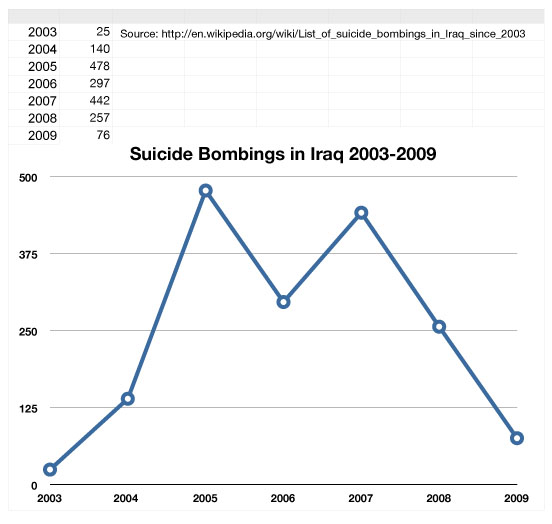
There have been more than 1700 suicide bombings in Iraq, many involving more than one bomber. This extraordinary statistic, which is symbolic of the violence perpetuated by Sunni extremists and is unprecedented in the history of the world, does not receive mention in Nir Rosen’s “ugly peace” analysis. Instead Mr. Rosen highlighted the crimes of the Shia militias and ignored the mostly one-sided sectarian violence aimed at Iraq’s Shia before 2006.
My uncles who lived most of their lives in Amriya, a neighborhood of western Baghdad, were expelled from their homes in the summer of 2005. From my perspective, it was Sunni extremists who began expelling Shias from their homes in Sunni-dominated neighborhoods and even turned Amriya, which according to Columbia University had a Shia majority in 2003 (I will call it “mixed” in 2003), into a Sunni majority district by 2006.
Maybe I should not be so critical of Nir Rosen, who is an excellent journalist and with “Ugly Peace” he has shed some light on the sectarianism that is the root of Iraq’s political problems. It’s just sad for me, as a liberal Iraqi American, to see liberal journalists seemingly taking sides and ignoring history.
Nir Rosen is not the only one who seems to be biased. Even in the documentary “Understanding the Surge”, which I posted last week, it is suggested that Iraq’s Sunni Arabs turned to Al Qaeda because Shia militias were expelling Sunnis from their homes, implying that Sunni Arabs allied themselves with AQI in 2006, after the Samarra bombing. Sunni militia actually began joining forces with AQI in 2004, after Saddam was captured, when it became clear that the US was determined to prevent hardcore Baathists from regaining power and to ensure a democratic government was established in Baghdad.
People who insist that Baathists, being secular, could not possibly ally themselves with Salafi (fundamentalist) groups should remember Saddam’s alliance with Saudi Arabia in the 80s and they should understand that hardcore Baathists would do anything to gain and retain power. Saddam and his cronies were experts at manipulating Islam for political gain. They called their attempt to exterminate Iraq’s Kurds the “Anfal”, a Qur’anic term that refers to the spoils of war belonging to Allah and his messengers. Saddam and his henchmen played God and the Wahhabi Arabs supported them in the 80s, so why would one be surprised by an alliance between Baathists and Salafi groups today? In the 1980s Saddam's regime also expelled tens of thousands of Iraqi Shia - today this is known as "ethnic cleansing", so they already had experience in that area too. Some might even dare to call it "sectarian violence". But in the eyes of many journalists, it seems that "sectarian violence" happens only when Shia militias attack innocent Sunnis.

Rosen did offer this bit of truth about the pre-2006 violence aimed at Shia, quoting an Iraqi Army Captain who commented on the security situation in 2004:
“At the time,” he told me, “there was only al Qaeda, not the Mahdi Army. We confiscated a lot of weapons and car bombs. This was before the sectarianism started.”
I should thank Rosen for quoting the Iraqi Army Captain who said there was only Al Qaeda in 2004 and no JAM. He also mentioned Baathist oppression, but he does not mention the expulsion of Shias from Sunni neighborhoods before the spike in sectarian violence of 2006. Perhaps he did not know about the expulsion of Shias from Sunni neighborhoods before 2006, or maybe I'm taking this too personally, or maybe with “Ugly Peace” he wanted to focus only on the sectarianism in Washash. Maybe Part 2 of "Ugly Peace" will be different from Part 1.
Rosen also quoted another Iraqi who said this: “most Sunnis supported al Qaeda and turned on them because of pressure from the government.”
So Rosen did offer bits of truth about the violence aimed at Shia before the Samarra bombing, but in the entire article he did not elaborate on the violence directed at Shia except to quote an Iraqi who said that there was only AQI in 2004. What did AQI do in 2004? What did Saddam's ousted leaders do? I suppose it is not worth mentioning or researching, or it would have made the article too long to read.
Many journalists’ accounts of recent history in Iraq read as if Iraqi Baathists were fighting a legitimate war against occupation, as if Baathists did not engage in sectarian violence against Iraqis. It is as if Rosen is afraid or unwilling to put Iraq’s Sunni Arabs in a bad light. The people who expelled my Shia relatives from Amriya in 2005 may not have been Iraqi, but the people who committed those crimes could not have known where the Shia lived in Amriya if they had not received help from locals, from Iraqis.
It seems that this Wikepedia entry, also the source for the numbers of suicide bombings since 2003, has it right:
‘A 2005 Human Rights Watch report analysed the insurgency in Iraq and highlighted, "The groups that are most responsible for the abuse, namely al-Qaeda in Iraq and its allies, Ansar al-Sunna and the Islamic State of Iraq, have all targeted civilians for abductions and executions. The first two groups have repeatedly boasted about massive car bombs and suicide bombs in mosques, markets, bus stations and other civilian areas. Such acts are war crimes and in some cases may constitute crimes against humanity, which are defined as serious crimes committed as part of a widespread or systematic attack against a civilian population."[2]
A 2008 RAND Research Brief Counterinsurgency in Iraq: 2003 - 2006 depicts a chart that shows in June and July 2004, Iraqi insurgents began to shift their focus away from attacking U.S. and coalition forces with roadside bombs and instead began targeting the Iraqi population with suicide bombers and vehicle-borne IEDs. By increasing the number of suicide bombings against civilians and accepting their targeting in retribution, the insurgents sought to expose the weakness of the coalition-Iraqi security and reconstruction apparatus, threaten those who collaborated with the government, generate funds and propaganda, and increasingly enact sectarian revenge. The U.S. failure to adapt to this shift had dramatic consequences. By June 2004, U.S. deaths represented less than 10% of overall deaths on the battlefield and Iraqi deaths represented more than 90% - a figure that remained constant for the next 18 months of the War.’
From my perspective based on my experiences and what I have heard and read, the truth about Iraq that most people seem to avoid is the fact that Iraq has been in a state of ethnic and sectarian conflict since 1980. There was a relative peace after the end of the war with Iran 1988, but it lasted only two years. The Arabs don’t like talking about it, but in general the Arabs have seen Iran as an enemy for decades, and Saddam used Iraq to fight that war that Sunni Arab states supported financially. That war with Iran, which Saddam always saw as an extension of the ancient war between Mesopotamia and Persia, continues today.
The war of 1991 and the following Shia rebellion against the dictator resulted in the deaths of hundreds of thousands of Iraqis. Approximately half of my relatives fled Iraq in the 80s and 90s. Journalists did not seem as concerned about those Iraqi refugees. In 2003, after the Liberation, two more of my relatives left Iraq because they finally could without risk of harm to their families. Many Iraqi Shia fled Iraq after 2003, even after they “won”.
There have been 76 suicide bombings in Iraq this year. I consider that to be sectarian violence. Sunni extremists continue to attack the Iraqi government and its security forces, even attacking police in Sunni towns, but primarily targeting the Shia-led government.
Discussing last month's bombings of three Shia-dominated Ministries,
'The top U.S. commander in Iraq, Gen. Ray Odierno, told a news conference last week that he believed a number of insurgent groups, including Baathists and al-Qaida in Iraq, were behind the bombings.
"This is a very complex issue. It's not black and white," he said.'
I would not call the situation in Iraq an “ugly peace”. It is no peace at all. Iraq has been in sectarian conflict since 1980, and the sectarian conflict continues, even as democracy sprouts in Iraq.
The criminal actions of AQI and the Baathists who supported them have shown that democracy and security in Iraq are very difficult to achieve. The hardcore Baathists will always attack the Iraqi government until they become the government. Baathists used violence to gain power in the first place, and they used violence to retain power for three decades.
Even as some of Iraq’s Sunni Arabs continue to support violent attacks against the Iraqi government and security forces, many Iraqi Sunni Arabs are participating in government, showing off their political strength. Tareq al Hashemi, one of Iraq’s Vice Presidents, has vetoed the recently passed election law, which the Iraqi parliament had been arguing about for weeks, because he said it does not include enough parliamentary seats for Sunni Arab refugees. This would be like a Shia VP of Saudi Arabia vetoing an election law because he believes it does not provide enough seats in the Saudi parliament for Saudi Shia (there are no elections and no Shia ‘VP’ in KSA). Like in war, in politics Iraq’s Sunni Arabs are playing hardball.
Even in a state of war, Iraq seems to be more democratic than most Arab countries. And Iraqis want better. Most Iraqis I know are tired of Maliki’s government, and they want to see big changes. I hope Iraqis will vote secular this time, and I hope the outcome of the election will result in true peace in Iraq, not just an “ugly peace”.
Iraqis must resolve their differences, and when they do so, hopefully they will also bring peace, justice, and prosperity to all of Iraq’s districts. Iraqis are making progress towards reconciliation without government efforts. One of my uncles who was expelled from his home in Amriya in 2005 was able to visit that house a few weeks ago and he found living in it a Sunni family, who graciously agreed to pay rent to my uncle. I have also read about Shia families being invited back to Adhamiya. I think that getting the history right, as difficult as it may be, may also contribute to the healing.
The Shia did not “win” in Iraq by expelling Sunni Arabs from Basra and Baghdad. The Shia sorta won by establishing a democracy, or at least a semblance of one, with the help of Americans. Clearly there are hurdles to overcome, and Baghdad is more segregated along sectarian lines than ever before. But there are still large numbers of Sunni Arabs in Baghdad, and it seems the Shia militias' "cleansing" and killing of innocent Sunni Arabs ended many months ago. Iraq’s Shia, after all their struggles, have not won a huge victory, and they will not be victorious until all of Iraq is truly peaceful, like it was before 1980. Real democracy in Iraq, and therefore victory, will be realized when power is passed peacefully from Nouri al Maliki to an Iraqi who will end the era of corruption and sectarianism and lead Iraq to a real peace.
Subscribe to:
Posts
(
Atom
)