Showing posts sorted by relevance for query 1991. Sort by date Show all posts

Thursday, November 30, 2006

The Ghosts of 1991

In 1991, after the US and its allies bombed Iraq for 41 days and nights with a total of 88,000 tons of bombs, equivalent to seven Hiroshima-size atomic bombs, after the Iraqi Republican Guard was defeated and expelled from Kuwait*, Bush urged Iraqis to rise up and overthrow Saddam's regime. The Shia of Iraq responded with an intifadha, and within days Saddam's regime lost control of the Shia areas of Iraq. Until the Shia uprising, Saddam's helicopters were easily shot down by allied forces, if Iraqi pilots dared fly them at all, but for some reason during the Shia uprising, General Norman Schwarzkopf allowed Saddam's generals to fly their helicopters, which they used to strafe Shia rebels on the ground and crush the uprising. Bush Senior ordered US troops not to intervene. Had US troops intervened, had Schwarzkopf not allowed Saddam's generals to fly their helicopters, Saddam's regime would have been overthrown in 1991, and sanctions would have ended immediately, and Usama bin Laden would have one less reason to hate the US. More importantly, Iraq would have been free. Al Qaeda and fedayeen Saddam did not exist in 1991. Saddam's regime was already in a weak position during the uprising. Democracy in Iraq would have taken shape with much less mayhem than we've seen in the last three years. This war would have been totally unnecessary.

Below is an article written by Peter Galbraith, published in the Washington Post in April, 2003. Galbraith was in rebel-held Iraq during the 1991 uprising, and in this article he explains much better than I can how the US betrayed the Iraqi Shia in 1991.

*Updated 12/29/09: Turns out Saddam kept most of his Republican Guards out of Kuwait.

The Ghosts of 1991

By Peter W. Galbraith

Saturday, April 12, 2003; Page A19

'Can it be that the events of 2003 in Iraq have finally dispelled the ghosts of 1991? The answer may not be quite as obvious as the welcoming throngs make it seem.

Just 12 years ago, the Shiite Muslims who constitute a majority in Iraq and in the city of Baghdad were betrayed by the United States -- an act that may have cost them as many as 100,000 lives [and many thousands more in following years]. That recent history -- of which the Shiites are understandably a good deal less forgetful than we -- explains why the Shiites in the south initially greeted invading American and British forces with a good deal more reserve than expected. And as the continuing turmoil in southern towns and cities makes clear, building a democratic state in Iraq over the long term will depend to a large degree on how strong and lasting a trust we can build among these people.

The spontaneous Shiite uprising of 1991 consumed the southern part of Iraq right up to the approaches to Baghdad. Rebels came to U.S. troops, who were then deployed in the Euphrates Valley, begging for U.S. intervention. The Shiite political parties sent emissaries to the few Americans who would see them. To this day, I am haunted by the desperation in the appeals made to me by one group, as they realized time was running out for their countrymen.

Many of the problems we face now and in the future with Shiites likely have to do with the way the first Bush administration responded to those appeals. On Feb. 15, 1991, President George H.W. Bush called on the Iraqi military and people to overthrow Saddam Hussein. On March 3, an Iraqi tank commander returning from Kuwait fired a shell through one of the portraits of Hussein in Basra's main square, igniting the southern uprising. A week later, Kurdish rebels ended Hussein's control over much of the north.

But although Bush had called for the rebellion, his administration was caught unprepared when it happened. The administration knew little about those in the Iraqi opposition because, as a matter of policy, it refused to talk to them. Policymakers tended to see Iraq's main ethnic groups in caricature: The Shiites were feared as pro-Iranian and the Kurds as anti-Turkish. Indeed, the U.S. administration seemed to prefer the continuation of the Baath regime (albeit without Hussein) to the success of the rebellion. As one National Security Council official told me at the time: "Our policy is to get rid of Saddam, not his regime."

The practical expression of this policy came in the decisions made by the military on the ground. U.S. commanders spurned the rebels' plea for help. The United States allowed Iraq to send Republican Guard units into southern cities and to fly helicopter gunships. (This in spite of a ban on flights, articulated by Gen. Norman Schwarzkopf with considerable swagger: "You fly, you die.") The consequences were devastating. Hussein's forces leveled the historical centers of the Shiite towns, bombarded sacred Shiite shrines and executed thousands on the spot. By some estimates, 100,000 people died in reprisal killings between March and September. Many of these atrocities were committed in proximity to American troops, who were under orders not to intervene.

In recent years Baghdad has shortchanged the south in the distribution of food and medicine, contributing to severe malnutrition among vulnerable populations. Some 100 Shiite clerics have been murdered, including four senior ayatollahs. Draining the marshes displaced 400,000 Marsh Arabs, destroying a culture that is one of the world's oldest, as well as causing immeasurable ecological damage.

The first Bush administration's decision to abandon the March uprising was a mistake of historic proportions. With U.S. help, or even neutrality, the March uprising could have succeeded, thus avoiding the need for a second costly war. (Bush's defenders insist the United States had no mandate to carry the war to Baghdad, but this is beside the point. The uprising started after the Gulf War ended, and the United States was positioned to easily down Iraqi helicopters and halt Iraqi tanks.)

The current President Bush cannot escape these ghosts. An American may understand what happened in 1991 as carelessness -- inexcusable but not malicious. An Iraqi Shiite saw a superpower that called for a rebellion and then ensured its failure. Naturally, he assumed this was intentional. In the months and years to come, many Shiites may take a lot of convincing about U.S. motives and reliability.

President George W. Bush has done much right that his father did wrong. His administration has been in constant contact with the Iraqi opposition. Humanitarian supplies are being rushed to southern Iraq, and clear warnings were issued against those who might have committed atrocities in the first days of the invasion. Unfortunately, the president carries a national and family legacy that many Iraqis associate with deadly betrayal. Overcoming that legacy has only begun. It is one of the critical challenges that lie ahead.'

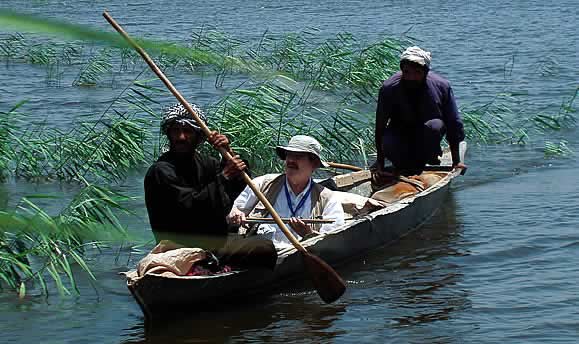
Marsh Arabs


Wednesday, August 22, 2007

Torture and murder by Saddam's regime

From what I have read, it appears that prosecutors are concentrating on crimes committed by the regime after the 1991 war in Kuwait.  Many Iraqis were tortured and murdered before 1991.  I was not in Iraq in 1991, but I have read reports that claim that 100,000 Iraqis were murdered by the regime during the 1991 uprising. 

Saddam aides accused of torture
A Shia woman from Baghdad holds a photo of her son, who was killed in the 1991 Shia uprising (21 August 2007)
The 1991 Shia uprising was swiftly crushed by government forces
An Iraqi ex-MP testifying at the trial of 15 aides of Saddam Hussein accused of crimes against humanity has said he was falsely imprisoned for months.

Kamil Abu al-Hail said he had been held at a prison in Baghdad where hundreds were beaten and tortured daily.

The defendants, including the cousin of Saddam Hussein, Ali Hassan al-Majid, are alleged to have helped suppress a Shia uprising after the 1991 Gulf War.

Tens of thousands are thought to have died in the short-lived rebellion.

In recent years, mass graves containing hundreds of bodies have been uncovered.

'Soaked with blood'

Mr Abu al-Hail was the third witness to testify against the 15 former senior military and Baath Party figures who are accused of engaging in widespread or systematic attacks against Iraq's civilian population.

DEFENDANTS
Ali Hassan al-Majid
Sultan Hashim al-Tai
Hussein Rashid al-Tikriti
Abd Hamid Mahmoud al-Nasseri
Ibrahim Abdul Sattar al-Dahan
Walid Hamid Tawfik al-Nasseri
Iyad Fatiya al-Rawi
Sabawi Ibrahim al-Hassan
Abdul Ghafour Fulayih al-Ani
Ayad Taha Shihab al-Douri
Latif Maal Hamoud al-Sabawi
Qais Abdul Razzaq al-Adhami
Sabir Abdul Aziz al-Douri
Saadi Tuma Abbas al-Jabouri
Sufyan Maher al-Ghairiri

The 76-year-old former Shia MP said he had been arrested after arriving in Baghdad to attend a parliamentary session in the aftermath of the uprising and taken to the nearby al-Radwaniya prison.

He told the court that Iraqi soldiers used to bring hundreds of people every day to the jail for interrogation and punishment.

"I heard screams of pain as prisoners were beaten and tortured," he said.

"At the end of the day, I could see people being carried out on blankets soaked with blood. They could not walk because of the harsh torture."

Mr Abu al-Hail said he was imprisoned even though he had not participated in the uprising. He was released several months later after receiving a presidential pardon, but said his life was destroyed.

"I was dismissed from the parliament. My cotton factory and my house were destroyed by the shelling from the army," he added.

'Ugliest crime'

In his opening statement at the start of the trial on Tuesday, the chief prosecutor accused the defendants of "one of the ugliest crimes ever committed against humanity in modern history".

The Shaaban Intifada (Uprising) started in March 1991 as defeated Iraqi troops fled back to southern Iraq after US-led forces took control of Kuwait.

Galvanised by a message by US President George Bush to "take matters into their own hands", Iraqi Shia rose in revolt in an attempt to topple Saddam Hussein.

But despite briefly seizing control of 14 of the country's provinces, opposition forces were swiftly crushed and mass reprisals followed.

Many Shia blame the US for the uprising's failure, as it came to a ceasefire agreement with the Iraqi government and did not intervene.

Ali Hassan al-Majid, who directed Baghdad's response to the rebellion, and two more of the defendants, Sultan Hashim al-Tai and Hussein Rashid al-Tikriti, have already been sentenced to death following an earlier trial for genocide against Iraq's Kurdish population.

Sunday, March 23, 2008

Hell no we won't surrender

Sometimes I feel like I should start a post by reminding people that I was born in Iraq, but I spent most of my life in the US. I am Americanized for sure, but I still care a great deal about Iraq, always have. Many of my feelings towards George (Dubya) Bush are conflicted. I had conflicted feelings about the war, before it was launched. I knew innocent people would die, like in 1991. But when I saw George Bush get on TV in 2003 and say to the world that Saddam and his filthy sons had 48 hours to leave Iraq, I felt great happiness. I thought "FINALLY" somebody powerful stepped up and did the right thing. George Bush is the cowboy who brought the end to the Arab Stalin, the unelected leader of a regime that mass murdered Iraqis before its fall and continued to murder Iraqis after the liberation.

Mine is an Iraqi American's perspective. I care about all the middle east, all of humanity, actually. So does Fouad Ajami, another Arab American. I have written about Fouad Ajami and posted his articles before. I cannot hide my admiration for this man, who is hated by many Arabs for his unwavering support for George Bush and the war against the terrorists and tyrants of the middle east. Mr. Ajami has always written about Saddam's horrors. I find it interesting that Ajami could not gain tenure at Princeton in the early 70s, maybe because he "made for himself there as a vocal supporter of Palestinian self-determination." Today he's a strong supporter of the war and George Bush. I suspect there are many Bush supporters who also support Palestinian self-determination and statehood. I believe President Bush advocates Palestinian statehood. Ajami's recent article No Surrender is another good one, although I do not necessarily agree that "Baghdad was the proper return address" in response to 9/11. Riyadh was the proper return address for 9/11. The US military was in Iraq in 1991, I'm sure Mr. Ajami remembers well, and he might agree that 1991 was the proper time to overthrow Saddam's murderous regime. In March 1991 the US and its allies (including Saudi Arabia) had already bombed Iraq (for 40 consecutive days and nights) and drove Saddam's army out of Kuwait. US troops were 50 miles from Baghdad when they were ordered to retreat. That was after the coalition bombing and destruction, right before the uprising. It took 9/11 for the US to take down Saddam. We can discuss what should have been, but we cannot change the past - it is what it is, right or wrong. The US avoided occupation and mayhem by retreating in 1991. I have argued before that Iraqi peace and democracy would have been much easier to achieve in 1991 than in 2003. For Iraqis the difference between 1991 and 2003 was 12 years of miserable sanctions and more mass murder. Most Iraqis I know left Iraq in the 1990s.

In the spring of 1991 most American soldiers returned home (a few stayed in KSA and Kuwait) to participate in an economy that soon boomed after the war. Some Americans like Anthony Arnove became even more concerned about Iraq and wrote about the devastating sanctions, some people were angry about the conditions in Iraq throughout the 1990s, and even George Clooney starred in a movie that highlighted Iraqis' suffering (not enough, imo, but the movie wasn't about the suffering of Iraqis). Most Americans, however, didn't seem to care. Even when told that some 500,000 Iraqi children had died as a result of sanctions, Bill Clinton's Secretary of State said it was worth it. But removing Saddam's murderous regime, even if it results in the deaths of hundreds of thousands, is not worth it. OK. Bad water and lack of medicine kills innocent Iraqis, but it is a silent death. Few people noticed in the 90s. A few Americans wrote books and raised some awareness, and the mainstream media caught the Secretary of State saying something stupid once, but there was no Code Pink in the 1990s. I don't remember any non-Iraqi Arabs complaining about Iraqi women's rights back then. Two words can describe most Iraqis' experience during the decade of the 1990s: it sucked. It took a long time for a powerful nation to stand up to the tyrants of Iraq. Iraqis have paid in so many horrible ways, awaiting liberation and democracy. Iraqis continue to struggle. But Iraqis and Americans won't surrender. We won't allow terrorists, in the guise of Islam or Arab nationalism, to take Iraqis hostage again. Iraq will be free, and with the help of America. Get used to it. The result will be a peaceful and prosperous democracy in Iraq, free of tyranny and Islamic extremism, for the first time in decades.

Monday, December 14, 2009

Who is responsible for the violence in Iraq?

On her show tonight, Rachel Maddow said Tony Blair "would have advocated war against Iraq even if he had known there were no weapons of mass destruction there," but in the interview Blair said "I would have still thought it right to remove him..."  So is arguing for Saddam's removal the same thing as advocating a war against Iraq?

I don't think it was Blair's intention to see the deaths of so many Iraqi civilians.  Blair and Bush wanted to remove a dictator from power; they did not intend to cause the sectarian war that followed the invasion.  If we can blame all the carnage that took place after the 2003 invasion on Tony Blair and George W. Bush, we can also blame George HW Bush and John Major for the deaths of Iraqis that resulted from the 1991 invasion.

If Tony Blair can be held responsible for the crimes of Saddamists and Salafi slime, the same logic can be used to try John Major for war crimes, because the 1991 invasion of Iraq also resulted in the deaths of hundreds of thousands of Iraqis.  I'm sure John Major did not intend to cause Saddam's Republican Guards to mass murder Iraqis in 1991, but the mass murder of Iraqis nevertheless happened as a result of the 1991 invasion of Iraq. Yet nobody demanded that John Major be tried as a war criminal after the 1991 invasion of Iraq.

Was the 1991 invasion of Iraq acceptable because Saddam was not removed?  Judging by how differently the Arabs and media reacted to each war, that appears to be the case.

I find the people who insist that we must punish George Bush and Tony Blair without punishing the Arab terrorists who are directly responsible for crimes against Iraqis to be naive.  On the NYT's At War blog, an Iraqi wrote a post titled 'I Have No Living Friends in Iraq Now' in which he discusses the death of his father and his ex-girlfriend.  The first comment was from a "Jim" in Austin, and it has been recommended by 15 readers: 

You can thank Bush, Cheney, and Rumsfield for killing your family and friends. If these three rulers were from any country but the US, they would be at the Hague facing charges of genocide. As an American, I apoligize for these individuals for the tragedy they brought to your country.

The Iraqi "can thank Bush, Cheney and Rumsfeld" for killing his family and friends.  I wonder if "Jim" realizes how insensitive his comment may seem to Iraqis.  I hated the Arabs who said that every bombing and shooting in Iraq is the responsibility of America and said nothing about the Arabs who actually committed the crimes. This kind of talk no doubt encouraged the Arab "resistance" to mass murder more Iraqis, and that made me very angry.  To see Americans saying the same thing is quite disheartening.  

Thursday, October 07, 2010

1991 Gulf War oil spill largest in history?

This article claims that the 1991 Gulf War oil spill is the largest in history: "The Gulf War oil spill, when Saddam Hussein intentionally spilled oil into the Persian Gulf, resulted in anywhere from 240 million to 460 million gallons of crude oil poured into the Gulf. It remains the world’s largest oil spill today."

I was surprised to see that today because just a few weeks ago, while writing the post Humans can be quite stupid, I read this Wikipedia article, which at the time listed the Gulf War oil spill as the third largest in history. The list of the largest oil spills in that Wiki entry has since been updated to include "Kuwaiti oil fires" and "Kuwaiti oil lakes". The Wiki article claims that an incredible 42-63 BILLION gallons of oil were burned in 1991, and a further 1-2 billion gallons of oil were spilled from sabotaged fields in Kuwait that year. One billion gallons is more than five times the amount of oil spilled as a result of the Deepwater Horizon explosion.

Until now I did not know that so much oil was burned in 1991 (more than 200 times the amount spilled by Deepwater Horizon), and I did not know that Saddam's saboteurs discharged millions of barrels of oil directly into the Persian Gulf. The burning of dozens of billions of gallons of oil may not be considered a spill by some, but it's definitely a waste and a huge spike in emissions of carbon dioxide and other pollutants into the atmosphere. Those environmentally damaging acts of sabotage alone should have been reason enough to overthrow Saddam in 1991.

Sunday, October 23, 2011

Sadr considers US embassy staff in Baghdad as "occupiers"

'In response to a question from one of his followers, Sadr now says that after the expiration of the SOFA, the staff of the embassy should be considered “occupiers” and must be “resisted”. '

On one hand I see Muqtada al Sadr as an ungrateful fundamentalist majnoon. His opposition to the US does not make sense, given that the US overthrew the dictator who murdered his father and his two oldest brothers in 1999.

On the other hand I can understand why Muqtada al Sadr and his followers would distrust the US, given that the US could have overthrown the dictator in 1991 after bombing Iraq for 40 consecutive days and marching to the outskirts of Baghdad. By the 29th day of the 1991 bombing, the "Allied air campaign passes 40,000-sortie mark - 10,000 more missions than were flown against Japan in final 14 months of World War II."

Based on comments by Americans for posts about 1991, some Americans seem to think the Iraqis should not be angry or bitter about what the US should have done differently in 1991. Some think Iraqis should blame the Saudis, who were afraid of Iran taking over. So did the US allow Saddam to fly his helicopters because the Saudis did not want to see the Shia take over Iraq? Did KSA & USA have common interests? Or was KSA in charge? Is America KSA's bitch? It seems that way, especially when you consider that KSA was not punished for 9/11. The friendship seemed to flourish, actually.

For Americans and Saudis, 1991 turned out to be a good year. They got it all: a short war with relatively little casualties, KSA paid for the war and Sunni Arab domination of Iraq continued. Few Americans and Arabs were interested in helping Iraqis overthrow the Saddam.

Despite the bad things that happened and the mistakes, I would say the average Iraqi does not agree with Muqtada al Sadr and would like to see normal relations with the US. Iraq needs international assistance to develop into a prosperous nation.

Friday, February 25, 2011

Could the Iraqi people have overthrown Saddam?

'The Tunisian and Egyptian uprisings succeeded because the military forces of those countries refused to protect the regimes by cracking down on their own countrymen. The Egyptian military's self-image is that of a force that protects the nation and the people, not Hosni Mubarak. Yes, many top officers were his cronies, but when the push came to shove, their loyalty to the state was greater than their loyalty to the regime. The same was true in Tunisia.

Saddam, on the other hand, could always count on two armed groups whose ONLY reason for being was their loyalty to him: the Republican Guard, and the paramilitary Fedayeen Saddam. As they showed while putting down the Shi'ite uprising after the Kuwait war, these forces were perfectly happy to kill tens of thousands of Iraqis on his orders.'

Read more: http://globalspin.blogs.time.com/2011/02/23/could-the-arab-revolution-have-removed-saddam/#ixzz1ExhllkU2

Thanks RhusLancia for posting over at Zeyad's Healing Iraq.

Fedayeen Saddam were not formed until after 1991. Otherwise Bobby Ghosh is right. Fedayeen was just another tool Saddam & Sons used to control Iraqis. Saddam was stronger in 2003 than he was in 1991.

I asked my my mom a couple of weeks ago if she thought Saddam would have fallen as easily as Mubarak. She said maybe not as easily, but she thinks eventually he would have fallen. I didn't have time to talk about 1991, but I disagree with her. Saddam had already brutally put down a major uprising in 1991 and he had a firm grip on Iraq in 2003. Saddam might have been overthrown if Iraq's Sunni Arabs, including his Republican Guard and Fedayeen, had been united with the Shia and Kurds to overthrow Saddam.

Tuesday, December 01, 2009

USA negligent in Iraqi deaths since 1980s

PS (Dec 2): If the 100,000 "excess deaths" in Iraq since 2003 can be blamed entirely on the US, so can deaths resulting from US support for Saddam during the 80s and the US failure in 1991 to help the Iraqi Shia who wanted very badly to see Saddam's murderous regime overthrown. UN sanctions, which Clinton continued to enforce, caused much suffering among ordinary Iraqis while Saddam built palaces.

I commented on a post entitled "Why they hate us (II): How many Muslims has the U.S. killed in the past 30 years?" on the Palestinian Pundit, and I think my comment is worth posting here:

'According to the UN, sanctions actually resulted in the deaths of 500,000 Iraqis by 1998, and I remember Secretary of State Madeline Albright on 60 Minutes saying the price was worth it.'

Albright's 60 Minutes interview took place in 1996, not 1998:


My comment continued:

'I think it's also worth mentioning US support of Saddam's murderous regime in the 80s and the war between Iraq and Iran, which resulted in the deaths of a million Muslims. Turns out the US was supporting both sides.

Furthermore, the Shia rebellion in 1991 was brutally put down, and one of Saddam's guys admitted the regime killed 300,000 Shia (Muslims) in April, 1991 alone. They did this as US soldiers stood not far away - Bush apparently gave the order not to intervene, as his Saudi buddies did not want the Shia to take over Iraq. I consider the US to be partially negligent in the mass murders committed by Saddam's regime, and I think the real numbers are much larger.'

In a second comment I also posted a link to this video, which I've posted before and watched again today, only to be angered again:


I'm glad the US overthrew Saddam's murderous regime, but it shoulda happened in 1991.

Tuesday, December 08, 2009

Comparing troop levels to 1991 war

At the height of the current conflict in Iraq, US troops totaled around 150,000 with at least 100,000 private security contractors, for a total of 250,000 US personnel. Add that to non-US coalition members, who all together numbered around 50,000.* 300,000 was the largest number of people the MNF could commit to Iraq, even though in 1990 the US was able to amass more than twice as many American soldiers and many more Arab members of the coalition.

Yes I do believe the overthrow of Saddam's murderous regime and democracy in Iraq would have been much easier to achieve in 1991, given what had already happened by March of that terrible year, and considering the consequences of allowing Saddam to maintain power after 1991.

*Numbers are approximate.

PS: There was no Al Qaeda in 1991. In 1990 "Bin Laden offered the services of his mujahedeen to King Fahd to protect Saudi Arabia from the Iraqi army."

In 1990, "The United States assembled a coalition of forces to join it in opposing Iraq's aggression, consisting of forces from 34 countries: Argentina, Australia, Bahrain, Bangladesh, Belgium, Canada, Denmark, Egypt, France, Greece, Italy, Kuwait, Morocco, The Netherlands, New Zealand, Niger, Norway, Oman, Pakistan, Philippines, Portugal, Qatar, South Korea, Saudi Arabia, Senegal, Sierra Leone, Singapore, Spain, Syria, the United Arab Emirates, the United Kingdom and the United States itself.

Although they did not contribute any forces, Japan and Germany made financial contributions totaling $10 billion and $6.6 billion respectively. US troops represented 73% of the coalition’s 956,600 troops in Iraq.

Many of the coalition forces were reluctant to join. Some felt that the war was an internal Arab affair, or did not want to increase US influence in the Middle East. In the end, however, many nations were persuaded by Iraq’s belligerence towards other Arab states, offers of economic aid or debt forgiveness, and threats to withhold aid."

Tuesday, March 01, 2011

CNN reporter told a lie today

At about 45 seconds into the clip below the reporter (Chris Lawrence) discusses the possibility of a no-fly zone over Libya, and the guy says that it may not necessarily help, that the no-fly zone in Iraq did not prevent Saddam from mass murdering Shia in the south and putting down the 1991 uprising. The problem with this theory is that the US did not enforce a no-fly zone in southern Iraq until August, 1992, 17 months after the uprising began, long after the mass murder had taken place. In fact the US military ALLOWED Saddam to fly helicopters during the uprising: 'at the Safwan negotiations, Schwarzkopf carelessly authorized the Iraqis to use helicopter gunships on their side of the cease-fire line. The Iraqi generals were so surprised by that concession—which permitted them to strafe and rocket Kurds and Shiites from the air—that one of the Iraqi generals incredulously asked: "So you mean even the helicopters that are armed can fly in the Iraqi skies?"'

Also the reporter says that US troops were not in Iraq during the 1991 uprising. Wrong again, Chris. US troops had been all over southern Iraq and Kuwait in March 1991, it has been well documented. The uprising began on March 1 (some sources say March 2nd and 3rd) but half a million US troops only began to leave the area on March 10: "On 10 March 1991, 540,000 American troops began to move out of the Persian Gulf."

Also: 'U.S. State Department spokesman Richard Boucher explained the next day on March 6: "We don't think that outside powers should be interfering in the internal affairs of Iraq." Consequently, U.S. occupation forces in Iraq stationed a few miles from Nasiriyah, Samawa, and Basra did nothing to help the anti-Saddam rebels.'

And: "The emboldened rebels wanted to move on Baghdad. They asked for support from the allied forces, still on the ground in southern Iraq, but were rebuffed."


I don't know if the lie was intentional. Maybe he just doesn't have the facts. Hope he does now!

Friday, March 11, 2011

Hillary Clinton says no-fly zone over Iraq didn't bring down Saddam

At two minutes into the clip below, Hillary Clinton said "we had a no-fly zone over Iraq. It did not prevent Saddam Hussein from slaughtering people on the ground and it did not get him out of office."

CNN reporter Chris Lawrence, NBC reporter Richard Engel, and now Secretary of State Hillary Clinton implied that there was a no-fly zone over Iraq during the 1991 uprising. All seem to be unaware that a no-fly zone over southern Iraq was enforced 17 months after the uprisings began in March, 1991. Mr. Engel said the no-fly zone in Iraq did "not apply" to low-flying helicopters. In fact the US allowed Saddam's peeps to fly helicopters during the uprising:

at the Safwan negotiations, Schwarzkopf carelessly authorized the Iraqis to use helicopter gunships on their side of the cease-fire line. The Iraqi generals were so surprised by that concession—which permitted them to strafe and rocket Kurds and Shiites from the air—that one of the Iraqi generals incredulously asked: "So you mean even the helicopters that are armed can fly in the Iraqi skies?"

It's interesting when smart people don't get the facts right, or make comparisons that don't work. The US dropped 250,000 bombs and missles on Iraq during 40 consecutive days and nights in 1991. The first thing US & allied pilots did was to destroy Saddam's SAMs and radar installations. They made sure American pilots could fly planes and helicopters over Kuwait and Iraq without being fired on, and then US troops marched into Kuwait and Iraq, almost all the way to Baghdad. Kuwait was liberated and the cease-fire with Saddam was signed on Feb. 28. Then the uprisings began and the rebels were slaughtered by Saddam's helicopter gunships. I guess Richard Engel's statement (of the three mentioned here) comes closest to the truth: the no-fly zone "did not apply" to low-flying helicopters. LOL!

If there was a real no-fly zone over Iraq during the 1991 uprisings, one that "included" low-flying helicopters, the uprising might have succeeded.

Saturday, June 27, 2009

There was no Al Qaeda in 1991

I just read the below review of Richard Haass's new book by a Geoffrey Wheatcroft, who suggests that the violence seen in Iraq since 2003 would have happened in 1991 if US troops had entered Baghdad and overthrown Saddam's murderous regime. How does he know this? There was no Al Qaeda in 1991. In fact Usama bin Ladin volunteered to assemble an army of mujahideen to fight Saddam's forces. There would have been no sectarian conflict ignited by the Wahhabi scum. There were no Fedayeen Saddam either. Liberating Iraq would have been much easier in 1991. Easier for the US and its allies and much easier for Iraqis.

'Much of the ground Haass covers is all too familiar by now. He goes over the arguments that America should have pressed on to “liberate Iraq” and destroy Hussein the first time round. As he says, the truth is that “there was no interest in going to Baghdad.” Bush the Elder thought he had a deal with the rest of the world that he would break if he extended the war; American troops would have found themselves engaged in dangerous and difficult fighting in cities; and “we would have become an occupying force in a hostile land with no exit strategy.” It would be superfluous for Haass to add “as later happened under that president’s son.” '

I am amazed by the number of "pundits" who think they know what they're writing about.

Tuesday, August 28, 2007

1991 changed everything

'Despite all this the Shia remained generally loyal – that is, until 1991, when Shia soldiers returning from the first Gulf war in Kuwait sparked a riot in Basra that quickly spread north to Najaf. The Shia looked to the United States for support, interpreting President George H.W. Bush's call to the Iraqi people to overthrow Saddam to mean American intervention on their behalf. However, Saudi Arabia warned Washington in no uncertain terms that if Saddam were to fall from power, Iran would gain control of southern Iraq.  The House of Saud did not wish to see the Shia uprising against Saddam succeed. Riyadh saw the same threat in Shia empowerment in Iraq in 1991 that it sees today. It preferred to keep Iraq under a Sunni dictatorship rather than risk empowering the Shia. Influenced by their ally in the war, the United States balked at involvement in the uprising. U.S. forces stationed in the Euphrates Valley looked on as Saddam sent his dreaded Republican Guards to the south, armed with tanks and helicopter gunships to crush the rebellion.


Large parts of Shia towns were razed, the shrines in Najaf and Karbala were shelled, and tens of thousands of Shias were killed. Bodies were draped across the beams of the shrine of Husayn in Karbala. The brutality was merciless; as one Iraqi general said about a massacre of Shias in Hilla after the 1991 uprising, "We captured many people and separated them into three groups. The first group we were sure were made up of people who were guilty. The second group we had doubts about, and the third group was innocent. We telephoned the high command to ask what we should do with them. They said we should kill them all, and that's what we did." –Vali Nasr, The Shia Revival

Sunday, July 13, 2008

Sectarian violence in 1991

As my mother told me last night about her relatives who were killed in 1991, she reminded me of her uncle's wife Bumooni. Bumooni's mother was a beautiful Iranian woman who met the mayor of Najaf in Iran and eventually married him and moved to Najaf with him. Bumooni worked most of her adult life as a midwife in Najaf. My parents say she was very generous and she became famous among Najafis. In March 1991, as Saddam's forces besieged Najaf, Bumooni and her daughter took shelter in the Imam Ali Mosque. Saddam's henchmen attacked the mosque and gunned down almost everybody inside. Bumooni was shot in the abdomen. Her devastated daughter and a good samaritan carried Bumooni to her home, where she died.

In my post "No sectarian violence before 2003" I posted a documentary about the Shia uprising of 1991 and Saddam's subsequent attacks on Najaf and Kerbala.

Monday, July 07, 2008

Iraq's debt to Kuwait should be forgiven

Iraq's remainder of the UN-imposed $53 billion in compensation claims to Kuwait should be forgiven. Saddam Hussein made the decision to invade Kuwait. Most Iraqis did not want to go to war with Kuwait. I think it is ridiculous to force Iraq, a cash-poor war-torn country whose citizens suffered through 12 years of sanctions while Saddam got richer and stronger, to pay billions of dollars to Kuwait, an oil-rich country. Kuwait's population is just 3 million, and it was the 11th largest oil producer in the world in 2006. Kuwait was able to rebuild quickly after the 1991 war and produce 2 million barrels of oil a day by 1994 - in that article I found this interesting:

"The rebuilding phase is over," said Nader Sultan, the deputy chairman and managing director of the state-owned Kuwait Petroleum Corporation. "The new phase for the next five to 10 years is looking for growth markets."

Yet Kuwait's growth strategy has been influenced by the Gulf war. Twenty years after nationalizing its oil business and defiantly vowing to make its own way, Kuwait is once again looking to work closely with the West's big oil corporations. Pragmatism prevails in Kuwait these days, and that means viewing the oil companies as useful sources of capital, technology and skills. After the war, Kuwait also recognizes that there might be security benefits from partnerships with Western oil companies.

Architects and engineers are at work now on blue prints for a petrochemical plant costing nearly $2 billion that will be built and operated jointly with Union Carbide, and the Government has contracted with British Petroleum and Chevron for help with exploration, drilling and training of Kuwaiti technicians.


It made me wonder how many US troops have been in Kuwait since 1991. Certainly US troops were in Kuwait in large numbers prior to the invasion of Iraq. Yet we haven't heard of suicide bombings or market bombings in Kuwait City. No attacks on Kuwaiti security forces. Maybe this is the worst part: many insurgents who fight in Iraq grew up in Kuwait. It's like the Jordanian who lived all his life within 15 miles of the Palestinian border, and to fight the infidel invader (ostensibly) he travels hundreds of miles and ends up mass murdering Iraqis.

Furthermore, Iraq has suffered through cruel sanctions and another war since the war of 1991. The damage inflicted on Iraq since 1991 has been much greater than the damage inflicted on Kuwait during the six months it was occupied by Iraq. Iraq has already paid reparations totaling $19 billion by 2005. Iraq still owes about $28 billion. The UN should make the move (because Kuwait apparently won't) to forgive Iraq's debt to Kuwait. It is only fair, in my opinion, given that Saddam and his henchmen killed any Iraqi who refused to serve in their army. It seems wrong to impose this debt on Iraq.

PS: I just deleted this part of the post: "Kuwait's government won't even recognize Iraq's new government, yet they demand reparation payments from Iraq." Iraq and Kuwait restored diplomatic relations in 2004! Saudi Arabia, on the other hand, is still considering restoring diplomatic ties with Iraq.

Monday, June 22, 2009

Saddam did not have "license" to slaughter Iraqis

Initially I wanted to title this post "Should Obama be quiet about Iran?" But then I realized how stupid the below comment by a Mr Sadjapour is, and that I should point out his stupidity. He makes it sound like Saddam had a "license" to slaughter Iraqis, because according to his logic, the world did not criticize the slaughter in 1991. Does a government ever have a "license" to slaughter its people?

'But Mr Sadjapour says President Obama's measured message is the right one.

"I think the President's rhetoric so far has been well calibrated, and the historical analogy which concerns me is Iraq in 1991, when George Bush senior encouraged Iraqis to rise up. Saddam slaughtered them and then the rest of the world didn't criticise Saddam for the slaughter, but they criticised George Bush for encouraging Iraqis to speak out," Mr Sadjapour said.

"So I think this regime is looking for the United States to step into this trap, so they have the licence to slaughter the Iranian people." '

This is a silly analogy anyway, because when Bush Senior called for Iraqis to rise up in 1991, the US-led allied forces had already pounded Iraq with 40 consecutive days of heavy bombing and a ground invasion that stopped at the outskirts of Baghdad. Allied troops had already defeated Iraq's military and it was up to the Americans what Saddam's military could do. Bush ordered the US military to do nothing while the Iraqi Shia were slaughtered.

The US military is currently not in Iran and never has been. The analogy is a terrible one. At least Mr. Sadjapour acknowledged the slaughter by Saddam.

Maybe the important question is this: is Obama being too quiet about Iran?

Tuesday, June 08, 2010

Did my mom's aunt die as a result of sanctions?

I visited family over Memorial Day weekend and I saw my cousin who had horrible experiences in 1991, as did so many Iraqis. He's a successful engineer and he's been happy in America since the mid 90s, but in the 80s he was forced to work as an engineer for the Iraqi military. He was released from the military at the end of the Iran-Iraq war in 1988, only to be redrafted in August 1990, in anticipation of the impending war with America. He was sent to a casting factory in Baghdad where missiles and other equipment were manufactured.

I asked him more about the last few weeks he spent in Iraq, after sanctions had an immediate and devastating effect on the Iraqi economy and when Baghdadis got their first taste of American bombing. My cousin and a few other relatives, including my mother's aunt, had escaped the intense bombing of Baghdad in January 1991 and went to Najaf, which the US and allied air forces had pretty much left untouched. It was in Najaf where my mother's aunt's condition deteriorated and where she died. I had always thought she died in Baghdad and her body was taken to Najaf to be buried. Another thing I got wrong: she did not die because she did not have asthma medicine as I claimed in this post. I don't know how I got that one wrong, because it's crucial, and I thought she died of an asthma attack because she'd run out of asthma medicine. My mom's aunt DID have asthma medicine, my cousin clarified after I asked him a week ago. It had become very expensive as a result of sanctions, as were so many necessities, including food. My cousin said that a small amount of food was handed out by Saddam's government, but that it wasn't nearly enough to feed everybody. To have enough food Iraqis had to resort to the black market, on which food was 30 times as expensive as it was before sanctions were imposed, according to my cousin. The average Iraqi family could not afford the black market. My mom's aunt may have died as a result of poor nutrition, but she did not die because she did not have asthma medicine. Sanctions did cause malnutrition among Iraqis and may have contributed to my mom's aunt's deterioration in health, but I cannot blame her death directly on sanctions. Her body was buried in Najaf. Allah Yurhamha. She loved us kids and took care of us as much as she could, considering she was blind all her life.

Another aunt of my cousin's, on his father's side, also in Najaf, had kidney problems, and she also died in 1991. My cousins buried her body in the same Najaf cemetery, but this time it was during the uprising, when Najaf was engulfed in heavy fighting between Saddam's forces and Shia rebels. My cousins were caught in the middle of it, and they were very lucky to escape with their lives. After the burial my relatives, the same group that escaped Baghdad just weeks earlier, were looking for a way to get out of Najaf alive. They heard that a bus was leaving for Baghdad the next morning and found a hotel near the bus station and stayed there. My cousin asked the hotel owner where they could find some food. The hotel owner said the owner of the house next to the hotel has a small store in the back. There my cousin found only biscuits and juice, and that's what my relatives had for dinner that night. My cousin said that entire night was filled with the sound of machine guns and bombs. The next morning was calmer and so they got on the bus to Baghdad. Incredibly, the bus broke down just south of Baghdad, and this during the middle of a Shia uprising when Saddam's Republican Guard was hunting down Shia rebels in southern provinces. Anybody suspected of participating in the uprising was arrested and in most cases killed. A couple of hours passed when my cousin saw a bus heading north. He got in the middle of the road and waved his arms. The bus driver stopped and picked them up. The driver had driven to Diwaniya earlier that day, but was not allowed to enter and was returning to Baghdad. The driver said my relatives were very lucky because there were no other buses going to Baghdad. On the outskirts of Baghdad the bus was stopped by the military, who were looking for rebels. Luckily my cousin had his military ID, and with that they got through the checkpoint. My relatives got home and found something they'd been missing: food.

The next day my cousin felt that he needed to report to his military bosses. He went to the missile casting factory to find it had been flattened. A few days later he left for Amman. Over the next few weeks a stream of relatives followed him and eventually moved to the UK, where nearly half my relatives now live. My cousin was the first to arrive in Amman, but he was the last to leave. The British government did not give him a visa because they said he was in Saddam's military. So we worked on getting him to the US instead, and that's exactly what happened. My cousin is a brilliant engineer and now a great asset to an American medical device company.

Back to the main subject of my post: the death of my mother's aunt cannot be blamed directly on sanctions, but sanctions did have a negative impact on the health of millions of Iraqis. An embargo does not affect the rulers of the country being embargoed. It is always the poor and middle class who suffer. This was true in Iraq and it's true in Gaza today, I'm sure. Saddam built palaces while ordinary Iraqis starved. Read Iraq Under Siege to learn how sanctions impacted the lives of ordinary Iraqis.

Monday, March 07, 2011

Sulaymaniya liberated 20 years ago today

"The 1991 Uprising in As Sulaymaniyah or Silêmanî was one of biggest 1991 uprisings in Iraq. As Sulaymaniyah, a Kurdish city of over 100,000 population was the first Iraqi city to be captured by rebels and the last one to fall."

It's interesting to see the uprisings of 2011 happening 20 years after the Iraqi uprising of 1991. Hopefully this time the dictators actually fall, and the people will have real democracy and freedom.

Sunday, February 13, 2011

Why democracy in Iraq has been difficult

The other day on facebook my dear cousin lamented that Iraqis came close to overthrowing their dictator in 1991, and their struggle did not get as much coverage as Egypt has. I commented that there was no Al Jazeera in 1991, and even if there was, they would have taken Saddam's side. LOL, just kidding. All the Persian Gulf states were freaked out by Saddam's invasion of Kuwait, and I'm sure Qatar was too. There were no media at all during the uprising in southern Iraq in 1991, nobody showing the world what Saddam's Republican Guards were doing to Iraqis all over the south, while US troops stood nearby (they were ordered to). Saddam & Sons would stay on in Baghdad to imprison, torture, and murder Allah-knows how many more innocent Iraqis.

Sanctions were enforced immediately after Saddam's invasion of Kuwait and continued to make life miserable for all Iraqis, especially the poor, for another twelve years. During the sanctions era Islamic fundamentalism spread throughout Iraq. Vali Nasr: "The works of the Iraqi exile thinker Muhammad Ahmad al-Rashid on jihad and the Islamic state, which were smuggled from Egypt, gained a following, but more important, the tentacles of fundamentalist and Salafist trends popular elsewhere in the region began to penetrate the country."

During his rule, Saddam led Iraq into two disastrous wars and economic ruin. In 2003 many Iraqis were happy to see the end of Saddam's regime, but they wanted to end it themselves, as difficult as it might have been, and they certainly did not want to see yet another bombardment of their country. They had no choice in the matter, and Saddam and his gang of thugs would end up on trial for crimes against humanity. Iraqis were finally free. Democracy would flourish, so we thought.

Amnesty International summarized in a 2010 report the situation in Iraq since 2003:
Since 2003 armed groups opposed to the Iraqi government and the presence of US forces in the country have been responsible for gross human rights abuses amounting to war crimes and crimes against humanity. They have targeted civilians and attacked indiscriminately, killing thousands of civilians, mostly in suicide bomb attacks in busy public places. They have also kidnapped, tortured and killed thousands of others. US and Iraqi forces have also committed grave human rights violations. They have tortured or otherwise ill-treated many prisoners, some of whom have died as a result. They have killed civilians in raids on houses, at checkpoints and during armed clashes. They have destroyed the houses and other property of Iraqis.

Last night I read Samia Nakhoul's article "Unlike Iraq, Egyptians do regime change their way". The article is mostly about how great Egypt is and doesn't really explain why Iraqis could not do regime change "their way". She doesn't mention the thousands of suicide bombers, the car bombs, the incredible sectarian violence that has ravaged Iraq, except to say "the fall of Saddam, at a cost of thousands of lives -- and a foreboding of so much more blood to come -- failed to ignite the sense of national triumph among Iraqis that has had Egyptians dancing in the streets after 18 days of popular protests." She did refer to the crippling sanctions. But not a single mention of suicide bombings or the other challenges that Iraqi democrats have had to overcome since 2003.

Terrorists have tried hard to destroy any possibility of democracy in Iraq. Egypt has not been through what Iraq has been through in the last three decades. Democracy is difficult to achieve during war. Iraq has been at war for a long time and is still in a state of war. On top of war there is corruption, ineffective government, high unemployment, and little progress. Iraqis have realized that elections do not necessarily yield a wonderful democracy.

As Yuliya Tymoshenko noted recently: "what if the enemies of freedom use elections to entrench their anti-democratic agendas? What if elements of the old regime, or the cadres of militant minorities, only pretend to embrace democratic norms in order to hijack the new democracy?"

And what if terrorists murder elected members of government, police, army recruits, judges, and ordinary citizens? How can democracy thrive in that setting?

Thursday, November 19, 2009

Saddam's conversation with the FBI

According to Saddam, James Baker told Saddam that Iraq would be taken back to the pre-industrial age of if he did not comply with US conditions. After 40 consecutive days and nights of bombing, the former Secretary of State fulfilled his promise.

'He takes personal responsibility for ordering the launching of SCUD missiles against Israeli targets during the 1991 Persian Gulf War, because he blamed Israel and its influence in the U.S. for “all the problems of the Arabs”, but denies that his purpose was to draw that country into the conflict and to divide Washington from its Arab allies. He provides details on the lead-up to the war, reporting that during a January 1991 meeting former Secretary of State James Baker told Saddam’s foreign minister that if Iraq did not comply with U.S. conditions “we’ll take you back to the pre-industrial stage.”

Saddam’s historical recollections include his ascendancy within the Ba’athist party in 1968 and 1969; his disappointment after the Iran-Iraq war with Arab governments for their lack of gratitude for Iraq’s “saving all of the Arab world” from occupation by Iran; details about the 1991 Persian Gulf war; and the post-war Shi’a uprising in Iraq’s south, which he characterizes as “treachery” instigated by Iran.

Not included in these FBI reports are issues of particular interest to students of Iraq’s complicated relationship with the U.S. – the reported role of the CIA in facilitating the Ba’ath party’s rise to power, the uneasy alliance forged between Iraq and the U.S. during the Iran-Iraq war, and the precise nature of U.S. views regarding Iraq’s chemical weapons policy during that conflict, given its contemporaneous knowledge of their repeated use against Iranians and the Kurds.

This series of interviews also does not address chemical warfare in Kurdish areas of Iraq in 1987-1988, although an FBI progress report says Saddam was questioned on the topic. One interview, #20, is redacted in its entirety on national security grounds, although it is not clear what issues agents could have discussed with Saddam that cannot now be disclosed to the public.'

Hat tip to Iraq Slogger.