"A report released today by Iraq Body Count -- an anti-war group that compiles statistics on confirmed deaths from violence in Iraq -- estimated that the death toll from the start of the Iraq war to the end of 2011 was approximately 162,000 people.
That figure includes US and other foreign troops, Iraqi government forces, members of militias both local and foreign, and civilians. The group found that a minimum of 114,212 civilians have been killed in the Iraq war to date."
Showing posts with label War. Show all posts
Showing posts with label War. Show all posts
Monday, January 02, 2012


Thursday, December 22, 2011
Iraq has experienced the equivalent of 300 9/11s since 2003
CSM: "Mr. Maliki has had an arrest warrant issued for Sunni Arab Vice President Tariq al-Hashemi, who has fled to autonomous Kurdistan. Mr. Hashemi has been charged with running a death squad. Whatever the merits of the charges against him -- few Iraqi politicians are more than one or two degrees separated from the sectarian violence at the height of Iraq's civil war – the timing of the charges sent a strong message that political consolidation, not reconciliation, is the order of the day.
Since then, the largely Sunni Iraqiya bloc has withdrawn its legislators, Maliki has begun parliamentary proceedings to remove the Sunni Saleh al-Mutlaq from his post as deputy prime minister (a position granted last year in recognition of the strong showing of Iraqiyya at the polls), and the prime minister has threatened to dismiss all of his political rivals from the cabinet and pack the government with Shiite loyalists.
As this paper wrote a few days ago, all of this strongly increases the odds that Iraq could plunge back into a sectarian civil war.
This is not, however, inevitable. The massive scale of Iraq's violence and the cleansing of whole neighborhoods of Christians, Shiites, and Sunnis will reverberate and create challenges for years. At minimum, 100,000 have died from violence in the war. Adjusted for population, that's the equivalent of one million Americans killed, or more than 300 9-11s, since 2003."
Since then, the largely Sunni Iraqiya bloc has withdrawn its legislators, Maliki has begun parliamentary proceedings to remove the Sunni Saleh al-Mutlaq from his post as deputy prime minister (a position granted last year in recognition of the strong showing of Iraqiyya at the polls), and the prime minister has threatened to dismiss all of his political rivals from the cabinet and pack the government with Shiite loyalists.
As this paper wrote a few days ago, all of this strongly increases the odds that Iraq could plunge back into a sectarian civil war.
This is not, however, inevitable. The massive scale of Iraq's violence and the cleansing of whole neighborhoods of Christians, Shiites, and Sunnis will reverberate and create challenges for years. At minimum, 100,000 have died from violence in the war. Adjusted for population, that's the equivalent of one million Americans killed, or more than 300 9-11s, since 2003."
Friday, December 16, 2011
Fall of Saddam was cause for celebration, but...
"The fact that Saddam Hussein is gone is a genuine cause for celebration. But the list of errors and horrors in this war is inexcusably long, starting with a rush to invasion based on manipulated intelligence.
The Bush administration had no plan for governing the country once Saddam was deposed. The Iraqi economy still bears the scars from the first frenzied days of looting. The decision to disband the Sunni-dominated Iraqi Army helped unleash five years of sectarian strife that has not fully abated. Iraq’s political system remains deeply riven by ethnic and religious differences."
The Bush administration had no plan for governing the country once Saddam was deposed. The Iraqi economy still bears the scars from the first frenzied days of looting. The decision to disband the Sunni-dominated Iraqi Army helped unleash five years of sectarian strife that has not fully abated. Iraq’s political system remains deeply riven by ethnic and religious differences."
Thursday, December 15, 2011
US officially ends Iraq war
LAT: 'The violence also goes on — by some estimates, an average of 30 bombings and other attacks each week and about 10 deaths a day. That death toll is roughly 20% of what it was during the worst days of the Shiite-Sunni warfare in 2006.
More than 100,000 Iraqi civilians have been killed, according to Iraq Body Count, a website that has tracked the war. About 12% died at the hands of American forces and the rest in terrorist attacks, sectarian violence and extrajudicial executions.
The security of civilians is now the responsibility of Iraqi troops and police, visible on virtually every major street in Baghdad, searching passing cars and patrolling avenues. More than a year ago, they took over security responsibilities after U.S. forces withdrew from Iraq's cities.
With the Americans gone, it is up to men like Cpl. Hatim Abdul Kareem to help control the country's endemic violence. He has his doubts. A Shiite, he lost a cousin to sectarian violence. He fears more bloodletting after U.S. troops leave.
"After the Americans are gone, there will be war in the streets," he said. "This is not just me saying this. Other soldiers are saying this. My family, my friends, they're all saying the violence will get worse." '
More than 100,000 Iraqi civilians have been killed, according to Iraq Body Count, a website that has tracked the war. About 12% died at the hands of American forces and the rest in terrorist attacks, sectarian violence and extrajudicial executions.
The security of civilians is now the responsibility of Iraqi troops and police, visible on virtually every major street in Baghdad, searching passing cars and patrolling avenues. More than a year ago, they took over security responsibilities after U.S. forces withdrew from Iraq's cities.
With the Americans gone, it is up to men like Cpl. Hatim Abdul Kareem to help control the country's endemic violence. He has his doubts. A Shiite, he lost a cousin to sectarian violence. He fears more bloodletting after U.S. troops leave.
"After the Americans are gone, there will be war in the streets," he said. "This is not just me saying this. Other soldiers are saying this. My family, my friends, they're all saying the violence will get worse." '
Friday, October 21, 2011
All US troops to leave Iraq by end of 2011
"President Obama announced Friday that the United States will withdraw nearly all troops from Iraq by the end of the year, effectively bringing the long and polarizing war in Iraq to an end."
Tuesday, September 20, 2011
Sabra & Shatila
I just watched Waltz With Bashir on YouTube. The animated documentary was chosen as one of the "50 Documentaries To See Before You Die" on Current TV. I wanted to watch the film on Netflix, but I couldn't find it there. So I went to YouTube and found it there. It wasn't until half way through the film that I realized the massacre the characters referred to was Sabra & Shatila. I have read a lot about this massacre. This is the first time I have seen a documentary about it, and in this clip there is some gruesome footage that I've never seen before:
"Wain al 3arab" (where are the Arabs?), screams one woman. It's a scream that was no doubt repeated by many Palestinians in the last 60 years. The Arabs were fighting Iran, it turns out.
PS: I just read this in Robert Fisk's "Pity the Nation":
"Wain al 3arab" (where are the Arabs?), screams one woman. It's a scream that was no doubt repeated by many Palestinians in the last 60 years. The Arabs were fighting Iran, it turns out.
PS: I just read this in Robert Fisk's "Pity the Nation":
"Pregnant women will give birth to terrorists; the children when they grow up will be terrorists."
--Phalangist involved in the Sabra and Chatila massacre, when questioned by an Israeli tank crew, west Beirut 17 September 1982
"We know, it's not to our liking, and don't interfere."
--Message from an Israeli army battalion commander to his men, on learning that Palestinians were being massacred 17 September 1982
Monday, July 18, 2011
Bush policies mostly responsible for huge deficits
I found this on "The Chart That Should Accompany Every Discussion of Deficits" after seeing it on my friend Heather's facebook page.

Why didn't Obama change the variables that could be changed? Why continue the huge defense spending? And why not raise taxes, at least on the rich?

Why didn't Obama change the variables that could be changed? Why continue the huge defense spending? And why not raise taxes, at least on the rich?
Wednesday, June 29, 2011
US cost of wars since 9/11 will exceed US cost of WWII
Insane: "The total cost to America of its wars in Iraq and Afghanistan, plus the related military operations in Pakistan, is set to exceed $4 trillion – more than three times the sum so far authorised by Congress in the decade since the 9/11 attacks.
...If the Brown study is correct, the wars that flowed from 9/11 will not only have been the longest in US history. At $4 trillion and counting, their combined cost is approaching that of the Second World War, put at some $4.1 trillion in today's prices by the Congressional Budget Office."
But will the Taliban stop killing 8 year old girls if the US leaves?
...If the Brown study is correct, the wars that flowed from 9/11 will not only have been the longest in US history. At $4 trillion and counting, their combined cost is approaching that of the Second World War, put at some $4.1 trillion in today's prices by the Congressional Budget Office."
But will the Taliban stop killing 8 year old girls if the US leaves?
Monday, March 21, 2011
History of US military intervention since 1982
Since 1982, every US President announced on TV the intervention of the US military, in small wars and big wars. And those are just the ones that were announced, as Rachel Maddow says in the clip below. Obama is trying to be different, he seeks Arab consent and minimal US involvement.
Engel says the rebels are a mixed bag, many are uneducated and/or untrained. Engel said that he would estimate one in five rebels are fighting Qaddafi because they believe Qaddafi is Jewish.
Engel says the rebels are a mixed bag, many are uneducated and/or untrained. Engel said that he would estimate one in five rebels are fighting Qaddafi because they believe Qaddafi is Jewish.
Visit msnbc.com for breaking news, world news, and news about the economy
Sunday, March 06, 2011
Kings & dictators have their supporters
Like Saddam did, Qaddafi and other dictators have their supporters. In this video, Qaddafi supporters are seen celebrating their recapture of Zawiya. They seem like normal people.
It turns out the Qatari blogger who was arrested recently is a Wahhabi, according to the Angry Arab: "Certainly, his writings reveal a fanatical extremist mind with an affinity to Saudi Wahhabi ideology."
The number of people who supported the likes of Saddam and Qaddafi is scary enough. Add to that the number of people who support their kings and/or Wahhabi ideology, and the sum is a significant number, no doubt. But is it a significant percentage of the population? I don't know. If the percentage is high, this revolution could turn into a regional civil war.
It turns out the Qatari blogger who was arrested recently is a Wahhabi, according to the Angry Arab: "Certainly, his writings reveal a fanatical extremist mind with an affinity to Saudi Wahhabi ideology."
The number of people who supported the likes of Saddam and Qaddafi is scary enough. Add to that the number of people who support their kings and/or Wahhabi ideology, and the sum is a significant number, no doubt. But is it a significant percentage of the population? I don't know. If the percentage is high, this revolution could turn into a regional civil war.
Friday, March 04, 2011
War in western Libya
At least 10 protesters were killed in Tripoli, and Gathafi's goons are fighting for control of Zawiya where dozens were killed.
Visit msnbc.com for breaking news, world news, and news about the economy
Sunday, February 13, 2011
Why democracy in Iraq has been difficult
The other day on facebook my dear cousin lamented that Iraqis came close to overthrowing their dictator in 1991, and their struggle did not get as much coverage as Egypt has. I commented that there was no Al Jazeera in 1991, and even if there was, they would have taken Saddam's side. LOL, just kidding. All the Persian Gulf states were freaked out by Saddam's invasion of Kuwait, and I'm sure Qatar was too. There were no media at all during the uprising in southern Iraq in 1991, nobody showing the world what Saddam's Republican Guards were doing to Iraqis all over the south, while US troops stood nearby (they were ordered to). Saddam & Sons would stay on in Baghdad to imprison, torture, and murder Allah-knows how many more innocent Iraqis.
Sanctions were enforced immediately after Saddam's invasion of Kuwait and continued to make life miserable for all Iraqis, especially the poor, for another twelve years. During the sanctions era Islamic fundamentalism spread throughout Iraq. Vali Nasr: "The works of the Iraqi exile thinker Muhammad Ahmad al-Rashid on jihad and the Islamic state, which were smuggled from Egypt, gained a following, but more important, the tentacles of fundamentalist and Salafist trends popular elsewhere in the region began to penetrate the country."
During his rule, Saddam led Iraq into two disastrous wars and economic ruin. In 2003 many Iraqis were happy to see the end of Saddam's regime, but they wanted to end it themselves, as difficult as it might have been, and they certainly did not want to see yet another bombardment of their country. They had no choice in the matter, and Saddam and his gang of thugs would end up on trial for crimes against humanity. Iraqis were finally free. Democracy would flourish, so we thought.
Amnesty International summarized in a 2010 report the situation in Iraq since 2003:
Last night I read Samia Nakhoul's article "Unlike Iraq, Egyptians do regime change their way". The article is mostly about how great Egypt is and doesn't really explain why Iraqis could not do regime change "their way". She doesn't mention the thousands of suicide bombers, the car bombs, the incredible sectarian violence that has ravaged Iraq, except to say "the fall of Saddam, at a cost of thousands of lives -- and a foreboding of so much more blood to come -- failed to ignite the sense of national triumph among Iraqis that has had Egyptians dancing in the streets after 18 days of popular protests." She did refer to the crippling sanctions. But not a single mention of suicide bombings or the other challenges that Iraqi democrats have had to overcome since 2003.
Terrorists have tried hard to destroy any possibility of democracy in Iraq. Egypt has not been through what Iraq has been through in the last three decades. Democracy is difficult to achieve during war. Iraq has been at war for a long time and is still in a state of war. On top of war there is corruption, ineffective government, high unemployment, and little progress. Iraqis have realized that elections do not necessarily yield a wonderful democracy.
As Yuliya Tymoshenko noted recently: "what if the enemies of freedom use elections to entrench their anti-democratic agendas? What if elements of the old regime, or the cadres of militant minorities, only pretend to embrace democratic norms in order to hijack the new democracy?"
And what if terrorists murder elected members of government, police, army recruits, judges, and ordinary citizens? How can democracy thrive in that setting?
Sanctions were enforced immediately after Saddam's invasion of Kuwait and continued to make life miserable for all Iraqis, especially the poor, for another twelve years. During the sanctions era Islamic fundamentalism spread throughout Iraq. Vali Nasr: "The works of the Iraqi exile thinker Muhammad Ahmad al-Rashid on jihad and the Islamic state, which were smuggled from Egypt, gained a following, but more important, the tentacles of fundamentalist and Salafist trends popular elsewhere in the region began to penetrate the country."
During his rule, Saddam led Iraq into two disastrous wars and economic ruin. In 2003 many Iraqis were happy to see the end of Saddam's regime, but they wanted to end it themselves, as difficult as it might have been, and they certainly did not want to see yet another bombardment of their country. They had no choice in the matter, and Saddam and his gang of thugs would end up on trial for crimes against humanity. Iraqis were finally free. Democracy would flourish, so we thought.

Amnesty International summarized in a 2010 report the situation in Iraq since 2003:
Since 2003 armed groups opposed to the Iraqi government and the presence of US forces in the country have been responsible for gross human rights abuses amounting to war crimes and crimes against humanity. They have targeted civilians and attacked indiscriminately, killing thousands of civilians, mostly in suicide bomb attacks in busy public places. They have also kidnapped, tortured and killed thousands of others. US and Iraqi forces have also committed grave human rights violations. They have tortured or otherwise ill-treated many prisoners, some of whom have died as a result. They have killed civilians in raids on houses, at checkpoints and during armed clashes. They have destroyed the houses and other property of Iraqis.
Last night I read Samia Nakhoul's article "Unlike Iraq, Egyptians do regime change their way". The article is mostly about how great Egypt is and doesn't really explain why Iraqis could not do regime change "their way". She doesn't mention the thousands of suicide bombers, the car bombs, the incredible sectarian violence that has ravaged Iraq, except to say "the fall of Saddam, at a cost of thousands of lives -- and a foreboding of so much more blood to come -- failed to ignite the sense of national triumph among Iraqis that has had Egyptians dancing in the streets after 18 days of popular protests." She did refer to the crippling sanctions. But not a single mention of suicide bombings or the other challenges that Iraqi democrats have had to overcome since 2003.
Terrorists have tried hard to destroy any possibility of democracy in Iraq. Egypt has not been through what Iraq has been through in the last three decades. Democracy is difficult to achieve during war. Iraq has been at war for a long time and is still in a state of war. On top of war there is corruption, ineffective government, high unemployment, and little progress. Iraqis have realized that elections do not necessarily yield a wonderful democracy.
As Yuliya Tymoshenko noted recently: "what if the enemies of freedom use elections to entrench their anti-democratic agendas? What if elements of the old regime, or the cadres of militant minorities, only pretend to embrace democratic norms in order to hijack the new democracy?"
And what if terrorists murder elected members of government, police, army recruits, judges, and ordinary citizens? How can democracy thrive in that setting?
Tuesday, January 25, 2011
Obama says Iraq war coming to an end
"President Barack Obama says the Iraq war is coming to an end and the drawdown of U.S. forces in Afghanistan will begin in July.
In remarks released in advance of his State of the Union address Tuesday, the president focused largely on domestic issues. He touched briefly on the two wars that the nation has fought for nearly a decade. In Iraq, he said the United States is finishing the job of bringing our troops out and America's commitment has been kept."
In remarks released in advance of his State of the Union address Tuesday, the president focused largely on domestic issues. He touched briefly on the two wars that the nation has fought for nearly a decade. In Iraq, he said the United States is finishing the job of bringing our troops out and America's commitment has been kept."
Wednesday, January 12, 2011
IEDs killed 21,000 Iraqi civilians in last 5 years
"Insurgents in Iraq killed more than 21,000 civilians and wounded another 68,000 people with homemade bombs over the past five years, according to newly released data from the Pentagon.
The highest number of casualties came in 2007, coinciding with the worst sectarian violence and the surge in U.S. military forces to quell it. In that year, 7,295 people died — nearly 20 a day — from improvised explosive devices, says the Pentagon. Another 21,970 Iraqis were wounded.
The devices include roadside bombs, car bombs and suicide bombers."
The highest number of casualties came in 2007, coinciding with the worst sectarian violence and the surge in U.S. military forces to quell it. In that year, 7,295 people died — nearly 20 a day — from improvised explosive devices, says the Pentagon. Another 21,970 Iraqis were wounded.
The devices include roadside bombs, car bombs and suicide bombers."
Monday, December 21, 2009
Iran-Iraq War in Wikipedia
'The Iran–Iraq War, also known as the Imposed War (جنگ تحمیلی, Jang-e-tahmīlī) and Holy Defense (دفاع مقدس, Defā'-e-moghaddas) in Iran, and Saddām's Qādisiyyah (قادسيّة صدّام, Qādisiyyat Ṣaddām) in Iraq, was a war between the armed forces of Iraq and Iran lasting from September 1980 to August 1988.
The war began when Iraq invaded Iran on 22 September 1980 following a long history of border disputes and fears of Shia insurgency among Iraq's long-suppressed Shia majority influenced by the Iranian Revolution. Although Iraq hoped to take advantage of revolutionary chaos in Iran and attacked without formal warning, they made only limited progress into Iran and within several months were repelled by the Iranians who regained virtually all lost territory by June, 1982. For the next six years, Iran was on the offensive.[14] Despite calls for a ceasefire by the United Nations Security Council, hostilities continued until 20 August, 1988. The last prisoners of war were exchanged in 2003.[14][15]
The war came at a great cost in lives and economic damage — a half a million Iraqi and Iranian soldiers as well as civilians are believed to have died in the war with many more injured and wounded — but brought neither reparations nor change in borders. The conflict is often compared to World War I[16] because tactics included large scale trench warfare, manned machine-gun posts, bayonet charges, use of barbed wire across trenches and on no-mans land, human wave attacks and Iraq's extensive use of chemical weapons (such as mustard gas) against Iranian troops and civilians as well as Iraqi Kurds. At the time, the UN Security Council issued statements that "chemical weapons had been used in the war." However, in these statements Iraq was not mentioned by name, so it has been said that "the international community remained silent as Iraq used weapons of mass destruction against Iranian as well as Iraqi Kurds" and it is believed that the United States government prevented the UN from condemning Iraq.[17]'
Wednesday, December 09, 2009
Iraqis are victims of a proxy-sectarian war
'In pre-Islamic times, sectarianism was a bipolar struggle between the Christian Byzantine Empire and Zoroastrian Iran, with Iraq often acting as the frontier land between the two superpowers. Over the centuries, powerful Islamic states rose and fell in the Middle East, each embracing a sectarian vision of Islam that would act as an ideological counterweight to that of its foes.
Iraq, proverbially stuck in the middle, was a sectarian trophy to be passed around by the most powerful. Baghdad changed hands no fewer than four times between the Sunni Ottomans and Shia Iran between the years 1508 and 1638, when the city finally came under long-term Sunni domination. This Sunni rule only ended in 2003, when President Bush decided to invade Iraq, starting off the cycle once again.
Today, Sunni-Shia divisions come in the form of a resurgent Iran pitted against a coalition of Sunni-Arab states, namely Saudi Arabia, Jordan and Egypt. Whether or not our leaders articulate it (or even understand it), in the eyes of our Sunni allies America's mission in Iraq has been to uphold a Shia-ruled, Iranian-aligned country with arguably the third largest reserves of oil in the world. To put it simply, many governments in the region would benefit from our mission's failure.
Over the years, thousands upon thousands of Sunni jihadists have streamed into Iraq from places such as Saudi Arabia, Libya, and Egypt. Making up a small minority of the Sunni insurgency, these foreign jihadists are nevertheless responsible for some of the most gruesome acts of violence, mass-casualty events aimed at stoking a chain reaction of sectarianism.'
Iraq, proverbially stuck in the middle, was a sectarian trophy to be passed around by the most powerful. Baghdad changed hands no fewer than four times between the Sunni Ottomans and Shia Iran between the years 1508 and 1638, when the city finally came under long-term Sunni domination. This Sunni rule only ended in 2003, when President Bush decided to invade Iraq, starting off the cycle once again.
Today, Sunni-Shia divisions come in the form of a resurgent Iran pitted against a coalition of Sunni-Arab states, namely Saudi Arabia, Jordan and Egypt. Whether or not our leaders articulate it (or even understand it), in the eyes of our Sunni allies America's mission in Iraq has been to uphold a Shia-ruled, Iranian-aligned country with arguably the third largest reserves of oil in the world. To put it simply, many governments in the region would benefit from our mission's failure.
Over the years, thousands upon thousands of Sunni jihadists have streamed into Iraq from places such as Saudi Arabia, Libya, and Egypt. Making up a small minority of the Sunni insurgency, these foreign jihadists are nevertheless responsible for some of the most gruesome acts of violence, mass-casualty events aimed at stoking a chain reaction of sectarianism.'
Sunday, November 29, 2009
Saddam TV targets Sunni Arabs
' Turning on their TVs during the long holiday weekend, Iraqis were greeted by a familiar if unexpected face from their brutal past: Saddam Hussein.
The late Iraqi dictator is lauded on a mysterious satellite channel that began broadcasting on the Islamic calendar's anniversary of his 2006 execution.
No one seems to know who is bankrolling the so-called Saddam Channel, although the Iraqi government suspects it's Baathists whose political party Saddam once led. The Associated Press tracked down a man in Damascus, Syria named Mohammed Jarboua, who claimed to be its chairman.
The Saddam channel, he said, "didn't receive a penny from the Baathists" and is for Iraqis and other Arabs who "long for his rule."
Jarboua has clearly made considerable efforts to hide where it's aired from and refuses to say who is funding it besides "people who love us."
Iraqis surprised to find Saddam on their TVs responded with the kind of divided emotions that marked his reign.
"Iraqis don't need such a satellite channel because it has hostile intentions," said Hassan Subhi, a 28-year-old Shiite who owns an Internet cafe in eastern Baghdad.
Others said they felt a nostalgic sorrow at the sight of their late leader, a Sunni Arab.
"All my family felt sad," said Samar Majid, a Sunni high school teacher in western Baghdad, mentioning images shown from Saddam's execution, and pictures of his two sons and grandson.
The channel, which is broadcast across the Arab world, dredges up the sectarian divisions that Saddam inspired among Shiites and Sunnis at a time when Iraq is gearing up for crucial national elections.* Iraqi politicians have been arguing over parliamentary seat distribution in a dispute that has inflamed the splits. The wrangling will likely delay the vote beyond its constitutionally required Jan. 30 deadline.'
continued
*Bold added by Iraqi Mojo
People who still miss Saddam should educate themselves:
In the name of Arab nationalism and sometimes Islam, Saddam and his clan used Iraq's resources to wage war and enrich themselves, and yet many Sunni Arabs seem to be enamored by him. It is frightening to observe such ignorance among our Arab brothers and sisters.
PS (Nov 30): Also read: Iraqi Poet Criticizes Arab Nationalist Poets for Supporting Tyrants
The late Iraqi dictator is lauded on a mysterious satellite channel that began broadcasting on the Islamic calendar's anniversary of his 2006 execution.
No one seems to know who is bankrolling the so-called Saddam Channel, although the Iraqi government suspects it's Baathists whose political party Saddam once led. The Associated Press tracked down a man in Damascus, Syria named Mohammed Jarboua, who claimed to be its chairman.
The Saddam channel, he said, "didn't receive a penny from the Baathists" and is for Iraqis and other Arabs who "long for his rule."
Jarboua has clearly made considerable efforts to hide where it's aired from and refuses to say who is funding it besides "people who love us."
Iraqis surprised to find Saddam on their TVs responded with the kind of divided emotions that marked his reign.
"Iraqis don't need such a satellite channel because it has hostile intentions," said Hassan Subhi, a 28-year-old Shiite who owns an Internet cafe in eastern Baghdad.
Others said they felt a nostalgic sorrow at the sight of their late leader, a Sunni Arab.
"All my family felt sad," said Samar Majid, a Sunni high school teacher in western Baghdad, mentioning images shown from Saddam's execution, and pictures of his two sons and grandson.
The channel, which is broadcast across the Arab world, dredges up the sectarian divisions that Saddam inspired among Shiites and Sunnis at a time when Iraq is gearing up for crucial national elections.* Iraqi politicians have been arguing over parliamentary seat distribution in a dispute that has inflamed the splits. The wrangling will likely delay the vote beyond its constitutionally required Jan. 30 deadline.'
continued
*Bold added by Iraqi Mojo
People who still miss Saddam should educate themselves:
In the name of Arab nationalism and sometimes Islam, Saddam and his clan used Iraq's resources to wage war and enrich themselves, and yet many Sunni Arabs seem to be enamored by him. It is frightening to observe such ignorance among our Arab brothers and sisters.
PS (Nov 30): Also read: Iraqi Poet Criticizes Arab Nationalist Poets for Supporting Tyrants
Sunday, November 22, 2009
No peace in Iraq since 1970s
I have been thinking about this post for a few days and I thought about titling it “Ugly Peace in Iraq since 1980”. Some Iraqis (especially Kurds) would argue that even in the 1970s Iraq did not have real peace.
Recently I have read a few articles that have tried to summarize the last six years in Iraq and the surge in particular. Some authors have attributed the reduction in violence in Iraq more to Iraqis than to Americans. Part 1 of Nir Rosen’s “Ugly Peace” focuses on Washash, a Shia-majority district of Baghdad that saw its Sunni Arab residents expelled by Shia militias in 2006. Rosen got the "ugly" part right, but I'm not sure about the peace. He seems to minimize and even disregard the worst violence committed by Sunni extremists, which is ongoing. It seems that not only Rosen but many fine journalists have been ignoring or minimizing the events of 2004 and 2005, when Sunni extremists attacked Shia all over Iraq in the most brutal ways.
Rosen exposes the injustices committed by Shia militias, as every journalist should, and I'm glad he makes a distinction between criminal elements of Jaish al Mahdi and those who only wanted to protect Shia from Sunni extremists, but he writes as if Shia militias started the sectarian violence after the bombing of the Askari shrine in Samarra in 2006. He explains that after the Samarra bombing, JAM began killing innocent Sunni Arabs, without really explaining what happened to the Shia in 2003, 2004, and 2005.
Rosen summarizes the explanation for the fall in violence: “the increasing calm stemmed from the ‘exhaustion of sectarian violence’ and a ‘Sunni return to politics,’ among other factors.”
Sounds like good news, but I do not know what Rosen means by “exhaustion of sectarian violence”. Maybe he means Shia militias stopped attacking Sunni Arabs. Sunni extremists continue to attack Shia. Maybe he did not read about the dozens of suicide bombings that have been carried out this year by AQI, which has always been the worst of the sectarian militias.
Nir Rosen:
The Sunnis were “brutally cleansed” from Baghdad, as if Shia were not treated brutally before Shia militias began their murderous rampages. It is as if all of Iraq’s Sunni Arabs have been kicked out of Iraq, as if they have no representation in the Iraqi government. The violence stopped because there are no Sunnis left to kill, and hence the "ugly peace".
Here is a map of Baghdad in mid 2008, showing many districts dominated by Sunnis:

In his article Rosen summarized some of the violence of 2003 and 2004, but he did not elaborate on the incredible violence aimed at Iraq’s Shia, except to call it simply a civil war and to write “by the middle of 2005 sectarian violence was endemic”, hinting that Shia too were innocent victims. But he does not go into detail about the ugly crimes of Sunni extremists. Instead he emphasizes the brutality of the Mahdi Army and gives examples of evidence of their crimes in Washash and other areas.
Here he details the violence aimed at Sunnis in 2003 and 2004, as if to rationalize subsequent Sunni attacks on Shia:
Not a single mention of the Sunni violence that was intended to destroy the new Iraq from the very beginning. No mention of the hundreds of Sunni suicide bombers who targeted Iraq’s security forces and ordinary Shia between 2003 and the 2006 bombing of the Askari shrine. Suicide bombings are a good indication of violence perpetuated by Sunni extremists; Shia do not participate in suicide bombings that target Iraqi civilians or security forces. The largest number of suicide bombings in the war occurred in 2005:

There have been more than 1700 suicide bombings in Iraq, many involving more than one bomber. This extraordinary statistic, which is symbolic of the violence perpetuated by Sunni extremists and is unprecedented in the history of the world, does not receive mention in Nir Rosen’s “ugly peace” analysis. Instead Mr. Rosen highlighted the crimes of the Shia militias and ignored the mostly one-sided sectarian violence aimed at Iraq’s Shia before 2006.
My uncles who lived most of their lives in Amriya, a neighborhood of western Baghdad, were expelled from their homes in the summer of 2005. From my perspective, it was Sunni extremists who began expelling Shias from their homes in Sunni-dominated neighborhoods and even turned Amriya, which according to Columbia University had a Shia majority in 2003 (I will call it “mixed” in 2003), into a Sunni majority district by 2006.
Maybe I should not be so critical of Nir Rosen, who is an excellent journalist and with “Ugly Peace” he has shed some light on the sectarianism that is the root of Iraq’s political problems. It’s just sad for me, as a liberal Iraqi American, to see liberal journalists seemingly taking sides and ignoring history.
Nir Rosen is not the only one who seems to be biased. Even in the documentary “Understanding the Surge”, which I posted last week, it is suggested that Iraq’s Sunni Arabs turned to Al Qaeda because Shia militias were expelling Sunnis from their homes, implying that Sunni Arabs allied themselves with AQI in 2006, after the Samarra bombing. Sunni militia actually began joining forces with AQI in 2004, after Saddam was captured, when it became clear that the US was determined to prevent hardcore Baathists from regaining power and to ensure a democratic government was established in Baghdad.
People who insist that Baathists, being secular, could not possibly ally themselves with Salafi (fundamentalist) groups should remember Saddam’s alliance with Saudi Arabia in the 80s and they should understand that hardcore Baathists would do anything to gain and retain power. Saddam and his cronies were experts at manipulating Islam for political gain. They called their attempt to exterminate Iraq’s Kurds the “Anfal”, a Qur’anic term that refers to the spoils of war belonging to Allah and his messengers. Saddam and his henchmen played God and the Wahhabi Arabs supported them in the 80s, so why would one be surprised by an alliance between Baathists and Salafi groups today? In the 1980s Saddam's regime also expelled tens of thousands of Iraqi Shia - today this is known as "ethnic cleansing", so they already had experience in that area too. Some might even dare to call it "sectarian violence". But in the eyes of many journalists, it seems that "sectarian violence" happens only when Shia militias attack innocent Sunnis.
Rosen did offer this bit of truth about the pre-2006 violence aimed at Shia, quoting an Iraqi Army Captain who commented on the security situation in 2004:
I should thank Rosen for quoting the Iraqi Army Captain who said there was only Al Qaeda in 2004 and no JAM. He also mentioned Baathist oppression, but he does not mention the expulsion of Shias from Sunni neighborhoods before the spike in sectarian violence of 2006. Perhaps he did not know about the expulsion of Shias from Sunni neighborhoods before 2006, or maybe I'm taking this too personally, or maybe with “Ugly Peace” he wanted to focus only on the sectarianism in Washash. Maybe Part 2 of "Ugly Peace" will be different from Part 1.
Rosen also quoted another Iraqi who said this: “most Sunnis supported al Qaeda and turned on them because of pressure from the government.”
So Rosen did offer bits of truth about the violence aimed at Shia before the Samarra bombing, but in the entire article he did not elaborate on the violence directed at Shia except to quote an Iraqi who said that there was only AQI in 2004. What did AQI do in 2004? What did Saddam's ousted leaders do? I suppose it is not worth mentioning or researching, or it would have made the article too long to read.
Many journalists’ accounts of recent history in Iraq read as if Iraqi Baathists were fighting a legitimate war against occupation, as if Baathists did not engage in sectarian violence against Iraqis. It is as if Rosen is afraid or unwilling to put Iraq’s Sunni Arabs in a bad light. The people who expelled my Shia relatives from Amriya in 2005 may not have been Iraqi, but the people who committed those crimes could not have known where the Shia lived in Amriya if they had not received help from locals, from Iraqis.
It seems that this Wikepedia entry, also the source for the numbers of suicide bombings since 2003, has it right:
From my perspective based on my experiences and what I have heard and read, the truth about Iraq that most people seem to avoid is the fact that Iraq has been in a state of ethnic and sectarian conflict since 1980. There was a relative peace after the end of the war with Iran 1988, but it lasted only two years. The Arabs don’t like talking about it, but in general the Arabs have seen Iran as an enemy for decades, and Saddam used Iraq to fight that war that Sunni Arab states supported financially. That war with Iran, which Saddam always saw as an extension of the ancient war between Mesopotamia and Persia, continues today.
The war of 1991 and the following Shia rebellion against the dictator resulted in the deaths of hundreds of thousands of Iraqis. Approximately half of my relatives fled Iraq in the 80s and 90s. Journalists did not seem as concerned about those Iraqi refugees. In 2003, after the Liberation, two more of my relatives left Iraq because they finally could without risk of harm to their families. Many Iraqi Shia fled Iraq after 2003, even after they “won”.
There have been 76 suicide bombings in Iraq this year. I consider that to be sectarian violence. Sunni extremists continue to attack the Iraqi government and its security forces, even attacking police in Sunni towns, but primarily targeting the Shia-led government.
Discussing last month's bombings of three Shia-dominated Ministries,
I would not call the situation in Iraq an “ugly peace”. It is no peace at all. Iraq has been in sectarian conflict since 1980, and the sectarian conflict continues, even as democracy sprouts in Iraq.
The criminal actions of AQI and the Baathists who supported them have shown that democracy and security in Iraq are very difficult to achieve. The hardcore Baathists will always attack the Iraqi government until they become the government. Baathists used violence to gain power in the first place, and they used violence to retain power for three decades.
Even as some of Iraq’s Sunni Arabs continue to support violent attacks against the Iraqi government and security forces, many Iraqi Sunni Arabs are participating in government, showing off their political strength. Tareq al Hashemi, one of Iraq’s Vice Presidents, has vetoed the recently passed election law, which the Iraqi parliament had been arguing about for weeks, because he said it does not include enough parliamentary seats for Sunni Arab refugees. This would be like a Shia VP of Saudi Arabia vetoing an election law because he believes it does not provide enough seats in the Saudi parliament for Saudi Shia (there are no elections and no Shia ‘VP’ in KSA). Like in war, in politics Iraq’s Sunni Arabs are playing hardball.
Even in a state of war, Iraq seems to be more democratic than most Arab countries. And Iraqis want better. Most Iraqis I know are tired of Maliki’s government, and they want to see big changes. I hope Iraqis will vote secular this time, and I hope the outcome of the election will result in true peace in Iraq, not just an “ugly peace”.
Iraqis must resolve their differences, and when they do so, hopefully they will also bring peace, justice, and prosperity to all of Iraq’s districts. Iraqis are making progress towards reconciliation without government efforts. One of my uncles who was expelled from his home in Amriya in 2005 was able to visit that house a few weeks ago and he found living in it a Sunni family, who graciously agreed to pay rent to my uncle. I have also read about Shia families being invited back to Adhamiya. I think that getting the history right, as difficult as it may be, may also contribute to the healing.
The Shia did not “win” in Iraq by expelling Sunni Arabs from Basra and Baghdad. The Shia sorta won by establishing a democracy, or at least a semblance of one, with the help of Americans. Clearly there are hurdles to overcome, and Baghdad is more segregated along sectarian lines than ever before. But there are still large numbers of Sunni Arabs in Baghdad, and it seems the Shia militias' "cleansing" and killing of innocent Sunni Arabs ended many months ago. Iraq’s Shia, after all their struggles, have not won a huge victory, and they will not be victorious until all of Iraq is truly peaceful, like it was before 1980. Real democracy in Iraq, and therefore victory, will be realized when power is passed peacefully from Nouri al Maliki to an Iraqi who will end the era of corruption and sectarianism and lead Iraq to a real peace.
Recently I have read a few articles that have tried to summarize the last six years in Iraq and the surge in particular. Some authors have attributed the reduction in violence in Iraq more to Iraqis than to Americans. Part 1 of Nir Rosen’s “Ugly Peace” focuses on Washash, a Shia-majority district of Baghdad that saw its Sunni Arab residents expelled by Shia militias in 2006. Rosen got the "ugly" part right, but I'm not sure about the peace. He seems to minimize and even disregard the worst violence committed by Sunni extremists, which is ongoing. It seems that not only Rosen but many fine journalists have been ignoring or minimizing the events of 2004 and 2005, when Sunni extremists attacked Shia all over Iraq in the most brutal ways.
Rosen exposes the injustices committed by Shia militias, as every journalist should, and I'm glad he makes a distinction between criminal elements of Jaish al Mahdi and those who only wanted to protect Shia from Sunni extremists, but he writes as if Shia militias started the sectarian violence after the bombing of the Askari shrine in Samarra in 2006. He explains that after the Samarra bombing, JAM began killing innocent Sunni Arabs, without really explaining what happened to the Shia in 2003, 2004, and 2005.
Rosen summarizes the explanation for the fall in violence: “the increasing calm stemmed from the ‘exhaustion of sectarian violence’ and a ‘Sunni return to politics,’ among other factors.”
Sounds like good news, but I do not know what Rosen means by “exhaustion of sectarian violence”. Maybe he means Shia militias stopped attacking Sunni Arabs. Sunni extremists continue to attack Shia. Maybe he did not read about the dozens of suicide bombings that have been carried out this year by AQI, which has always been the worst of the sectarian militias.
Nir Rosen:
“One explanation that few are prepared to discuss openly is that Iraq’s civil war ended because Shias won: violence against Sunnis ceased after Sunnis were brutally cleansed from Basra and large swaths of Baghdad, and Shias gained firm control of government ministries and local police. Sunnis knew they were defeated and Shias no longer worried that Ba’athist oppression would resume. With no external enemy, Shia militias began to fight each other and turned into criminal gangs terrorizing their own communities. The defeat of the Sunnis and divisions among Shias created space for new possibilities, and the government and American forces occupied that space.”
The Sunnis were “brutally cleansed” from Baghdad, as if Shia were not treated brutally before Shia militias began their murderous rampages. It is as if all of Iraq’s Sunni Arabs have been kicked out of Iraq, as if they have no representation in the Iraqi government. The violence stopped because there are no Sunnis left to kill, and hence the "ugly peace".
Here is a map of Baghdad in mid 2008, showing many districts dominated by Sunnis:

In his article Rosen summarized some of the violence of 2003 and 2004, but he did not elaborate on the incredible violence aimed at Iraq’s Shia, except to call it simply a civil war and to write “by the middle of 2005 sectarian violence was endemic”, hinting that Shia too were innocent victims. But he does not go into detail about the ugly crimes of Sunni extremists. Instead he emphasizes the brutality of the Mahdi Army and gives examples of evidence of their crimes in Washash and other areas.
Here he details the violence aimed at Sunnis in 2003 and 2004, as if to rationalize subsequent Sunni attacks on Shia:
“In October 2003 a Sunni Sheikh, his brother, and a teenage assistant were riddled with bullets as they walked home from mosque. In August 2004 a police chief and a patrolman were killed in an explosion. In December 2004 several members of a Sunni Salafist group were killed. Sunni and Shia clerics issued a futile joint edict banning sectarian fighting, and by the middle of 2005 sectarian violence was endemic.
American soldiers raiding a house in 2006 found evidence that Shia militias were cleansing Sunnis from Washash. There was a list of nearly 70 homes where Sunni families were expelled and a list of “good” families who were not be disturbed. There were letters threatening Sunnis, as well as copies of a DVD with a message from the Mahdi Army: images of exploding houses.”
Not a single mention of the Sunni violence that was intended to destroy the new Iraq from the very beginning. No mention of the hundreds of Sunni suicide bombers who targeted Iraq’s security forces and ordinary Shia between 2003 and the 2006 bombing of the Askari shrine. Suicide bombings are a good indication of violence perpetuated by Sunni extremists; Shia do not participate in suicide bombings that target Iraqi civilians or security forces. The largest number of suicide bombings in the war occurred in 2005:
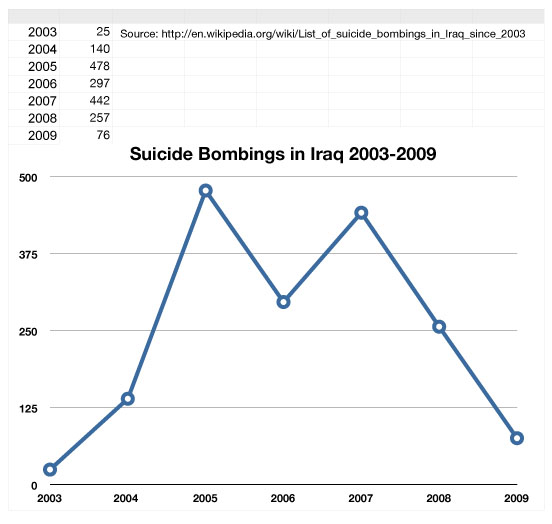
There have been more than 1700 suicide bombings in Iraq, many involving more than one bomber. This extraordinary statistic, which is symbolic of the violence perpetuated by Sunni extremists and is unprecedented in the history of the world, does not receive mention in Nir Rosen’s “ugly peace” analysis. Instead Mr. Rosen highlighted the crimes of the Shia militias and ignored the mostly one-sided sectarian violence aimed at Iraq’s Shia before 2006.
My uncles who lived most of their lives in Amriya, a neighborhood of western Baghdad, were expelled from their homes in the summer of 2005. From my perspective, it was Sunni extremists who began expelling Shias from their homes in Sunni-dominated neighborhoods and even turned Amriya, which according to Columbia University had a Shia majority in 2003 (I will call it “mixed” in 2003), into a Sunni majority district by 2006.
Maybe I should not be so critical of Nir Rosen, who is an excellent journalist and with “Ugly Peace” he has shed some light on the sectarianism that is the root of Iraq’s political problems. It’s just sad for me, as a liberal Iraqi American, to see liberal journalists seemingly taking sides and ignoring history.
Nir Rosen is not the only one who seems to be biased. Even in the documentary “Understanding the Surge”, which I posted last week, it is suggested that Iraq’s Sunni Arabs turned to Al Qaeda because Shia militias were expelling Sunnis from their homes, implying that Sunni Arabs allied themselves with AQI in 2006, after the Samarra bombing. Sunni militia actually began joining forces with AQI in 2004, after Saddam was captured, when it became clear that the US was determined to prevent hardcore Baathists from regaining power and to ensure a democratic government was established in Baghdad.
People who insist that Baathists, being secular, could not possibly ally themselves with Salafi (fundamentalist) groups should remember Saddam’s alliance with Saudi Arabia in the 80s and they should understand that hardcore Baathists would do anything to gain and retain power. Saddam and his cronies were experts at manipulating Islam for political gain. They called their attempt to exterminate Iraq’s Kurds the “Anfal”, a Qur’anic term that refers to the spoils of war belonging to Allah and his messengers. Saddam and his henchmen played God and the Wahhabi Arabs supported them in the 80s, so why would one be surprised by an alliance between Baathists and Salafi groups today? In the 1980s Saddam's regime also expelled tens of thousands of Iraqi Shia - today this is known as "ethnic cleansing", so they already had experience in that area too. Some might even dare to call it "sectarian violence". But in the eyes of many journalists, it seems that "sectarian violence" happens only when Shia militias attack innocent Sunnis.

Rosen did offer this bit of truth about the pre-2006 violence aimed at Shia, quoting an Iraqi Army Captain who commented on the security situation in 2004:
“At the time,” he told me, “there was only al Qaeda, not the Mahdi Army. We confiscated a lot of weapons and car bombs. This was before the sectarianism started.”
I should thank Rosen for quoting the Iraqi Army Captain who said there was only Al Qaeda in 2004 and no JAM. He also mentioned Baathist oppression, but he does not mention the expulsion of Shias from Sunni neighborhoods before the spike in sectarian violence of 2006. Perhaps he did not know about the expulsion of Shias from Sunni neighborhoods before 2006, or maybe I'm taking this too personally, or maybe with “Ugly Peace” he wanted to focus only on the sectarianism in Washash. Maybe Part 2 of "Ugly Peace" will be different from Part 1.
Rosen also quoted another Iraqi who said this: “most Sunnis supported al Qaeda and turned on them because of pressure from the government.”
So Rosen did offer bits of truth about the violence aimed at Shia before the Samarra bombing, but in the entire article he did not elaborate on the violence directed at Shia except to quote an Iraqi who said that there was only AQI in 2004. What did AQI do in 2004? What did Saddam's ousted leaders do? I suppose it is not worth mentioning or researching, or it would have made the article too long to read.
Many journalists’ accounts of recent history in Iraq read as if Iraqi Baathists were fighting a legitimate war against occupation, as if Baathists did not engage in sectarian violence against Iraqis. It is as if Rosen is afraid or unwilling to put Iraq’s Sunni Arabs in a bad light. The people who expelled my Shia relatives from Amriya in 2005 may not have been Iraqi, but the people who committed those crimes could not have known where the Shia lived in Amriya if they had not received help from locals, from Iraqis.
It seems that this Wikepedia entry, also the source for the numbers of suicide bombings since 2003, has it right:
‘A 2005 Human Rights Watch report analysed the insurgency in Iraq and highlighted, "The groups that are most responsible for the abuse, namely al-Qaeda in Iraq and its allies, Ansar al-Sunna and the Islamic State of Iraq, have all targeted civilians for abductions and executions. The first two groups have repeatedly boasted about massive car bombs and suicide bombs in mosques, markets, bus stations and other civilian areas. Such acts are war crimes and in some cases may constitute crimes against humanity, which are defined as serious crimes committed as part of a widespread or systematic attack against a civilian population."[2]
A 2008 RAND Research Brief Counterinsurgency in Iraq: 2003 - 2006 depicts a chart that shows in June and July 2004, Iraqi insurgents began to shift their focus away from attacking U.S. and coalition forces with roadside bombs and instead began targeting the Iraqi population with suicide bombers and vehicle-borne IEDs. By increasing the number of suicide bombings against civilians and accepting their targeting in retribution, the insurgents sought to expose the weakness of the coalition-Iraqi security and reconstruction apparatus, threaten those who collaborated with the government, generate funds and propaganda, and increasingly enact sectarian revenge. The U.S. failure to adapt to this shift had dramatic consequences. By June 2004, U.S. deaths represented less than 10% of overall deaths on the battlefield and Iraqi deaths represented more than 90% - a figure that remained constant for the next 18 months of the War.’
From my perspective based on my experiences and what I have heard and read, the truth about Iraq that most people seem to avoid is the fact that Iraq has been in a state of ethnic and sectarian conflict since 1980. There was a relative peace after the end of the war with Iran 1988, but it lasted only two years. The Arabs don’t like talking about it, but in general the Arabs have seen Iran as an enemy for decades, and Saddam used Iraq to fight that war that Sunni Arab states supported financially. That war with Iran, which Saddam always saw as an extension of the ancient war between Mesopotamia and Persia, continues today.
The war of 1991 and the following Shia rebellion against the dictator resulted in the deaths of hundreds of thousands of Iraqis. Approximately half of my relatives fled Iraq in the 80s and 90s. Journalists did not seem as concerned about those Iraqi refugees. In 2003, after the Liberation, two more of my relatives left Iraq because they finally could without risk of harm to their families. Many Iraqi Shia fled Iraq after 2003, even after they “won”.
There have been 76 suicide bombings in Iraq this year. I consider that to be sectarian violence. Sunni extremists continue to attack the Iraqi government and its security forces, even attacking police in Sunni towns, but primarily targeting the Shia-led government.
Discussing last month's bombings of three Shia-dominated Ministries,
'The top U.S. commander in Iraq, Gen. Ray Odierno, told a news conference last week that he believed a number of insurgent groups, including Baathists and al-Qaida in Iraq, were behind the bombings.
"This is a very complex issue. It's not black and white," he said.'
I would not call the situation in Iraq an “ugly peace”. It is no peace at all. Iraq has been in sectarian conflict since 1980, and the sectarian conflict continues, even as democracy sprouts in Iraq.
The criminal actions of AQI and the Baathists who supported them have shown that democracy and security in Iraq are very difficult to achieve. The hardcore Baathists will always attack the Iraqi government until they become the government. Baathists used violence to gain power in the first place, and they used violence to retain power for three decades.
Even as some of Iraq’s Sunni Arabs continue to support violent attacks against the Iraqi government and security forces, many Iraqi Sunni Arabs are participating in government, showing off their political strength. Tareq al Hashemi, one of Iraq’s Vice Presidents, has vetoed the recently passed election law, which the Iraqi parliament had been arguing about for weeks, because he said it does not include enough parliamentary seats for Sunni Arab refugees. This would be like a Shia VP of Saudi Arabia vetoing an election law because he believes it does not provide enough seats in the Saudi parliament for Saudi Shia (there are no elections and no Shia ‘VP’ in KSA). Like in war, in politics Iraq’s Sunni Arabs are playing hardball.
Even in a state of war, Iraq seems to be more democratic than most Arab countries. And Iraqis want better. Most Iraqis I know are tired of Maliki’s government, and they want to see big changes. I hope Iraqis will vote secular this time, and I hope the outcome of the election will result in true peace in Iraq, not just an “ugly peace”.
Iraqis must resolve their differences, and when they do so, hopefully they will also bring peace, justice, and prosperity to all of Iraq’s districts. Iraqis are making progress towards reconciliation without government efforts. One of my uncles who was expelled from his home in Amriya in 2005 was able to visit that house a few weeks ago and he found living in it a Sunni family, who graciously agreed to pay rent to my uncle. I have also read about Shia families being invited back to Adhamiya. I think that getting the history right, as difficult as it may be, may also contribute to the healing.
The Shia did not “win” in Iraq by expelling Sunni Arabs from Basra and Baghdad. The Shia sorta won by establishing a democracy, or at least a semblance of one, with the help of Americans. Clearly there are hurdles to overcome, and Baghdad is more segregated along sectarian lines than ever before. But there are still large numbers of Sunni Arabs in Baghdad, and it seems the Shia militias' "cleansing" and killing of innocent Sunni Arabs ended many months ago. Iraq’s Shia, after all their struggles, have not won a huge victory, and they will not be victorious until all of Iraq is truly peaceful, like it was before 1980. Real democracy in Iraq, and therefore victory, will be realized when power is passed peacefully from Nouri al Maliki to an Iraqi who will end the era of corruption and sectarianism and lead Iraq to a real peace.
Tuesday, October 13, 2009
85,000 Iraqis killed by violence 2004 - 2008
"Iraq's human rights ministry said on Tuesday that at least 85,000 people had been killed by bombs, murders and fighting in 2004-08, in a rare death toll release by an Iraqi government agency.
Mayhem and bitter clashes erupted after the U.S. invasion of Iraq in 2003, followed by years of sectarian carnage that has only recently begun to abate. The number of people killed by U.S. and Iraqi forces or insurgents remains highly contentious.
"Outlawed groups through terrorist attacks like explosions, assassinations, kidnappings or forced displacements created these terrible figures, which represent a huge challenge for the rule of law and for the Iraqi people," the ministry said.
"These figures draw a picture about the impact of terrorism and the violation of natural life in Iraq," the ministry said in a draft report on deaths in Iraq.
The report -- which only represents death certificates issued by the health ministry -- also said that 147,195 people had been wounded from 2004 to the end of October 2008.
The data makes no distinction between civilians and others.
A senior rights ministry official said that the report did not include missing persons, estimated at around 10,000 people."
Mayhem and bitter clashes erupted after the U.S. invasion of Iraq in 2003, followed by years of sectarian carnage that has only recently begun to abate. The number of people killed by U.S. and Iraqi forces or insurgents remains highly contentious.
"Outlawed groups through terrorist attacks like explosions, assassinations, kidnappings or forced displacements created these terrible figures, which represent a huge challenge for the rule of law and for the Iraqi people," the ministry said.
"These figures draw a picture about the impact of terrorism and the violation of natural life in Iraq," the ministry said in a draft report on deaths in Iraq.
The report -- which only represents death certificates issued by the health ministry -- also said that 147,195 people had been wounded from 2004 to the end of October 2008.
The data makes no distinction between civilians and others.
A senior rights ministry official said that the report did not include missing persons, estimated at around 10,000 people."
Thursday, April 16, 2009
Most victims of air raids are women and children
This is very sad, but not surprising. I have posted about "collateral damage" before.
Iraq air raids hit mostly women and children
Report urges review of military strategy when targeting urban areas
By Kim Sengupta, Defence correspondent
Thursday, 16 April 2009
Air strikes and artillery barrages have taken a heavy toll among the most vulnerable of the Iraqi people, with children and women forming a disproportionate number of the dead.
Analysis carried out for the research group Iraq Body Count (IBC) found that 39 per cent of those killed in air raids by the US-led coalition were children and 46 per cent were women. Fatalities caused by mortars, used by American and Iraqi government forces as well as insurgents, were 42 per cent children and 44 per cent women.
continued
Iraq air raids hit mostly women and children
Report urges review of military strategy when targeting urban areas
By Kim Sengupta, Defence correspondent
Thursday, 16 April 2009
Air strikes and artillery barrages have taken a heavy toll among the most vulnerable of the Iraqi people, with children and women forming a disproportionate number of the dead.
Analysis carried out for the research group Iraq Body Count (IBC) found that 39 per cent of those killed in air raids by the US-led coalition were children and 46 per cent were women. Fatalities caused by mortars, used by American and Iraqi government forces as well as insurgents, were 42 per cent children and 44 per cent women.
continued
Subscribe to:
Posts
(
Atom
)