I have noticed from the comments section of this blog, Angry Arab, Healing Iraq, Baghdad Treasure, and a few others that to identify the sect of murder victims in Iraq is to invite almost certain attack from people who say things like 'I am puzzled why these posters are so rude, and almost entirely failing to examine the present for solutions. Even Saad said that eliminating religious identifications in discussing various incidents of murder would have some effect in restoring peace.'
Is it rude or inappropriate to identify the sect of an Iraqi when discussing the casualties of the current civil war? Apparently to some people it is rude to say whether an Iraqi murder victim is Shii or Sunni, and at least one commentator on Zeyad’s blog believes that not identifying the sects of victims will somehow bring about peace in Iraq. When I told Baghdad Treasure in his comment section that as a Shii I was ashamed to read about Shia militias murdering innocent Sunna, he said that Shia militias do not represent all Shia and Sunni militants who kill innocents do not represent all Sunna. He said ‘we never talked about this subject [whether Iraqis are Shia or Sunna] and we are always friends forever. We are all Iraqis and just Iraqis.’ Even my parents told me that we do not tell people that we are Shia – we just say that we are Muslim. Many Iraqis, like Alaa the Mesopotamian and the Jarrar kids, are products of inter-sect marriages, and they cannot be labeled as Shia or Sunna by their sectarian lineage. However, their ideologies and the way they discuss the war show that they too have chosen sides.
While it is true that Iraqi Shia and Sunna coexisted peacefully before 2003, the fact is that the top brass of Saddam Hussein’s regime were Tikritis, and the vast majority of their victims were Shia and Kurds. Sunni Arabs who defied Saddam’s rule (or even insulted him or his family) were also murdered or jailed, but Sunni Arab towns never saw the mass slaughter of their people like many Shia and Kurdish towns did. Are the Sunni Arabs of Iraq to blame for what Saddam and his henchmen did to the Shia and Kurds? Absolutely not, and the Iraqi people never blamed the Sunni Arabs for the crimes of Saddam Hussein’s regime. Sunni Arab civilians were attacked in large scale by Shia militias for the first time in 2005.
In 2003 the Baathi mafia was overthrown by the Americans, and today the Tikriti clan and their supporters no longer dominate the political scene in Iraq. The insurgency that emerged after the invasion started targeting Shia neighborhoods and towns in addition to Iraqis who worked for the new government and the Americans, and they continue to do so. The vast majority of victims of suicide bombings have been Shia. Arab media does not like to admit this fact, but even they cannot escape it when a suicide bomber detonates his explosives in Hilla or Sadr city, both dominated by Shia. It seems that the Arab media only started acknowledging that this is primarily a sectarian war when Shia militias began mass murdering innocent Sunna in 2005.
After the recent murder of Iraqi comedian Walid Hassan, who made fun of US forces, the Iraqi government, and sectarian militias, I was curious whether he was Sunni or Shii. This wasn’t discussed by the media, certainly not the Arab media. I finally found the answer in the Washington Post:
‘On Monday, Hassan, 47, a father of five children, became a victim of the war and chaos from which he drew his inspiration. A Shiite Muslim, he was found in the majority-Sunni neighborhood of Yarmouk in west Baghdad with multiple bullet wounds to his back and head, according to police.’
We don’t know who murdered Hassan, but the Post article certainly gives facts that cannot be found in Arab media. It gives us context that symbolizes the greater conflict. Compare the Post’s coverage of Hassan’s murder to that of Al Jazeera (the progressive Arab news source):
‘Walid Hassan, whose satirical television show made fun of the US-led forces, sectarian militias and the government, was shot three times in the head while on his way to work.’
The same Al Jazeera article points out that the Iraqi Education Ministry, which was recently attacked by Shia militias and dozens of their employees were kidnapped, was Sunni-run, and the Interior Minister, a Shii, said that the attack was not sectarian based:
‘Nearly 1,500 Iraqis have been reported killed during November. "We are in a state of war and in war all measures are permissible," Abd al-Qader Jassim, Iraq's defence minister, said on Monday.
He was speaking at a news conference attended by several government ministers who are at odds over the fate of dozens of kidnapped education ministry workers.
Education officials have rejected government claims that most of the hostages have been freed, saying dozens are still missing. They blamed Shia militias for abducting them.
Iraq's interior minister, a Shia, said that the attack on the Sunni-run higher education ministry was not sectarian.’
Saturday, November 25, 2006


Retaliation Against Iraqi Sunni Arabs
There are so many good Sunni Arabs like Zeyad in Iraq. My father's best friend was a Sunni from Samarra - he was murdered by the former regime in 85. The ordinary Sunni Arabs of Iraq should not be blamed for the actions of a few Wahabi wackos and their Baathi mafia encouragers.
Friday, November 24, 2006
Fatwas Against Murder of Shia
I have read about fatwas against suicide bombings, issued by both Sunni and Shia clerics. However, I have never read or heard about a fatwa by a top Sunni cleric that denounces the murder of Shia, which seems to be so popular these days in Iraq. I have never read about a senior Saudi Sheikh say that Shia are not infidels, that Shia are Muslims whose murder will not be rewarded by God. I wish the top Sunni Arab clerics would issue such a fatwa. Maybe it would convince the Wahabis that blowing themselves up among veggie-shopping Shia in Iraq will definitely not be rewarded with a trip on the fast track to Heavenly Paradise.
Tuesday, November 21, 2006
Suicide Bombings in Iraq since 2003
I found this list of suicide bombings in Iraq on Wikipedia, and every time I look at it I'm amazed by the growing number of bombings and the total number of people killed. Most of the victims have been civilians, and I wonder what these bombers hoped to accomplish by killing innocent civilians.
Suicide bombings in Iraq since 2003
2003
- March 29: Iraqi soldier Ali Hammadi al-Namani kills 4 US soldiers in a suicide car bombing near Najaf, the first such attack.
- August 19: Canal Hotel Bombing, in Baghdad, kills 22 people (including the top UN representative Sergio Vieira de Mello) and wounds over 100.
- August 29: Car bomb outside Imam Ali Mosque, in Najaf, kills more than 80 people, including SCIRISayed Mohammed Baqir al-Hakim. leader
2004
- February 1: 109 Kurds are killed in 2 suicide bombings in Arbil.
- March 2: Ashoura Massacre: Suicide bombings at Shia holy sites kill 181 and wound more than 500 during the Ashura.
- April 21: Basra bombs kill 74 and injure hundreds.
- July 28: "70 killed, 56 wounded" by a suicide car bomb "next to a line of police applicants."
- September 30: "42 dead, 35 of them children,... as U.S. troops handed out sweets in western Baghdad."
- December 19: "54 killed... amid a funeral procession in Najaf."
2005
- January 13: The Associated Press reports that of 181 car bombings since the creation of the Iraqi interim government at the end of June, 68 were suicide attacks.
- February 28: About 125 people are killed by a suicide car bomb outside a medical center in Hilla, south of Baghdad.
- July 16: A suicide bomber blows up an oil tanker in the predominantly Shiite town of Musayyib, killing 98 people.
- August 31: About 1000 people died in a stampede on Al-Aaimmah bridge in Baghdad, after warnings of an imminent suicide bombing.
2006
- January 2: A suicide bomber kills 7 people on a bus in Baquba. [7]
- January 5: A suicide bomber in Ramadi blew himself up outside a police station[8]
- January 6: More than a hundred people are killed when a suicide bomber detonated near a Shia holy shrine[9][10]
- January 8: A suicide bomber targeted an Interior Ministry patrol, and one policeman was killed in the explosion which wounded 7 others [11][12]
- January 23: A suicide bomber kills 3 people and injures 7 others near the Iranian embassy in Baghdad. [13]
- March 10: A suicide truck bomber kills eight and wounds 11 at a checkpoint in Falluja. [14]
- March 27: A suicide bomber kills 30 to 40 people at a security-forces recruitment center in northern Iraq [15]
- April 3: Ten die and 38 are wounded during a suicide truck bomb attack near a Shiite mosque in northeastern Baghdad [16]
- April 7: Three suicide bombers target the Baratha mosque in Baghdad, killing 81 people and wounding 160. [17] [18]
- April 11: A suicide bomber kills an American soldier in Raweh. [19]
- April 17: A suicide car bombing in Ramadi wounds one U.S. Marine. [20]
- May 2: Ten people die and six are injured when a suicide bomber explodes near a convoy carrying the governor of Anbar in central Ramadi. [21]
- May 3: Suicide bomber kills 16 and wounds 25 at a police recruitment center in Falluja. [22]
- May 6: Suicide bomber kills three Iraqi soldiers at a base in Tikrit. [23]
- May 7: Suicide bomber kills five and wounds 18 in Karbala. [24]
- May 9: A suicide car bombing kills 20 and wounds 37 in Tal Afar. [25]
- May 21: A suicide bomber kills 13 and wounds 18 in a restaurant in central Baghdad. [26]
- June 11: A suicide car bomb explodes at an Iraqi Army checkpoint in Baquba, killing three Iraqi soldiers and wounding six.
- June 16: A suicide bomber slips into a Shiite mosque in Baghdad, killing 11 and wounding 25 during Friday prayers. [27]
- June 20: A suicide bomber kills two and injures two in a senior citizens' home in Basra. [28]
- June 26: Two Iraqi police commandos die and four people are injured when a suicide bomber explodes at a military checkpoint in western Baghdad. [29]
- June 29: A suicide car bomber kills five and wounds at least 31 during a wake for an Iraqi soldier in Kirkuk. [30] [31]
- July 12: A suicide bomber blows himself up in a restaurant in southern Baghdad, killing seven and injuring 20. [32]
- July 16: A suicide bomber strikes a cafe in Tuz Khurmatu, killing 23 to 26 people. [33] [34]
- July 18: A suicide car bomb kills 53 to 59 people and injures more than 100 at a market in Kufa. [35][36]
- July 23: 32 to 34 are killed and 65 to 70 are wounded when a suicide bomber driving a minibus blows it up near a market in Sadr City, Baghdad. [37] [38]
- August 1: A suicide car bomber kills at least 10 people and wounds 22 near an Iraqi army convoy in central Baghdad. [39]
- August 4: A suicide bomber in a pick-up truck blew up in an athletic field in Hadhar, killing 10 and wounding 12. [40] [41]
- August 6: A suicide bomber attacks a funeral in central Tikrit, killing 15 people and injuring 17. [42] [43]
- August 7: Nine soldiers die and 10 civilians are injured due to a suicide truck bomb in Samarra. [44]
- August 10: A suicide bomber struck a checkpoint near a shrine in Najaf, killing 35 and injuring 122. [45][46]
- August 15: A suicide truck bomber killed nine people and wounded 36 outside the headquarters of the Patriotic Union of Kurdistan in Mosul.[47]
- August 28: In Baghdad, 11 people died when a suicide car bomber attacked a compound of the Iraqi interior ministry.In Baghdad, dozens of people were injured in the mid-morning blast outside the interior ministry. The ministry complex has been frequently targeted in the past and is heavily guarded. At least eight policemen are reported to be among the fatalities. The Baghdad bomber struck as UK Defence Minister Des Browne was in the capital for talks with Iraqi officials.[48]
- November 1: A car bomb blast ripped through a wedding party in north Baghdad yesterday, killing 15 guests -- including four children -- and wounding 19 more, a security official said.
- November 13: A suicide bomber wearing an explosives belt blew himself up inside a bus Monday in northeastern Baghdad, killing 10 people and wounding 17 others, emergency police said.
- November 18: Bomb kills 20 people in city of Hilla: A suicide bomber in a minivan killed 20 people and wounded 46 after detonating the explosives near a crowd of day laborers in a southern Iraqi city, police said.
Thursday, November 16, 2006
The Great Hypocrisy of the Arab ‘Resistance’ and the Civil War in Iraq

Before the invasion of Iraq in March 2003, one of my cousins told me that he was afraid that the Baathi regime of Saddam Hussein would burn the country and poison the rivers if they were overthrown. It seems that he was right, although they have yet to poison the rivers, maybe because the rivers run through many Sunni Arab towns. Hopefully they don’t read this and come up with crazy ideas. After the invasion, non-Iraqi Arab and Muslim insurgents poured into Iraq to become part of the ‘resistance’ that has ostensibly fought US troops there. Unfortunately, insurgents have also attacked Iraqi civilians. Despite the fact that ‘about 80% of insurgent attacks are targeted against coalition forces, the Iraqi population suffers about 80% of all casualties, according to US officials in late 2005.’
Insurgent attacks against the Iraqi government and the civilian Shia majority of Iraq, no doubt carried out by the surviving hardcore Baathists who ruled Iraq for 35 years, have not been entirely surprising to me. Iraqis have always feared that the regime of Saddam Hussein would destroy Iraq before giving up power. What has surprised me most has been the non-Iraqi Arab fighters who have flocked to Iraq, many of them willing to die while killing Iraqi security forces, members of the Iraqi government, and ordinary civilian Iraqi Shia, who are considered by many Wahabis to be infidels. These backward aberrations of the Islamic faith, these fools who travel hundreds of miles to murder Iraqis who work for and with Americans, come from countries like Saudi Arabia, a US ally where thousands of Arabs work for American companies like ARAMCO*. They come from Jordan and Egypt, whose governments have collaborated with the Israeli and American governments for decades. Yet the ‘resistance’ fighters in those countries have not fought their respective governments like the ‘resistance’ has fought the new Iraqi government. The ‘resistance’ in Iraq has been praised by the Arab street and most of the Arab media for fighting the American occupiers for the last three and a half years, yet the illegal occupation of the West Bank, Gaza, and East Jerusalem, coupled with continued Israeli annexation of Palestinian land and killing of Palestinian civilians, will enter its 40th year in 2007 without much resistance from these ‘brave’ Arab fighters.
Until 2005, the Iraqi Shia for the most part did not retaliate against Sunni civilians, partly due to Sistani’s efforts to call for calm despite the mass murder of Shia and the numerous attacks on Shia mosques. In 2005 the Shia militias, evidently supported by the Interior Ministry, started rounding up ordinary Sunni men in Baghdad and jailing them without trial and often torturing them to death. Earlier this year, after the attack on the Askariya mosque in Samarra, Shia militias sharply escalated their attacks on Sunni civilians, and the sectarian violence has turned into a full blown civil war. Even Sistani is apparently no longer able to influence the Shia militias and politicians. The escalation of random sectarian violence by Shia militias has obviously aggravated the already tense situation in Iraq and has tainted the image of the Iraqi government. I hope to see Prime Minister Maliki fire Minister of the Interior Bayan Jabr**, who spent many years in Iran and has undoubtedly been influenced by the Iranian regime, like so many prominent members of the Iraqi government have. Maliki must crack down on all militias that target innocent Sunni civilians for the sake of Iraq, for the sake of justice. Maliki and his government should not be influenced by the Iranian regime, who may only want revenge against Sunni Arabs who worked for and supported Saddam’s regime. Most Sunni Arabs in Iraq are good people after all, and they do not deserve to be jailed or killed just because they are Sunni. Even among the Baathists there were many decent people who did not necessarily support the unjust policies of Saddam, and those decent ex-Baathists who spent many years working diligently for Saddam while silently denouncing his mayhem are still capable of participating in governing Iraq. The Prime Minister must pull those good Iraqis into the current government, and he must rid the government of people whose only interest is revenge.
Insurgent attacks against the Iraqi government and the civilian Shia majority of Iraq, no doubt carried out by the surviving hardcore Baathists who ruled Iraq for 35 years, have not been entirely surprising to me. Iraqis have always feared that the regime of Saddam Hussein would destroy Iraq before giving up power. What has surprised me most has been the non-Iraqi Arab fighters who have flocked to Iraq, many of them willing to die while killing Iraqi security forces, members of the Iraqi government, and ordinary civilian Iraqi Shia, who are considered by many Wahabis to be infidels. These backward aberrations of the Islamic faith, these fools who travel hundreds of miles to murder Iraqis who work for and with Americans, come from countries like Saudi Arabia, a US ally where thousands of Arabs work for American companies like ARAMCO*. They come from Jordan and Egypt, whose governments have collaborated with the Israeli and American governments for decades. Yet the ‘resistance’ fighters in those countries have not fought their respective governments like the ‘resistance’ has fought the new Iraqi government. The ‘resistance’ in Iraq has been praised by the Arab street and most of the Arab media for fighting the American occupiers for the last three and a half years, yet the illegal occupation of the West Bank, Gaza, and East Jerusalem, coupled with continued Israeli annexation of Palestinian land and killing of Palestinian civilians, will enter its 40th year in 2007 without much resistance from these ‘brave’ Arab fighters.
Until 2005, the Iraqi Shia for the most part did not retaliate against Sunni civilians, partly due to Sistani’s efforts to call for calm despite the mass murder of Shia and the numerous attacks on Shia mosques. In 2005 the Shia militias, evidently supported by the Interior Ministry, started rounding up ordinary Sunni men in Baghdad and jailing them without trial and often torturing them to death. Earlier this year, after the attack on the Askariya mosque in Samarra, Shia militias sharply escalated their attacks on Sunni civilians, and the sectarian violence has turned into a full blown civil war. Even Sistani is apparently no longer able to influence the Shia militias and politicians. The escalation of random sectarian violence by Shia militias has obviously aggravated the already tense situation in Iraq and has tainted the image of the Iraqi government. I hope to see Prime Minister Maliki fire Minister of the Interior Bayan Jabr**, who spent many years in Iran and has undoubtedly been influenced by the Iranian regime, like so many prominent members of the Iraqi government have. Maliki must crack down on all militias that target innocent Sunni civilians for the sake of Iraq, for the sake of justice. Maliki and his government should not be influenced by the Iranian regime, who may only want revenge against Sunni Arabs who worked for and supported Saddam’s regime. Most Sunni Arabs in Iraq are good people after all, and they do not deserve to be jailed or killed just because they are Sunni. Even among the Baathists there were many decent people who did not necessarily support the unjust policies of Saddam, and those decent ex-Baathists who spent many years working diligently for Saddam while silently denouncing his mayhem are still capable of participating in governing Iraq. The Prime Minister must pull those good Iraqis into the current government, and he must rid the government of people whose only interest is revenge.
Corrections and Revisions
*(11/21/06): My father has informed me that ARAMCO is now fully Saudi owned and has been for years - thanks dad. Americans and other westerners still work in Saudi Arabia, and many other American companies do business with the Saudis. If you haven't already, watch "Fahrenheit 9/11" to learn more about Saudi-US relations.
**PM Maliki appointed Jawad al Boloni as the new Interior Minister in June 2006. To his credit, Bolani has charged 57 employees of the Interior Ministry with human rights crimes against Sunni Arabs.
Revised 1/4/10: Replaced "led by" with "carried out".
Wednesday, November 08, 2006
Saddam and Rumsfeld
So Saddam and two of his filthy henchmen were sentenced to death on Sunday. It wasn't surprising, and I do believe that justice will be served by their hanging, but it wasn't entirely joyful either. Personally I would have liked to see a sentence of life in prison handed to them, as death, in my opinion, is an easy way out, but many Iraqis, including my parents, worry that a life sentence would only encourage Saddam's supporters to continue fighting, with the hope of eventually freeing their beloved leader.
It would have been much better for Iraq, for the entire world, if this trial had taken place in the 1990s. 'If Saddam Hussein had been sentenced to death 10 years ago, Zaki Alherz, an Iraqi-American engineer living in Fremont, would have been overjoyed. But when Alherz turned on his computer Sunday morning and read that his dream had finally come true, he just kept sipping his coffee, unable to even crack a smile. "It's kind of a sour triumph," said Alherz, a Shiite Muslim, who said his cousins were killed by Hussein's security forces. "Yes, it's great that Saddam Hussein is removed," he said. "On the other hand, though, the country isn't in any better shape than it was. It might even be worse." Other Iraqi bloggers have expressed similar feelings. Zeyad (Healing Iraq) wrote a good post (although I don't agree that Maliki should be tried) and also compiled opinions of other Iraqi bloggers. In his post Zeyad linked to a video of the courtroom verdict - Saddam yelled "Allah w'akbar" over and over as the judge read the sentence. It's ironic that Saddam, whose regime killed so many Muslims, would yell "Allah w'akbar" and clutch a Quran while being sentenced to death for murdering only God knows how many tens of thousands of Muslims. I hope that Zeyad doesn't mind that I mention that he is a Sunni Arab - many Iraqi Sunni Arabs agreed with the verdict, or at least agreed that Saddam was guilty of crimes against humanity. However, I am not surprised by the Sunni Arabs (most of them non-Iraqi) who glorify Saddam - many of them benefited from his rule. Although I expected many Sunni Arabs to defend Saddam, I am still shocked when I hear or read a seemingly educated westerner commending Saddam, and Alaa (the Mesopotamian) wrote a short post entitled 'In Praise of Tyranny' and linked to an embarrassing Guardian article that praises Saddam.
The Iraqi nation is still in bad shape, Iraqis say, and many Iraqis believe that life in Iraq was better for them before 2003. But who doubts that that the primary goal of the insurgency has been to make life for Iraqis much worse than life under Saddam's rule? The insurgency, also known by many people as the 'resistance' (they should resist the urge to murder innocents), does not want democracy in Iraq - they want to see the new Iraq fail. One of my cousins told me before the invasion that he was afraid that Saddam's regime would burn the country and poison the rivers before giving up power. It seems that he was right, even though the Baathists are no longer in power. They don't need to be in power to cause mayhem. I believe that if Saddam and his thugs have any influence over the insurgency, the Iraqi government should make them an offer: accept life in prison and encourage the insurgency to stop killing people. Perhaps this offer has already been made, as Saddam today called on Iraqis to reconcile. For the first time in my life, I agree with Saddam.
In other news, Secretary of Defense Donald Rumsfeld resigned today. His resignation, like Saddam's verdict, was also overdue in my opinion. I was dismayed by Rumsfeld's decision to use cluster bombs over civilian areas and heavily bomb the people who hated Saddam and cause so much destruction and death there. Thousands of Shia have been maimed. I am no military expert, but I do not understand why cluster bombs are used in civilian areas. Furthermore, I can't help but wonder if Saddam would have been so powerful had he not received so much support from Reagan's administration, for which Rumsfeld worked as special envoy to the Mideast. Rumsfeld visited Iraq in 1983 and shook Saddam's hand, presumably to discuss the sale of US-made weapons to Iraq and how to use them effectively against America's nemesis at the time. Of course Saddam's regime did not use them only against Iran. This is what I love about America: I can write these things without fearing that the FBI or CIA will send somebody to apprehend me and my family in the middle of the night and take us to prison where they might torture me in front of my family.
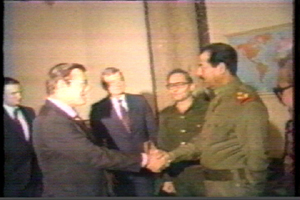
It would have been much better for Iraq, for the entire world, if this trial had taken place in the 1990s. 'If Saddam Hussein had been sentenced to death 10 years ago, Zaki Alherz, an Iraqi-American engineer living in Fremont, would have been overjoyed. But when Alherz turned on his computer Sunday morning and read that his dream had finally come true, he just kept sipping his coffee, unable to even crack a smile. "It's kind of a sour triumph," said Alherz, a Shiite Muslim, who said his cousins were killed by Hussein's security forces. "Yes, it's great that Saddam Hussein is removed," he said. "On the other hand, though, the country isn't in any better shape than it was. It might even be worse." Other Iraqi bloggers have expressed similar feelings. Zeyad (Healing Iraq) wrote a good post (although I don't agree that Maliki should be tried) and also compiled opinions of other Iraqi bloggers. In his post Zeyad linked to a video of the courtroom verdict - Saddam yelled "Allah w'akbar" over and over as the judge read the sentence. It's ironic that Saddam, whose regime killed so many Muslims, would yell "Allah w'akbar" and clutch a Quran while being sentenced to death for murdering only God knows how many tens of thousands of Muslims. I hope that Zeyad doesn't mind that I mention that he is a Sunni Arab - many Iraqi Sunni Arabs agreed with the verdict, or at least agreed that Saddam was guilty of crimes against humanity. However, I am not surprised by the Sunni Arabs (most of them non-Iraqi) who glorify Saddam - many of them benefited from his rule. Although I expected many Sunni Arabs to defend Saddam, I am still shocked when I hear or read a seemingly educated westerner commending Saddam, and Alaa (the Mesopotamian) wrote a short post entitled 'In Praise of Tyranny' and linked to an embarrassing Guardian article that praises Saddam.
The Iraqi nation is still in bad shape, Iraqis say, and many Iraqis believe that life in Iraq was better for them before 2003. But who doubts that that the primary goal of the insurgency has been to make life for Iraqis much worse than life under Saddam's rule? The insurgency, also known by many people as the 'resistance' (they should resist the urge to murder innocents), does not want democracy in Iraq - they want to see the new Iraq fail. One of my cousins told me before the invasion that he was afraid that Saddam's regime would burn the country and poison the rivers before giving up power. It seems that he was right, even though the Baathists are no longer in power. They don't need to be in power to cause mayhem. I believe that if Saddam and his thugs have any influence over the insurgency, the Iraqi government should make them an offer: accept life in prison and encourage the insurgency to stop killing people. Perhaps this offer has already been made, as Saddam today called on Iraqis to reconcile. For the first time in my life, I agree with Saddam.
In other news, Secretary of Defense Donald Rumsfeld resigned today. His resignation, like Saddam's verdict, was also overdue in my opinion. I was dismayed by Rumsfeld's decision to use cluster bombs over civilian areas and heavily bomb the people who hated Saddam and cause so much destruction and death there. Thousands of Shia have been maimed. I am no military expert, but I do not understand why cluster bombs are used in civilian areas. Furthermore, I can't help but wonder if Saddam would have been so powerful had he not received so much support from Reagan's administration, for which Rumsfeld worked as special envoy to the Mideast. Rumsfeld visited Iraq in 1983 and shook Saddam's hand, presumably to discuss the sale of US-made weapons to Iraq and how to use them effectively against America's nemesis at the time. Of course Saddam's regime did not use them only against Iran. This is what I love about America: I can write these things without fearing that the FBI or CIA will send somebody to apprehend me and my family in the middle of the night and take us to prison where they might torture me in front of my family.

Saturday, November 04, 2006
The First American War Against Iraq
'In 1980, Iraq started an eight-year war with neighboring Iran. That prolonged battle left Iraq in dire economic straits. So Hussein borrowed money from his Arab neighbors, including Kuwait. When Kuwait began to call in those debts and pump oil from a disputed border field, Hussein responded by flexing his muscles, again' explains CNN. The reasons Saddam decided to invade Kuwait are a bit more complicated than this, which I will explain later. I remember watching CNN from campus with my brother - we were the only Iraqis (Iraqi Americans) on campus, and I remember thinking how bizarre it was that we were living in a country that was bombing the country we were born in. It was very sad, but in the end there was no choice but to see Baghdad bombed, and it was televised, and many Arab states participated in the 'liberation' of Kuwait, the '19th province of Iraq' as Saddam Hussein so astutely observed. The bombing was intense: 40+ days/nights of heavy bombing by the US and its allies.
My mother's aunt, a sweet 70-something-year old woman who was blind and had asthma, lived with my aunt (my mom's sister) for many years in Baghdad. We called her 'Amma' which means 'aunt' in Arabic, and we loved her - my cousins who lived with her regarded her as a second mother. Their household was one of our favorites to stay with every summer we visited Iraq in the 70s. Immediately after Iraq invaded Kuwait in 1990, the UN imposed economic sanctions against Iraq, and no 'dual use' medicines were allowed to be sold to Iraq. I don't know how asthma medicine can be converted to a weapon, but it was on the long list of medicines that were considered to be 'dual use' and were therefore prohibited by the sanctions. By the time the coalition started bombing Iraq, Amma had run out of her asthma medicine, and in late January, 1991, she died as a result. One of my cousins, who eventually moved to the US, told me that during the intense bombing he and one of his brothers had to take Amma's body to Nejef and bury her there. He told me that it was the saddest experience of his life.
Back to why Iraq invaded Kuwait. After the war with Iran, Iraq was $40 billion in debt, and Iraq was desperate for money. In 1989 Kuwait started selling oil 20% beyond their OPEC quota. This extra oil on the market caused a drop in the price of oil on the world market, and as a result, Iraq lost about one-third of its oil income. In the following months, Iraq's Oil Minister demanded that Kuwait reduce its oil sales, but Kuwait refused. In 1990 Saddam Hussein publicly threatened to invade Kuwait. The official response from the US was surprising. The American ambassador to Iraq, April Glaspie, states at a US State Department briefing that "there are no special defense or security commitments to Kuwait" - this was 6 days before Iraq invaded Kuwait.
The US relationship with Saddam Hussein's regime, the events that led to Gulf War I and the sanctions are well explained and chronicled in the excellent documentary, Hidden Wars of Desert Storm, which features former US Attorney General Ramsey Clark, Phyllis Bennis, Dennis Haliday, Norman Schwartzkopf, and other officials and experts. It explains how the CIA helped Saddam and the Baath party come to power in Iraq. In 'Hidden Wars' an American Arms Trade analyst explains that 52 countries supplied arms to Iraq or Iran during their long war. 29 of those countries, including the US, supplied arms to BOTH sides. The documentary shows a clip of April Glaspie saying that there's no security agreement with Kuwait in August 1990, and the look on her face is rather odd, as if she was being forced to say this. I was surprised to learn that the US apparently lied to the Saudis about satellite photos which allegedly showed that Iraqi troops were massed at the Saudi border in order to receive a Saudi invitation to allow US troops into their country. An investigative reporter says in the documentary that these photos do not exist, and the St. Petersburg Times along with ABC ran stories in January 1991 that also questioned the buildup of Iraqi troops at the Saudi border. A sinister-looking James Baker (former Secretary of State) is shown at the UN meeting at which members voted on whether force should be used to force Iraq out of Kuwait, and Phyllis Bennis explains that three days after Yemem voted 'No' on the use of force, the US cut its entire aid budget to Yemen, the poorest country in the Arab world. Hidden Wars goes on to discuss the uprising in southern Iraq and the lack of support for the uprising from the US. The documentary spends a great deal of time on sanctions and their devastating impact on ordinary Iraqis during the following decade. Sanctions made Saddam stronger, and the documentary explains how. The remainder of Hidden Wars discusses the use of depleted uranium and its horrible effects on Iraqis and US soldiers and their families. I believe that this documentary is so good that I've added a link to hiddenwars.com on my side bar.
To learn more about the impact sanctions had on Iraq click here.
My mother's aunt, a sweet 70-something-year old woman who was blind and had asthma, lived with my aunt (my mom's sister) for many years in Baghdad. We called her 'Amma' which means 'aunt' in Arabic, and we loved her - my cousins who lived with her regarded her as a second mother. Their household was one of our favorites to stay with every summer we visited Iraq in the 70s. Immediately after Iraq invaded Kuwait in 1990, the UN imposed economic sanctions against Iraq, and no 'dual use' medicines were allowed to be sold to Iraq. I don't know how asthma medicine can be converted to a weapon, but it was on the long list of medicines that were considered to be 'dual use' and were therefore prohibited by the sanctions. By the time the coalition started bombing Iraq, Amma had run out of her asthma medicine, and in late January, 1991, she died as a result. One of my cousins, who eventually moved to the US, told me that during the intense bombing he and one of his brothers had to take Amma's body to Nejef and bury her there. He told me that it was the saddest experience of his life.
Back to why Iraq invaded Kuwait. After the war with Iran, Iraq was $40 billion in debt, and Iraq was desperate for money. In 1989 Kuwait started selling oil 20% beyond their OPEC quota. This extra oil on the market caused a drop in the price of oil on the world market, and as a result, Iraq lost about one-third of its oil income. In the following months, Iraq's Oil Minister demanded that Kuwait reduce its oil sales, but Kuwait refused. In 1990 Saddam Hussein publicly threatened to invade Kuwait. The official response from the US was surprising. The American ambassador to Iraq, April Glaspie, states at a US State Department briefing that "there are no special defense or security commitments to Kuwait" - this was 6 days before Iraq invaded Kuwait.
The US relationship with Saddam Hussein's regime, the events that led to Gulf War I and the sanctions are well explained and chronicled in the excellent documentary, Hidden Wars of Desert Storm, which features former US Attorney General Ramsey Clark, Phyllis Bennis, Dennis Haliday, Norman Schwartzkopf, and other officials and experts. It explains how the CIA helped Saddam and the Baath party come to power in Iraq. In 'Hidden Wars' an American Arms Trade analyst explains that 52 countries supplied arms to Iraq or Iran during their long war. 29 of those countries, including the US, supplied arms to BOTH sides. The documentary shows a clip of April Glaspie saying that there's no security agreement with Kuwait in August 1990, and the look on her face is rather odd, as if she was being forced to say this. I was surprised to learn that the US apparently lied to the Saudis about satellite photos which allegedly showed that Iraqi troops were massed at the Saudi border in order to receive a Saudi invitation to allow US troops into their country. An investigative reporter says in the documentary that these photos do not exist, and the St. Petersburg Times along with ABC ran stories in January 1991 that also questioned the buildup of Iraqi troops at the Saudi border. A sinister-looking James Baker (former Secretary of State) is shown at the UN meeting at which members voted on whether force should be used to force Iraq out of Kuwait, and Phyllis Bennis explains that three days after Yemem voted 'No' on the use of force, the US cut its entire aid budget to Yemen, the poorest country in the Arab world. Hidden Wars goes on to discuss the uprising in southern Iraq and the lack of support for the uprising from the US. The documentary spends a great deal of time on sanctions and their devastating impact on ordinary Iraqis during the following decade. Sanctions made Saddam stronger, and the documentary explains how. The remainder of Hidden Wars discusses the use of depleted uranium and its horrible effects on Iraqis and US soldiers and their families. I believe that this documentary is so good that I've added a link to hiddenwars.com on my side bar.
To learn more about the impact sanctions had on Iraq click here.
Subscribe to:
Posts
(
Atom
)