Iraq Pundit wrote another great post:
'The Atlantic magazine has a moving pictorial about Iraqi refugees. The slide show is accompanied by this commentary: "It has been almost seven years since the U.S. invaded Iraq. While the war is officially over, another crisis continues to unfold, attracting far fewer headlines and less public debate. All across Iraq, civilians are fleeing their homes. There are nearly three million of these refugees, according to various NGO and relief-group estimates."
No Iraqi would begudge the attention these people are getting. But some of us can't help but ask where this thoughtful commentary was when we were forced to leave Baathist Iraq? Thank God for the agencies that help the great number of refugees who fled since 2003. But trust me, the story is incomplete.
Iraqis do not have a tradition of emigration the way the peoples of the Levant do. Most Iraqis left in the 1980s and 1990s. Certainly the last several years resulted in the deaths of countless Iraqis leading to refugees next door. But so did the Iran-Iraq war. Also, Saddam kicked out, chased out, and murdered millions. Otherwise, travel was not possible. Saddam had all sorts of rules about how and when anyone could travel -- if allowed to leave Iraq at all. I don't remember anyone losing sleep over the artists, the musicians, the scientists, and scholars who had to start life over again far away from home. I know first hand what it's like to leave the life you know and start all over again. My heart goes out to those mentioned in magazine.
Many people left in recent years for serious reasons. But those of us who left earlier also had serious reasons to leave. I do recall countless articles about the well-connected political people, but there was nothing about ordinary people. One reason is probably that the fear of the Baathists was so strong that Iraqis lived quietly. That same fear remains so strong that many continue to do so. It sounds to me as though if one opposes Saddam and the Baathists, his plight is not as interesting as one who opposes the United States. My question to The Atlantic is simply why?'
Showing posts with label Ethnic cleansing. Show all posts
Showing posts with label Ethnic cleansing. Show all posts
Sunday, December 20, 2009


Tuesday, November 24, 2009
Pre-2003 ethnic cleansing in Iraq
This is to corroborate my post No peace in Iraq since 1970s:
'Many Shī‘ī Iranians migrated to what is now Iraq in the sixteenth century. "It is said that when modern Iraq was formed, 75% of the population of Karbala was Iranian". In time, these immigrants adopted the Arabic language and Arab identity, but their origin has been used to "unfairly cast them as lackeys of Iran. Other Iraqi Shī‘īs are ethnic Arabs with roots in Iraq as deep as those of their Sunni counterparts.
...The Shia suffered indirect and direct persecution under post-colonial Iraqi governments since 1932, especially that of Saddam Hussein. Under Saddam public Shia festivals such as Ashoura were banned. It is said that every Shia clerical family of note in Iraq had tales of torture and murder to recount. In 1969 the son of Iraq's highest Shia Ayatollah Muhsin al-Hakim was arrested and allegedly tortured. From 1979-1983 Saddam's regime executed 48 major Shia clerics in Iraq. They included Shia leader Mohammad Baqir al-Sadr and his sister. Tens of thousands of Iranians and Arabs of Iranian origin were expelled in 1979 and 1980 and a further 75,000 in 1989. Shia opposition to the government following the first Gulf War was reportedly suppressed.'
'Many Shī‘ī Iranians migrated to what is now Iraq in the sixteenth century. "It is said that when modern Iraq was formed, 75% of the population of Karbala was Iranian". In time, these immigrants adopted the Arabic language and Arab identity, but their origin has been used to "unfairly cast them as lackeys of Iran. Other Iraqi Shī‘īs are ethnic Arabs with roots in Iraq as deep as those of their Sunni counterparts.
...The Shia suffered indirect and direct persecution under post-colonial Iraqi governments since 1932, especially that of Saddam Hussein. Under Saddam public Shia festivals such as Ashoura were banned. It is said that every Shia clerical family of note in Iraq had tales of torture and murder to recount. In 1969 the son of Iraq's highest Shia Ayatollah Muhsin al-Hakim was arrested and allegedly tortured. From 1979-1983 Saddam's regime executed 48 major Shia clerics in Iraq. They included Shia leader Mohammad Baqir al-Sadr and his sister. Tens of thousands of Iranians and Arabs of Iranian origin were expelled in 1979 and 1980 and a further 75,000 in 1989. Shia opposition to the government following the first Gulf War was reportedly suppressed.'
Sunday, November 22, 2009
No peace in Iraq since 1970s
I have been thinking about this post for a few days and I thought about titling it “Ugly Peace in Iraq since 1980”. Some Iraqis (especially Kurds) would argue that even in the 1970s Iraq did not have real peace.
Recently I have read a few articles that have tried to summarize the last six years in Iraq and the surge in particular. Some authors have attributed the reduction in violence in Iraq more to Iraqis than to Americans. Part 1 of Nir Rosen’s “Ugly Peace” focuses on Washash, a Shia-majority district of Baghdad that saw its Sunni Arab residents expelled by Shia militias in 2006. Rosen got the "ugly" part right, but I'm not sure about the peace. He seems to minimize and even disregard the worst violence committed by Sunni extremists, which is ongoing. It seems that not only Rosen but many fine journalists have been ignoring or minimizing the events of 2004 and 2005, when Sunni extremists attacked Shia all over Iraq in the most brutal ways.
Rosen exposes the injustices committed by Shia militias, as every journalist should, and I'm glad he makes a distinction between criminal elements of Jaish al Mahdi and those who only wanted to protect Shia from Sunni extremists, but he writes as if Shia militias started the sectarian violence after the bombing of the Askari shrine in Samarra in 2006. He explains that after the Samarra bombing, JAM began killing innocent Sunni Arabs, without really explaining what happened to the Shia in 2003, 2004, and 2005.
Rosen summarizes the explanation for the fall in violence: “the increasing calm stemmed from the ‘exhaustion of sectarian violence’ and a ‘Sunni return to politics,’ among other factors.”
Sounds like good news, but I do not know what Rosen means by “exhaustion of sectarian violence”. Maybe he means Shia militias stopped attacking Sunni Arabs. Sunni extremists continue to attack Shia. Maybe he did not read about the dozens of suicide bombings that have been carried out this year by AQI, which has always been the worst of the sectarian militias.
Nir Rosen:
The Sunnis were “brutally cleansed” from Baghdad, as if Shia were not treated brutally before Shia militias began their murderous rampages. It is as if all of Iraq’s Sunni Arabs have been kicked out of Iraq, as if they have no representation in the Iraqi government. The violence stopped because there are no Sunnis left to kill, and hence the "ugly peace".
Here is a map of Baghdad in mid 2008, showing many districts dominated by Sunnis:

In his article Rosen summarized some of the violence of 2003 and 2004, but he did not elaborate on the incredible violence aimed at Iraq’s Shia, except to call it simply a civil war and to write “by the middle of 2005 sectarian violence was endemic”, hinting that Shia too were innocent victims. But he does not go into detail about the ugly crimes of Sunni extremists. Instead he emphasizes the brutality of the Mahdi Army and gives examples of evidence of their crimes in Washash and other areas.
Here he details the violence aimed at Sunnis in 2003 and 2004, as if to rationalize subsequent Sunni attacks on Shia:
Not a single mention of the Sunni violence that was intended to destroy the new Iraq from the very beginning. No mention of the hundreds of Sunni suicide bombers who targeted Iraq’s security forces and ordinary Shia between 2003 and the 2006 bombing of the Askari shrine. Suicide bombings are a good indication of violence perpetuated by Sunni extremists; Shia do not participate in suicide bombings that target Iraqi civilians or security forces. The largest number of suicide bombings in the war occurred in 2005:

There have been more than 1700 suicide bombings in Iraq, many involving more than one bomber. This extraordinary statistic, which is symbolic of the violence perpetuated by Sunni extremists and is unprecedented in the history of the world, does not receive mention in Nir Rosen’s “ugly peace” analysis. Instead Mr. Rosen highlighted the crimes of the Shia militias and ignored the mostly one-sided sectarian violence aimed at Iraq’s Shia before 2006.
My uncles who lived most of their lives in Amriya, a neighborhood of western Baghdad, were expelled from their homes in the summer of 2005. From my perspective, it was Sunni extremists who began expelling Shias from their homes in Sunni-dominated neighborhoods and even turned Amriya, which according to Columbia University had a Shia majority in 2003 (I will call it “mixed” in 2003), into a Sunni majority district by 2006.
Maybe I should not be so critical of Nir Rosen, who is an excellent journalist and with “Ugly Peace” he has shed some light on the sectarianism that is the root of Iraq’s political problems. It’s just sad for me, as a liberal Iraqi American, to see liberal journalists seemingly taking sides and ignoring history.
Nir Rosen is not the only one who seems to be biased. Even in the documentary “Understanding the Surge”, which I posted last week, it is suggested that Iraq’s Sunni Arabs turned to Al Qaeda because Shia militias were expelling Sunnis from their homes, implying that Sunni Arabs allied themselves with AQI in 2006, after the Samarra bombing. Sunni militia actually began joining forces with AQI in 2004, after Saddam was captured, when it became clear that the US was determined to prevent hardcore Baathists from regaining power and to ensure a democratic government was established in Baghdad.
People who insist that Baathists, being secular, could not possibly ally themselves with Salafi (fundamentalist) groups should remember Saddam’s alliance with Saudi Arabia in the 80s and they should understand that hardcore Baathists would do anything to gain and retain power. Saddam and his cronies were experts at manipulating Islam for political gain. They called their attempt to exterminate Iraq’s Kurds the “Anfal”, a Qur’anic term that refers to the spoils of war belonging to Allah and his messengers. Saddam and his henchmen played God and the Wahhabi Arabs supported them in the 80s, so why would one be surprised by an alliance between Baathists and Salafi groups today? In the 1980s Saddam's regime also expelled tens of thousands of Iraqi Shia - today this is known as "ethnic cleansing", so they already had experience in that area too. Some might even dare to call it "sectarian violence". But in the eyes of many journalists, it seems that "sectarian violence" happens only when Shia militias attack innocent Sunnis.
Rosen did offer this bit of truth about the pre-2006 violence aimed at Shia, quoting an Iraqi Army Captain who commented on the security situation in 2004:
I should thank Rosen for quoting the Iraqi Army Captain who said there was only Al Qaeda in 2004 and no JAM. He also mentioned Baathist oppression, but he does not mention the expulsion of Shias from Sunni neighborhoods before the spike in sectarian violence of 2006. Perhaps he did not know about the expulsion of Shias from Sunni neighborhoods before 2006, or maybe I'm taking this too personally, or maybe with “Ugly Peace” he wanted to focus only on the sectarianism in Washash. Maybe Part 2 of "Ugly Peace" will be different from Part 1.
Rosen also quoted another Iraqi who said this: “most Sunnis supported al Qaeda and turned on them because of pressure from the government.”
So Rosen did offer bits of truth about the violence aimed at Shia before the Samarra bombing, but in the entire article he did not elaborate on the violence directed at Shia except to quote an Iraqi who said that there was only AQI in 2004. What did AQI do in 2004? What did Saddam's ousted leaders do? I suppose it is not worth mentioning or researching, or it would have made the article too long to read.
Many journalists’ accounts of recent history in Iraq read as if Iraqi Baathists were fighting a legitimate war against occupation, as if Baathists did not engage in sectarian violence against Iraqis. It is as if Rosen is afraid or unwilling to put Iraq’s Sunni Arabs in a bad light. The people who expelled my Shia relatives from Amriya in 2005 may not have been Iraqi, but the people who committed those crimes could not have known where the Shia lived in Amriya if they had not received help from locals, from Iraqis.
It seems that this Wikepedia entry, also the source for the numbers of suicide bombings since 2003, has it right:
From my perspective based on my experiences and what I have heard and read, the truth about Iraq that most people seem to avoid is the fact that Iraq has been in a state of ethnic and sectarian conflict since 1980. There was a relative peace after the end of the war with Iran 1988, but it lasted only two years. The Arabs don’t like talking about it, but in general the Arabs have seen Iran as an enemy for decades, and Saddam used Iraq to fight that war that Sunni Arab states supported financially. That war with Iran, which Saddam always saw as an extension of the ancient war between Mesopotamia and Persia, continues today.
The war of 1991 and the following Shia rebellion against the dictator resulted in the deaths of hundreds of thousands of Iraqis. Approximately half of my relatives fled Iraq in the 80s and 90s. Journalists did not seem as concerned about those Iraqi refugees. In 2003, after the Liberation, two more of my relatives left Iraq because they finally could without risk of harm to their families. Many Iraqi Shia fled Iraq after 2003, even after they “won”.
There have been 76 suicide bombings in Iraq this year. I consider that to be sectarian violence. Sunni extremists continue to attack the Iraqi government and its security forces, even attacking police in Sunni towns, but primarily targeting the Shia-led government.
Discussing last month's bombings of three Shia-dominated Ministries,
I would not call the situation in Iraq an “ugly peace”. It is no peace at all. Iraq has been in sectarian conflict since 1980, and the sectarian conflict continues, even as democracy sprouts in Iraq.
The criminal actions of AQI and the Baathists who supported them have shown that democracy and security in Iraq are very difficult to achieve. The hardcore Baathists will always attack the Iraqi government until they become the government. Baathists used violence to gain power in the first place, and they used violence to retain power for three decades.
Even as some of Iraq’s Sunni Arabs continue to support violent attacks against the Iraqi government and security forces, many Iraqi Sunni Arabs are participating in government, showing off their political strength. Tareq al Hashemi, one of Iraq’s Vice Presidents, has vetoed the recently passed election law, which the Iraqi parliament had been arguing about for weeks, because he said it does not include enough parliamentary seats for Sunni Arab refugees. This would be like a Shia VP of Saudi Arabia vetoing an election law because he believes it does not provide enough seats in the Saudi parliament for Saudi Shia (there are no elections and no Shia ‘VP’ in KSA). Like in war, in politics Iraq’s Sunni Arabs are playing hardball.
Even in a state of war, Iraq seems to be more democratic than most Arab countries. And Iraqis want better. Most Iraqis I know are tired of Maliki’s government, and they want to see big changes. I hope Iraqis will vote secular this time, and I hope the outcome of the election will result in true peace in Iraq, not just an “ugly peace”.
Iraqis must resolve their differences, and when they do so, hopefully they will also bring peace, justice, and prosperity to all of Iraq’s districts. Iraqis are making progress towards reconciliation without government efforts. One of my uncles who was expelled from his home in Amriya in 2005 was able to visit that house a few weeks ago and he found living in it a Sunni family, who graciously agreed to pay rent to my uncle. I have also read about Shia families being invited back to Adhamiya. I think that getting the history right, as difficult as it may be, may also contribute to the healing.
The Shia did not “win” in Iraq by expelling Sunni Arabs from Basra and Baghdad. The Shia sorta won by establishing a democracy, or at least a semblance of one, with the help of Americans. Clearly there are hurdles to overcome, and Baghdad is more segregated along sectarian lines than ever before. But there are still large numbers of Sunni Arabs in Baghdad, and it seems the Shia militias' "cleansing" and killing of innocent Sunni Arabs ended many months ago. Iraq’s Shia, after all their struggles, have not won a huge victory, and they will not be victorious until all of Iraq is truly peaceful, like it was before 1980. Real democracy in Iraq, and therefore victory, will be realized when power is passed peacefully from Nouri al Maliki to an Iraqi who will end the era of corruption and sectarianism and lead Iraq to a real peace.
Recently I have read a few articles that have tried to summarize the last six years in Iraq and the surge in particular. Some authors have attributed the reduction in violence in Iraq more to Iraqis than to Americans. Part 1 of Nir Rosen’s “Ugly Peace” focuses on Washash, a Shia-majority district of Baghdad that saw its Sunni Arab residents expelled by Shia militias in 2006. Rosen got the "ugly" part right, but I'm not sure about the peace. He seems to minimize and even disregard the worst violence committed by Sunni extremists, which is ongoing. It seems that not only Rosen but many fine journalists have been ignoring or minimizing the events of 2004 and 2005, when Sunni extremists attacked Shia all over Iraq in the most brutal ways.
Rosen exposes the injustices committed by Shia militias, as every journalist should, and I'm glad he makes a distinction between criminal elements of Jaish al Mahdi and those who only wanted to protect Shia from Sunni extremists, but he writes as if Shia militias started the sectarian violence after the bombing of the Askari shrine in Samarra in 2006. He explains that after the Samarra bombing, JAM began killing innocent Sunni Arabs, without really explaining what happened to the Shia in 2003, 2004, and 2005.
Rosen summarizes the explanation for the fall in violence: “the increasing calm stemmed from the ‘exhaustion of sectarian violence’ and a ‘Sunni return to politics,’ among other factors.”
Sounds like good news, but I do not know what Rosen means by “exhaustion of sectarian violence”. Maybe he means Shia militias stopped attacking Sunni Arabs. Sunni extremists continue to attack Shia. Maybe he did not read about the dozens of suicide bombings that have been carried out this year by AQI, which has always been the worst of the sectarian militias.
Nir Rosen:
“One explanation that few are prepared to discuss openly is that Iraq’s civil war ended because Shias won: violence against Sunnis ceased after Sunnis were brutally cleansed from Basra and large swaths of Baghdad, and Shias gained firm control of government ministries and local police. Sunnis knew they were defeated and Shias no longer worried that Ba’athist oppression would resume. With no external enemy, Shia militias began to fight each other and turned into criminal gangs terrorizing their own communities. The defeat of the Sunnis and divisions among Shias created space for new possibilities, and the government and American forces occupied that space.”
The Sunnis were “brutally cleansed” from Baghdad, as if Shia were not treated brutally before Shia militias began their murderous rampages. It is as if all of Iraq’s Sunni Arabs have been kicked out of Iraq, as if they have no representation in the Iraqi government. The violence stopped because there are no Sunnis left to kill, and hence the "ugly peace".
Here is a map of Baghdad in mid 2008, showing many districts dominated by Sunnis:

In his article Rosen summarized some of the violence of 2003 and 2004, but he did not elaborate on the incredible violence aimed at Iraq’s Shia, except to call it simply a civil war and to write “by the middle of 2005 sectarian violence was endemic”, hinting that Shia too were innocent victims. But he does not go into detail about the ugly crimes of Sunni extremists. Instead he emphasizes the brutality of the Mahdi Army and gives examples of evidence of their crimes in Washash and other areas.
Here he details the violence aimed at Sunnis in 2003 and 2004, as if to rationalize subsequent Sunni attacks on Shia:
“In October 2003 a Sunni Sheikh, his brother, and a teenage assistant were riddled with bullets as they walked home from mosque. In August 2004 a police chief and a patrolman were killed in an explosion. In December 2004 several members of a Sunni Salafist group were killed. Sunni and Shia clerics issued a futile joint edict banning sectarian fighting, and by the middle of 2005 sectarian violence was endemic.
American soldiers raiding a house in 2006 found evidence that Shia militias were cleansing Sunnis from Washash. There was a list of nearly 70 homes where Sunni families were expelled and a list of “good” families who were not be disturbed. There were letters threatening Sunnis, as well as copies of a DVD with a message from the Mahdi Army: images of exploding houses.”
Not a single mention of the Sunni violence that was intended to destroy the new Iraq from the very beginning. No mention of the hundreds of Sunni suicide bombers who targeted Iraq’s security forces and ordinary Shia between 2003 and the 2006 bombing of the Askari shrine. Suicide bombings are a good indication of violence perpetuated by Sunni extremists; Shia do not participate in suicide bombings that target Iraqi civilians or security forces. The largest number of suicide bombings in the war occurred in 2005:
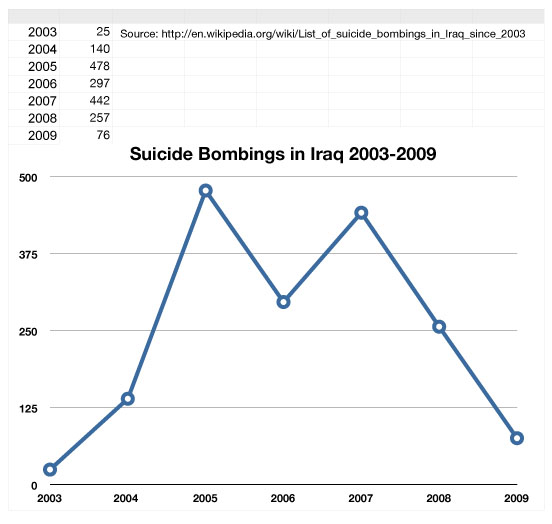
There have been more than 1700 suicide bombings in Iraq, many involving more than one bomber. This extraordinary statistic, which is symbolic of the violence perpetuated by Sunni extremists and is unprecedented in the history of the world, does not receive mention in Nir Rosen’s “ugly peace” analysis. Instead Mr. Rosen highlighted the crimes of the Shia militias and ignored the mostly one-sided sectarian violence aimed at Iraq’s Shia before 2006.
My uncles who lived most of their lives in Amriya, a neighborhood of western Baghdad, were expelled from their homes in the summer of 2005. From my perspective, it was Sunni extremists who began expelling Shias from their homes in Sunni-dominated neighborhoods and even turned Amriya, which according to Columbia University had a Shia majority in 2003 (I will call it “mixed” in 2003), into a Sunni majority district by 2006.
Maybe I should not be so critical of Nir Rosen, who is an excellent journalist and with “Ugly Peace” he has shed some light on the sectarianism that is the root of Iraq’s political problems. It’s just sad for me, as a liberal Iraqi American, to see liberal journalists seemingly taking sides and ignoring history.
Nir Rosen is not the only one who seems to be biased. Even in the documentary “Understanding the Surge”, which I posted last week, it is suggested that Iraq’s Sunni Arabs turned to Al Qaeda because Shia militias were expelling Sunnis from their homes, implying that Sunni Arabs allied themselves with AQI in 2006, after the Samarra bombing. Sunni militia actually began joining forces with AQI in 2004, after Saddam was captured, when it became clear that the US was determined to prevent hardcore Baathists from regaining power and to ensure a democratic government was established in Baghdad.
People who insist that Baathists, being secular, could not possibly ally themselves with Salafi (fundamentalist) groups should remember Saddam’s alliance with Saudi Arabia in the 80s and they should understand that hardcore Baathists would do anything to gain and retain power. Saddam and his cronies were experts at manipulating Islam for political gain. They called their attempt to exterminate Iraq’s Kurds the “Anfal”, a Qur’anic term that refers to the spoils of war belonging to Allah and his messengers. Saddam and his henchmen played God and the Wahhabi Arabs supported them in the 80s, so why would one be surprised by an alliance between Baathists and Salafi groups today? In the 1980s Saddam's regime also expelled tens of thousands of Iraqi Shia - today this is known as "ethnic cleansing", so they already had experience in that area too. Some might even dare to call it "sectarian violence". But in the eyes of many journalists, it seems that "sectarian violence" happens only when Shia militias attack innocent Sunnis.

Rosen did offer this bit of truth about the pre-2006 violence aimed at Shia, quoting an Iraqi Army Captain who commented on the security situation in 2004:
“At the time,” he told me, “there was only al Qaeda, not the Mahdi Army. We confiscated a lot of weapons and car bombs. This was before the sectarianism started.”
I should thank Rosen for quoting the Iraqi Army Captain who said there was only Al Qaeda in 2004 and no JAM. He also mentioned Baathist oppression, but he does not mention the expulsion of Shias from Sunni neighborhoods before the spike in sectarian violence of 2006. Perhaps he did not know about the expulsion of Shias from Sunni neighborhoods before 2006, or maybe I'm taking this too personally, or maybe with “Ugly Peace” he wanted to focus only on the sectarianism in Washash. Maybe Part 2 of "Ugly Peace" will be different from Part 1.
Rosen also quoted another Iraqi who said this: “most Sunnis supported al Qaeda and turned on them because of pressure from the government.”
So Rosen did offer bits of truth about the violence aimed at Shia before the Samarra bombing, but in the entire article he did not elaborate on the violence directed at Shia except to quote an Iraqi who said that there was only AQI in 2004. What did AQI do in 2004? What did Saddam's ousted leaders do? I suppose it is not worth mentioning or researching, or it would have made the article too long to read.
Many journalists’ accounts of recent history in Iraq read as if Iraqi Baathists were fighting a legitimate war against occupation, as if Baathists did not engage in sectarian violence against Iraqis. It is as if Rosen is afraid or unwilling to put Iraq’s Sunni Arabs in a bad light. The people who expelled my Shia relatives from Amriya in 2005 may not have been Iraqi, but the people who committed those crimes could not have known where the Shia lived in Amriya if they had not received help from locals, from Iraqis.
It seems that this Wikepedia entry, also the source for the numbers of suicide bombings since 2003, has it right:
‘A 2005 Human Rights Watch report analysed the insurgency in Iraq and highlighted, "The groups that are most responsible for the abuse, namely al-Qaeda in Iraq and its allies, Ansar al-Sunna and the Islamic State of Iraq, have all targeted civilians for abductions and executions. The first two groups have repeatedly boasted about massive car bombs and suicide bombs in mosques, markets, bus stations and other civilian areas. Such acts are war crimes and in some cases may constitute crimes against humanity, which are defined as serious crimes committed as part of a widespread or systematic attack against a civilian population."[2]
A 2008 RAND Research Brief Counterinsurgency in Iraq: 2003 - 2006 depicts a chart that shows in June and July 2004, Iraqi insurgents began to shift their focus away from attacking U.S. and coalition forces with roadside bombs and instead began targeting the Iraqi population with suicide bombers and vehicle-borne IEDs. By increasing the number of suicide bombings against civilians and accepting their targeting in retribution, the insurgents sought to expose the weakness of the coalition-Iraqi security and reconstruction apparatus, threaten those who collaborated with the government, generate funds and propaganda, and increasingly enact sectarian revenge. The U.S. failure to adapt to this shift had dramatic consequences. By June 2004, U.S. deaths represented less than 10% of overall deaths on the battlefield and Iraqi deaths represented more than 90% - a figure that remained constant for the next 18 months of the War.’
From my perspective based on my experiences and what I have heard and read, the truth about Iraq that most people seem to avoid is the fact that Iraq has been in a state of ethnic and sectarian conflict since 1980. There was a relative peace after the end of the war with Iran 1988, but it lasted only two years. The Arabs don’t like talking about it, but in general the Arabs have seen Iran as an enemy for decades, and Saddam used Iraq to fight that war that Sunni Arab states supported financially. That war with Iran, which Saddam always saw as an extension of the ancient war between Mesopotamia and Persia, continues today.
The war of 1991 and the following Shia rebellion against the dictator resulted in the deaths of hundreds of thousands of Iraqis. Approximately half of my relatives fled Iraq in the 80s and 90s. Journalists did not seem as concerned about those Iraqi refugees. In 2003, after the Liberation, two more of my relatives left Iraq because they finally could without risk of harm to their families. Many Iraqi Shia fled Iraq after 2003, even after they “won”.
There have been 76 suicide bombings in Iraq this year. I consider that to be sectarian violence. Sunni extremists continue to attack the Iraqi government and its security forces, even attacking police in Sunni towns, but primarily targeting the Shia-led government.
Discussing last month's bombings of three Shia-dominated Ministries,
'The top U.S. commander in Iraq, Gen. Ray Odierno, told a news conference last week that he believed a number of insurgent groups, including Baathists and al-Qaida in Iraq, were behind the bombings.
"This is a very complex issue. It's not black and white," he said.'
I would not call the situation in Iraq an “ugly peace”. It is no peace at all. Iraq has been in sectarian conflict since 1980, and the sectarian conflict continues, even as democracy sprouts in Iraq.
The criminal actions of AQI and the Baathists who supported them have shown that democracy and security in Iraq are very difficult to achieve. The hardcore Baathists will always attack the Iraqi government until they become the government. Baathists used violence to gain power in the first place, and they used violence to retain power for three decades.
Even as some of Iraq’s Sunni Arabs continue to support violent attacks against the Iraqi government and security forces, many Iraqi Sunni Arabs are participating in government, showing off their political strength. Tareq al Hashemi, one of Iraq’s Vice Presidents, has vetoed the recently passed election law, which the Iraqi parliament had been arguing about for weeks, because he said it does not include enough parliamentary seats for Sunni Arab refugees. This would be like a Shia VP of Saudi Arabia vetoing an election law because he believes it does not provide enough seats in the Saudi parliament for Saudi Shia (there are no elections and no Shia ‘VP’ in KSA). Like in war, in politics Iraq’s Sunni Arabs are playing hardball.
Even in a state of war, Iraq seems to be more democratic than most Arab countries. And Iraqis want better. Most Iraqis I know are tired of Maliki’s government, and they want to see big changes. I hope Iraqis will vote secular this time, and I hope the outcome of the election will result in true peace in Iraq, not just an “ugly peace”.
Iraqis must resolve their differences, and when they do so, hopefully they will also bring peace, justice, and prosperity to all of Iraq’s districts. Iraqis are making progress towards reconciliation without government efforts. One of my uncles who was expelled from his home in Amriya in 2005 was able to visit that house a few weeks ago and he found living in it a Sunni family, who graciously agreed to pay rent to my uncle. I have also read about Shia families being invited back to Adhamiya. I think that getting the history right, as difficult as it may be, may also contribute to the healing.
The Shia did not “win” in Iraq by expelling Sunni Arabs from Basra and Baghdad. The Shia sorta won by establishing a democracy, or at least a semblance of one, with the help of Americans. Clearly there are hurdles to overcome, and Baghdad is more segregated along sectarian lines than ever before. But there are still large numbers of Sunni Arabs in Baghdad, and it seems the Shia militias' "cleansing" and killing of innocent Sunni Arabs ended many months ago. Iraq’s Shia, after all their struggles, have not won a huge victory, and they will not be victorious until all of Iraq is truly peaceful, like it was before 1980. Real democracy in Iraq, and therefore victory, will be realized when power is passed peacefully from Nouri al Maliki to an Iraqi who will end the era of corruption and sectarianism and lead Iraq to a real peace.
Tuesday, April 28, 2009
Rationalizing Ethnic Cleansing on Israel's B-day
I have argued before that occupation is not necessarily the problem, that injustice during occupation is the problem. Palestine was occupied for centuries before the Zionist influx, and yet Palestinians were not dispossessed during those many centuries of British, Ottoman, and Arab rule. Here I will argue that statelessness is not necessarily the problem, but the injustice that happens during statelessness is the problem. In this article a Zionut attempts to rationalize the ethnic cleansing of Palestine, to make room for a Jewish state, and says that seeking to establish a Palestinian state is an: "Anti-Semitic trick":
Apparently the Palestinians must move to other Arab lands, and Arab countries must accept them and not complain. Otherwise we are anti-Semitic. Apparently he doesn't realize that Basques, Catalonians, Corsicans, and Scots are represented proportionally in the governments that rule them, that they have not been subjected to ethnic cleansing and their land has not been stolen from them.
This is a good example of how some right wing Zionists try to justify their destruction of Palestine. It is hasbara at its worst. It is injustice that many Americans support or would rather ignore. The Palestinians have been occupied and stateless before the Zionuts expelled most of them from their homes. But this is Israel's "manifest destiny" and we must accept it whether we like it or not. It makes me sick.
Thanks tgia for posting the article.
'The Kurds, for example, a people boasting a rich history and numbering 25 million souls, are forced to get by without a state of their own. The Basques, Catalonians, Corsicans, and Scots also have no state. Even the Native Americans, Flemish, the Copts and the Maronites have no state. Therefore, it is quite odd that it is precisely the absence of a Palestinian state that preoccupies the international community and the Israeli consciousness.
But in fact, it’s not so odd. The demand for the establishment of a Palestinian state, speaking of the recent Durban II conference, is another type of anti-Semitic trick against us. With all the giant states in the Middle East, it is the Jewish State that is required to share with the Palestinians the little territory that we have. Instead of our neighboring countries crowding a little more in favor of their repressed brethren, we are the only ones required to make do with less territory.
All the archeological and biblical findings prove that we were here much before them, yet the contemporary narrative insists on equality of historical rights between us.'
Apparently the Palestinians must move to other Arab lands, and Arab countries must accept them and not complain. Otherwise we are anti-Semitic. Apparently he doesn't realize that Basques, Catalonians, Corsicans, and Scots are represented proportionally in the governments that rule them, that they have not been subjected to ethnic cleansing and their land has not been stolen from them.
This is a good example of how some right wing Zionists try to justify their destruction of Palestine. It is hasbara at its worst. It is injustice that many Americans support or would rather ignore. The Palestinians have been occupied and stateless before the Zionuts expelled most of them from their homes. But this is Israel's "manifest destiny" and we must accept it whether we like it or not. It makes me sick.
Thanks tgia for posting the article.
Wednesday, December 17, 2008
Anfal
"Anfal" alone should have been reason enough to overthrow Saddam's regime in 1991 and try them for crimes against humanity. Thanks Molly.
Witness to Genocide
Volume 62 Number 1, January/February 2009
by Heather Pringle
"In May 1988, a prison guard checked Taymour Abdullah Ahmad's name off a list and directed him to a bus idling in the Popular Army camp in Topzawa, southwest of Kirkuk. The camp was one of Iraq's grimmest prisons. During his month-long internment there, the 12-year-old Kurdish boy watched guards beating male prisoners senseless with lengths of coaxial cable. He had seen four children weaken and then die of starvation. He stood helplessly as a guard stripped his father to his undershorts and led him off to his death. So Taymour was not sorry to see the last of Topzawa. He did not know that the paper in the guard's hand was an execution list.
The buses idling in the prison courtyard looked like ambulances. But this, Taymour soon discovered, was a cruel illusion; inside, they were squalid mobile prisons. The boy, his mother, and two younger sisters were forced into a dark air compartment that reeked of urine and feces. There was no toilet, no food, no water, no way out. The only ventilation came from a small, mesh-covered opening. By the time the bus pulled out, 60 or so frightened passengers--mainly Kurdish women and their young children--were crushed together in the stifling heat.
After more than 12 hours of travel, the bus bumped to a halt in the desert near the Saudi Arabian border. Taymour stepped into the cool night air and noticed at once that their bus, along with the 30 others in the convoy, had parked next to a large, shallow pit. Before he could take this in, however, a soldier pushed Taymour and his mother and sisters over the edge. Gunmen began firing. "When the first bullet hit me," Taymour later recalled, "I ran to a soldier and grabbed his hand." He had seen tears in the man's eyes, and instinctively reached toward him, hoping he would pull him out. But an officer watching nearby issued a command in Arabic, and the soldier shot Taymour. This time the boy fell to the ground, wounded in the left shoulder and lower back. He played dead until the gunmen moved away, then crawled out of the open grave and set off into the darkness. Several hours later, he reached a camp of Bedouins who took pity on him, hiding him in their tents.
Taymour told this story in 1992 to Human Rights Watch, which was investigating the treatment of Kurds in Iraq. Ethnically and linguistically distinct from the country's Arab majority, the Kurds have long sought independence from Iraqi rule. Moreover, a small number of Kurds follow an ancient religion known as Ezidi. To advance the separatist cause, some Kurds sided with Iran during the Iran-Iraq War, from 1980 to 1988. Their defiance infuriated Saddam Hussein, who feared losing control over the rich oil fields of northern Iraq's Kurdish region. So in 1988, Hussein's government publicly announced a campaign to crush Kurdish resistance. They dubbed it Anfal--The Spoils of War--the title of the eighth chapter of the Koran, which records revelations received by Muhammad after his first victorious battle over non-believers. By characterizing the Kurds as infidels, Iraqi officials hoped to rouse support in the Muslim world for their genocidal campaign.
Anfal proceeded with terrifying precision. Iraqi aircraft first dropped conventional bombs and chemical weapons on unsuspecting Kurdish villages; ground attacks followed, driving the survivors to collection points situated near main roads. Paramilitary and military forces waited in secret to gather up the terrified families and bus them to army camps and temporary holding centers. Seven months later, in September 1988, the Iraqi government announced the end of Anfal and declared a general amnesty for anyone who had sided with Iran during the war. By then, however, some 100,000 Kurds had vanished without a trace and around 2,600 Kurdish villages lay in ruins."
continued
Witness to Genocide
Volume 62 Number 1, January/February 2009
by Heather Pringle
"In May 1988, a prison guard checked Taymour Abdullah Ahmad's name off a list and directed him to a bus idling in the Popular Army camp in Topzawa, southwest of Kirkuk. The camp was one of Iraq's grimmest prisons. During his month-long internment there, the 12-year-old Kurdish boy watched guards beating male prisoners senseless with lengths of coaxial cable. He had seen four children weaken and then die of starvation. He stood helplessly as a guard stripped his father to his undershorts and led him off to his death. So Taymour was not sorry to see the last of Topzawa. He did not know that the paper in the guard's hand was an execution list.
The buses idling in the prison courtyard looked like ambulances. But this, Taymour soon discovered, was a cruel illusion; inside, they were squalid mobile prisons. The boy, his mother, and two younger sisters were forced into a dark air compartment that reeked of urine and feces. There was no toilet, no food, no water, no way out. The only ventilation came from a small, mesh-covered opening. By the time the bus pulled out, 60 or so frightened passengers--mainly Kurdish women and their young children--were crushed together in the stifling heat.
After more than 12 hours of travel, the bus bumped to a halt in the desert near the Saudi Arabian border. Taymour stepped into the cool night air and noticed at once that their bus, along with the 30 others in the convoy, had parked next to a large, shallow pit. Before he could take this in, however, a soldier pushed Taymour and his mother and sisters over the edge. Gunmen began firing. "When the first bullet hit me," Taymour later recalled, "I ran to a soldier and grabbed his hand." He had seen tears in the man's eyes, and instinctively reached toward him, hoping he would pull him out. But an officer watching nearby issued a command in Arabic, and the soldier shot Taymour. This time the boy fell to the ground, wounded in the left shoulder and lower back. He played dead until the gunmen moved away, then crawled out of the open grave and set off into the darkness. Several hours later, he reached a camp of Bedouins who took pity on him, hiding him in their tents.
Taymour told this story in 1992 to Human Rights Watch, which was investigating the treatment of Kurds in Iraq. Ethnically and linguistically distinct from the country's Arab majority, the Kurds have long sought independence from Iraqi rule. Moreover, a small number of Kurds follow an ancient religion known as Ezidi. To advance the separatist cause, some Kurds sided with Iran during the Iran-Iraq War, from 1980 to 1988. Their defiance infuriated Saddam Hussein, who feared losing control over the rich oil fields of northern Iraq's Kurdish region. So in 1988, Hussein's government publicly announced a campaign to crush Kurdish resistance. They dubbed it Anfal--The Spoils of War--the title of the eighth chapter of the Koran, which records revelations received by Muhammad after his first victorious battle over non-believers. By characterizing the Kurds as infidels, Iraqi officials hoped to rouse support in the Muslim world for their genocidal campaign.
Anfal proceeded with terrifying precision. Iraqi aircraft first dropped conventional bombs and chemical weapons on unsuspecting Kurdish villages; ground attacks followed, driving the survivors to collection points situated near main roads. Paramilitary and military forces waited in secret to gather up the terrified families and bus them to army camps and temporary holding centers. Seven months later, in September 1988, the Iraqi government announced the end of Anfal and declared a general amnesty for anyone who had sided with Iran during the war. By then, however, some 100,000 Kurds had vanished without a trace and around 2,600 Kurdish villages lay in ruins."
continued
Monday, August 11, 2008
The Thieves of Baghdad
I spent Saturday night with my parents and three of my father’s siblings, along with their children in a nice suburb of London. It was the biggest gathering of close relatives since last summer, when my cousin’s (mom’s side) wife declared that America brought Al Qaeda to Iraq, and warned me with great sternness that it is blasphemous to defend infidels. There are some religious people in my extended family. Some of them are religious and educated at the same time. My uncles – my father’s brothers - and my aunt’s children are religious, yet quite educated and successful. Many of them are doctors and dentists. For as long as I can remember, one of my cousins, Majeed, a pediatrician who is closer to my dad’s age than mine, possessed a great intensity and unique emotional flare, much like my father. They both have a great sense of humor. They even look alike. In my first post I wrote about Majeed’s brother, who was murdered by Saddam’s regime in 1980. Until last year I had not spent much time with Majeed, and I was surprised last summer to see him married with children – three of them, aged 16 to 19! Majeed is married to E, an engineer and niece of Jiddu, whom I wrote about in October 2007. It was good to spend more time with Majeed and his wonderful family this weekend. After a long night of eating delicious food and catching up, we had to spend the night there because it was so late.
The next morning, after E served us breakfast, she told us her story, which I will summarize here. E, like so many Iraqis, escaped Iraq long before 2003. The current conflict in Iraq may have eclipsed what happened to Iraqis during Saddam’s long reign of terror and intimidation, and certainly the media’s coverage of Iraq in the last five years has been much greater than all the media's coverage of Saddam’s atrocities. This is why I believe it is important to document these crimes, to remind people of what took place in Iraq before 2003.
Madrasat Rahibat
As a thirteen year old in the early 1970s, E attended Madrasat Rahibat (Nuns’ School), a private school for well-to-do Baghdadis. In her class E remembers a girl, a Faili (Shia) Kurd, who one day debated another girl, Ilham, the daughter of Khairallah Tulfah, the Governor of Baghdad and uncle of Saddam Hussein. The Kurdish girl argued during Religion class that the Kurds who were killed by the Baathi regime were martyrs. Ilham disagreed, and she believed that the Kurds who were killed by the state were in fact traitors, not martyrs. E recalls how casual the debate was, and how their teacher, a Najafi woman, allowed the debate to proceed. The next morning, after E boarded the school bus, she noticed that her Kurdish friend was missing. When E arrived at school, her teacher was not there. E never saw her teacher again. Her Kurdish friend and her family also disappeared.
To digress, Ilham was later married to Haythem, son of Ahmed Hassan al Bakr. When Saddam became President, he forced the couple to divorce and he forced Ilham to marry his half brother. Saddam’s older half brother, Barzan, was already married to Ilham’s sister Ahlam.
Mass Graves
E’s cousins and their children (most of them older than E, in University and the Army) lived in Kerbala. During Saddam’s campaign to expel Iraqis of Iranian ancestry, and despite the fact that E’s ancestors had lived in Iraq for 700 years, her relatives in Kerbala were targeted for deportation to Iran. One of her uncles in Kerbala had a 15 year old son, who was separated from his parents after they were arrested – the Baathi authorities were afraid the kid would join the Iranian Army. The kid’s parents were driven to the Iranian border and dropped off there, just like God knows how many Iraqis were. The family of this boy waited anxiously for 24 years hoping Saddam’s regime would fall so they could be reunited with their son, their brother. In 2003 the boy’s older brother traveled to Iraq, where he learned that his little brother had been murdered and buried in a mass grave. Upon hearing this news, his father fell ill and suffered from a stroke. He finally died last year, after being paralyzed by the stroke.
The Thief of Baghdad
Khairallah Tulfah was also known as “Harami Baghdad” (The Thief of Baghdad). Uncle of Saddam Hussein, father of Sajida (Saddam’s wife), Khairallah Tulfah was appointed Governor of Baghdad in the 1970s and by 1980 he amassed a great fortune by usurping financial and real assets of Iraqis. E’s family had the misfortune of living next to Tulfah in the 1970s. In early 1980, during Saddam’s campaign to expel Iraqis of Iranian descent, E’s entire family was arrested one day while they were eating lunch – Saddam’s secret police walked into the home and told E’s family to gather their essentials. While the family gathered their essentials, Saddam’s “emen” (security) sat down and ate the dolma that E’s mother had prepared. Before E’s family was taken away, her mother called E’s older sister, who was married and living in a different part of town, and told her what was happening. E’s sister immediately took a taxi to her parents’ house, where she saw none of her family at home, and she saw Khairallah Tulfah standing in the street. She became angry and asked Tulfah how he could allow the police to take away his innocent neighbors. He had no response, but after a few hours he called the detention center and told them to release E’s family. This good natured act was not free.
When this happened to E’s family, her father was naturally furious and saddened by what had become of his country. He decided that he would send his children out of the country one by one, but he died just a few weeks later. Soon after E’s father died, Khairallah Tulfah sent an aide to E’s family to inform them that he wanted to be a “partner” in the sports clothing factory that E’s father had built into a successful business. E’s family felt they had no choice in the matter – they still felt under threat. E’s brother continued to run the factory, but Tulfah diverted all the factory’s profits to himself. Khairallah Tulfah freed E’s family, and then he stole their livelihood. After six months, Tulfah’s assistant informed E’s family that he wanted the factory all for himself, but because they were his neighbors, he offered to “sell” the factory back to E’s family for 100,000 dinars (more than $300k at the time!). E’s family raised the money by selling their jewelry and borrowing from relatives. They bought the business that Tulfah stole from them. E’s family understood they were buying their safety, their immunity from prosecution for being of "Iranian descent". Soon after they got their factory back, E escaped Iraq for Abu Dhabi in August 1980. Because of the long war with Iran and its economic effects, E’s family were unable to import material or spare parts, and eventually the factory was closed. Today it sits in Abu Ghraib collecting dust.
This conversation with E was surrounded by other discussions, of course, and many of those discussions had to do with the current situation in Iraq and the Iraqis who participated in thievery and injustice after 2003.
The next morning, after E served us breakfast, she told us her story, which I will summarize here. E, like so many Iraqis, escaped Iraq long before 2003. The current conflict in Iraq may have eclipsed what happened to Iraqis during Saddam’s long reign of terror and intimidation, and certainly the media’s coverage of Iraq in the last five years has been much greater than all the media's coverage of Saddam’s atrocities. This is why I believe it is important to document these crimes, to remind people of what took place in Iraq before 2003.
Madrasat Rahibat
As a thirteen year old in the early 1970s, E attended Madrasat Rahibat (Nuns’ School), a private school for well-to-do Baghdadis. In her class E remembers a girl, a Faili (Shia) Kurd, who one day debated another girl, Ilham, the daughter of Khairallah Tulfah, the Governor of Baghdad and uncle of Saddam Hussein. The Kurdish girl argued during Religion class that the Kurds who were killed by the Baathi regime were martyrs. Ilham disagreed, and she believed that the Kurds who were killed by the state were in fact traitors, not martyrs. E recalls how casual the debate was, and how their teacher, a Najafi woman, allowed the debate to proceed. The next morning, after E boarded the school bus, she noticed that her Kurdish friend was missing. When E arrived at school, her teacher was not there. E never saw her teacher again. Her Kurdish friend and her family also disappeared.
To digress, Ilham was later married to Haythem, son of Ahmed Hassan al Bakr. When Saddam became President, he forced the couple to divorce and he forced Ilham to marry his half brother. Saddam’s older half brother, Barzan, was already married to Ilham’s sister Ahlam.
Mass Graves
E’s cousins and their children (most of them older than E, in University and the Army) lived in Kerbala. During Saddam’s campaign to expel Iraqis of Iranian ancestry, and despite the fact that E’s ancestors had lived in Iraq for 700 years, her relatives in Kerbala were targeted for deportation to Iran. One of her uncles in Kerbala had a 15 year old son, who was separated from his parents after they were arrested – the Baathi authorities were afraid the kid would join the Iranian Army. The kid’s parents were driven to the Iranian border and dropped off there, just like God knows how many Iraqis were. The family of this boy waited anxiously for 24 years hoping Saddam’s regime would fall so they could be reunited with their son, their brother. In 2003 the boy’s older brother traveled to Iraq, where he learned that his little brother had been murdered and buried in a mass grave. Upon hearing this news, his father fell ill and suffered from a stroke. He finally died last year, after being paralyzed by the stroke.
The Thief of Baghdad
Khairallah Tulfah was also known as “Harami Baghdad” (The Thief of Baghdad). Uncle of Saddam Hussein, father of Sajida (Saddam’s wife), Khairallah Tulfah was appointed Governor of Baghdad in the 1970s and by 1980 he amassed a great fortune by usurping financial and real assets of Iraqis. E’s family had the misfortune of living next to Tulfah in the 1970s. In early 1980, during Saddam’s campaign to expel Iraqis of Iranian descent, E’s entire family was arrested one day while they were eating lunch – Saddam’s secret police walked into the home and told E’s family to gather their essentials. While the family gathered their essentials, Saddam’s “emen” (security) sat down and ate the dolma that E’s mother had prepared. Before E’s family was taken away, her mother called E’s older sister, who was married and living in a different part of town, and told her what was happening. E’s sister immediately took a taxi to her parents’ house, where she saw none of her family at home, and she saw Khairallah Tulfah standing in the street. She became angry and asked Tulfah how he could allow the police to take away his innocent neighbors. He had no response, but after a few hours he called the detention center and told them to release E’s family. This good natured act was not free.
When this happened to E’s family, her father was naturally furious and saddened by what had become of his country. He decided that he would send his children out of the country one by one, but he died just a few weeks later. Soon after E’s father died, Khairallah Tulfah sent an aide to E’s family to inform them that he wanted to be a “partner” in the sports clothing factory that E’s father had built into a successful business. E’s family felt they had no choice in the matter – they still felt under threat. E’s brother continued to run the factory, but Tulfah diverted all the factory’s profits to himself. Khairallah Tulfah freed E’s family, and then he stole their livelihood. After six months, Tulfah’s assistant informed E’s family that he wanted the factory all for himself, but because they were his neighbors, he offered to “sell” the factory back to E’s family for 100,000 dinars (more than $300k at the time!). E’s family raised the money by selling their jewelry and borrowing from relatives. They bought the business that Tulfah stole from them. E’s family understood they were buying their safety, their immunity from prosecution for being of "Iranian descent". Soon after they got their factory back, E escaped Iraq for Abu Dhabi in August 1980. Because of the long war with Iran and its economic effects, E’s family were unable to import material or spare parts, and eventually the factory was closed. Today it sits in Abu Ghraib collecting dust.
This conversation with E was surrounded by other discussions, of course, and many of those discussions had to do with the current situation in Iraq and the Iraqis who participated in thievery and injustice after 2003.
Sunday, October 14, 2007
Jiddu's Last Gift: Pomegranates
Two weeks ago a beloved elder in our extended family passed away. We all called him Jiddu (grandpa). He was 77 years old and he spent the last 27 years of his life in exile. He grew up in Kerbala, where he learned Farsi from the Iranians who lived there. In 1980, after Saddam Hussein took over Iraq, many Iraqi Shia were accused of being Iranian. Thousands of Iraqis were imprisoned, killed, and many were rounded up and dropped off at the Iranian border. Jiddu was one of those Iraqis who was taken to the Iranian border. The group he was with walked across the mine-infested area where some of them were killed by exploding mines. They walked all day into Iran, and after sunset some of them began to think they would die like the others, some of them thought they would be attacked by wild dogs. Finally, in total darkness they climbed to a hilltop, from which they saw lights: it was a camp that had been set up by Iran to receive Iraqi refugees. He stayed in Iran for a few months and then with his cousin's financial help, Jiddu moved to Dubai, where he opened a small grocery store. He struggled in Dubai for 15 years, and in 1995, after his grocery store failed, he moved to California to live with his daughter and son-in-law.
I met Jiddu for the first time when I moved the Bay area a couple of years ago. I learned so much from this great man, a true Muslim. Over the summer we took Jiddu to Sausalito, where we sat down at a Starbucks at the end of the day. My cousin asked Jiddu if he realized that we were buying tea and coffee from Jews (the CEO of Starbucks is Jewish) - I guess she expected him to spit out his tea in disgust. Instead he replied by saying "we're giving our money to Jews? Even better! Jews are the original people of the book!" He went on to explain that Iraq had a great Jewish community for centuries, and that we Muslims should be friendly with Jews as the Quran instructs.
Many people from all backgrounds, maybe half of them Iranian, came to his funeral. Everybody who knew him loved him. I started writing this post a few days after his funeral, but his relatives were afraid that telling his story and posting his photo might put them in danger (Iraqis are still fearful of the old regime), so I decided to post photos of pomegranates from Jiddu's small garden, which he cared for so well. Jiddu's pomegranates have been distributed to his friends and family during this Eid. Eyamek sa3eeda (may your days be happy) in Heaven ya Jiddu.

I just ate this one. It was perfectly sweet and sour:

I met Jiddu for the first time when I moved the Bay area a couple of years ago. I learned so much from this great man, a true Muslim. Over the summer we took Jiddu to Sausalito, where we sat down at a Starbucks at the end of the day. My cousin asked Jiddu if he realized that we were buying tea and coffee from Jews (the CEO of Starbucks is Jewish) - I guess she expected him to spit out his tea in disgust. Instead he replied by saying "we're giving our money to Jews? Even better! Jews are the original people of the book!" He went on to explain that Iraq had a great Jewish community for centuries, and that we Muslims should be friendly with Jews as the Quran instructs.
Many people from all backgrounds, maybe half of them Iranian, came to his funeral. Everybody who knew him loved him. I started writing this post a few days after his funeral, but his relatives were afraid that telling his story and posting his photo might put them in danger (Iraqis are still fearful of the old regime), so I decided to post photos of pomegranates from Jiddu's small garden, which he cared for so well. Jiddu's pomegranates have been distributed to his friends and family during this Eid. Eyamek sa3eeda (may your days be happy) in Heaven ya Jiddu.

I just ate this one. It was perfectly sweet and sour:

Subscribe to:
Posts
(
Atom
)