Showing posts with label Amriya. Show all posts

Thursday, November 19, 2009

The sectarian segregation of Baghdad

Baghdad has been increasingly segregated by sect over the last six years as a result of the conflict. I read Joel Wng's post in which he mentioned that Amriya was listed as Shiite-majority in 2003, which struck me as odd. My uncles moved to Amriya with my grandparents in the late 60s and my impression was that Amriya was always a Sunni majroity neighborhood, especially after my uncles were evicted from their homes in 2005. But in reality Amriya must have been a mixed neighborhood, because other distant relatives of mine, also Shia, lived there and prospered there for many years.

I wrote this in March 2007: 'In the 1960s my grandparents moved from Nejef to Amriya, a neighborhood in western Baghdad. After my grandparents died, two of my uncles continued to live in their parent's house without problems until 2004, when 'mujahideen' started taking over the neighborhood. In the summer of 2005 my uncles received a letter telling them to leave or they would be killed. Fearing for their lives, my uncles took their wives and kids to Nejef, where they are lucky to have places to stay. I don't think any Shia live in Amriya anymore.'

For this reason I thought Amriya was a Sunni neighborhood, but according to a map by Dr. Michael Izady of Columbia’s School of International and Public Affairs, Amriya was a Shia-majority neighborhood in 2003.

Baghdad by sect in 2003:


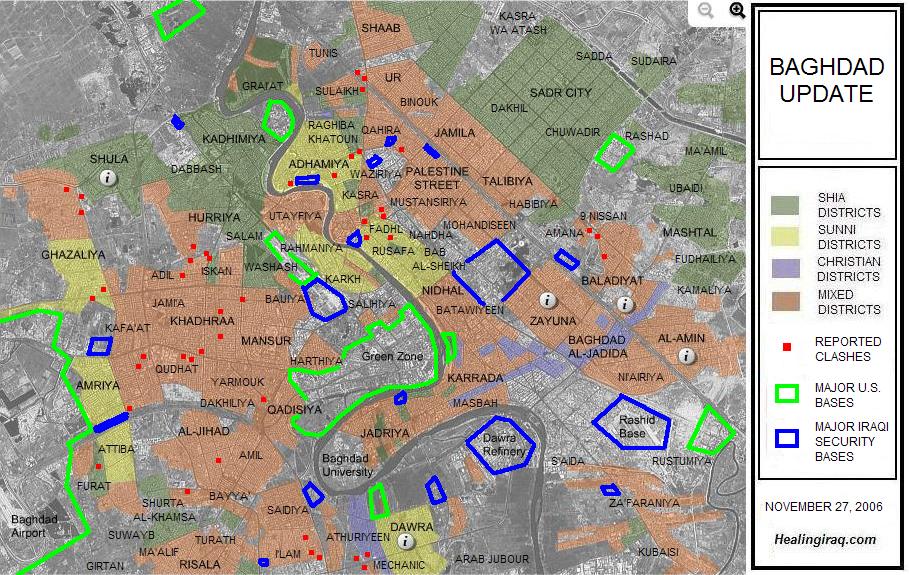
By 2006, Amriya was turned into a Sunni-majority neighborhood:


In late 2006 Zeyad of Healing Iraq also showed Amriya as a Sunni district.

How the hell did Armiya go from a Shia-majority district to a Sunni-majority district in three years? Here are some clues:

'Al Amriya is considered amongst most sect-driven areas in the capital and the Takfiris - with short dishdash and Afghan style dreadlocks were quite active and until one month ago.

Before, the Takfiris were usually seen in the streets shooting at any unidentified passersby and would slaughter - with the literal meaning of the word, anyone in its home if they ‘deem’ that he/she worked for the invaders authority. Also, they would target the police forces (mainly Shiites) and abduct cops and later would chop their heads off and dumb them in the trash. And they too planted road bombs to get the invaders forces.'


This explains how many Shia, including my two uncles and distant relatives, were expelled by violence and threats of violence in Amriya.

Wednesday, November 28, 2007

Knights of Mesopotamia secure Amriya

By Jim Muir
BBC News, Baghdad


There is general recognition that the security situation in Baghdad and some other parts of Iraq has got significantly better in the past three months or so.

US soldier patrols market in the Dora area of Baghdad -
The US surge has brought calm to previously restive areas of Baghdad
In addition to the current surge of US forces, one of the major factors that is credited with helping the improvement, has been the emergence in Sunni areas, of local fighters recruited by the Americans as a kind of neighbourhood watch.

There are thought to be nearly 80,000 of them nationwide.

Many of them used to fight alongside the insurgents, but now, encouraged by their tribal leaders, they have turned against al-Qaeda and are helping keep it out of their areas.

We went to al-Ameriya, a journey we would not have dreamt of attempting just a few months ago, to see some of the local fighters in action.

This part of Baghdad used to be a stronghold of al-Qaeda or groups linked to it.

Knights of Mesopotamia

Now we are travelling, not with the American army as we might once have done, but with a tribal Sunni sheikh whose followers are now controlling the area along with the Americans, helping to drive al-Qaeda out and to keep it out.

Abdul Abed, Sunni militia leader
People saw al-Qaeda doing terrible things. They were killing Sunnis, Shias, and Christians. There were bodies everywhere, being eaten by dogs. So we had to fight them
Abdul Abed

We are under the protection of the Fursan al-Rafidain, the Knights of Mesopotamia, a force of about 600, and they clearly rule the roost in al-Ameriya.

They are paid and supplied with uniforms by the Americans, and work closely with them. Our first stop was at their headquarters.

Their leader, Abul Abed, meets the Americans every day.

On the wall is a picture of him with General David Petraeus, the top US commander in Iraq.

But it was not always that way. Before turning against al-Qaeda, he used to be in an insurgent group which fought the Americans.

"At the beginning, people saw it as an occupation which had to be resisted. But then they saw that the Americans were working in the interests of the people.

"They saw al-Qaeda doing terrible things. They were killing Sunnis, Shias, and Christians. There were bodies everywhere, being eaten by dogs. So we had to fight them," Abul Abed said.  continued
 
[I have to say this: why didn't they fight Al Qaeda until recently?  Is it because they weren't getting paid?]

Thursday, November 08, 2007

Amriya

I'm glad to read about the turnaround in the western Baghdad neighborhood of Amriya, where my uncles lived until they were expelled by "mujahideen" in 2005 and where two distant relatives were murdered earlier this year. 
 

Troops praise progress in Baghdad enclave that once was al-Qaeda base

12:00 AM CST on Thursday, November 8, 2007

From Wire Reports Douglas Birch, The Associated Press

BAGHDAD – Twilight brings traffic jams to the main shopping district of this once-affluent corner of Baghdad, and hundreds of people stroll past well-stocked vegetable stands, bakeries and butcher shops.

DOUGLAS BIRCH/The Associated Press
Iraqis pass an armored vehicle in Baghdad's Amariyah neighborhood. Violence has sharply declined in the neighborhood, a drop attributed in part to the buildup of U.S. troops.

To many in Amariyah, it seems little short of a miracle.

Just six months ago, this mostly Sunni neighborhood was a base of operations for al-Qaeda in Iraq. The district in western Baghdad was hit by more than a dozen bombings and shootings some days.

On Tuesday, women shopped and men drank tea in sidewalk cafes. Occasionally, U.S. soldiers walking the streets were greeted with salaams and smiles.

What is happening here reflects similar trends across Baghdad and parts of Iraq, where civilian and U.S. military casualties have dropped sharply in the past two months. Maj. Gen. Joseph Fil said Tuesday that all but 12 to 13 percent of Baghdad is under control by the U.S. military and other security forces.

But the speed of the turnaround in Amariyah has taken almost everyone by surprise.

"The progress that we made is almost unbelievable," said Capt. Brendan Gallagher, 29, of Columbia, Md., with the Army's 2nd Brigade, 1st Cavalry Division.

The neighborhood is still nowhere near its former gloss as the Beverly Hills of Baghdad, as it was called before the 2003 U.S. invasion. A six-foot-high concrete wall rings the two-square-mile neighborhood, many villas stand empty, and the streets are littered with trash. There is 70 percent unemployment, military officials say.

But residents are making the first small steps to rebuilding.

"Amariyah was one of the first places where things got real bad," said 1st Lt. Schulyer Williamson, 24, of Pensacola, Fla., part of Capt. Gallagher's unit. "My platoon sergeant and I would pick up six dead bodies a day."

The violence peaked in May, U.S. officials said, as al-Qaeda in Iraq fighters killed 14 U.S. military troops in a series of bombings.

Several U.S. military officials said the most important factor in reducing the violence in Amariyah was the U.S. troop increase, which quadrupled the number of U.S. military forces patrolling the neighborhood in mid-June.

Another key to progress, they said, was the formation in late May of a local anti-insurgent alliance, the Farsan al-Rafidayn, which means "Knights of the Land of the Two Rivers."